A2 German: From Phrases to Conversations
A2 is the elementary level. You move from memorized phrases to building your own sentences, talking about the past and handling everyday errands on your own. Here’s exactly what A2 covers and how to get there.
See all A2 lessonsReview A1 firstA2 in one sentence
At A2 you can understand frequently used sentences about familiar topics (family, shopping, work, your area), communicate in simple routine tasks, and describe your background and immediate needs in simple terms. Expect about 3-4 months of study after A1.
What you can do at A2
- Talk about what you did last weekend using the Perfekt (Ich habe … gemacht, Ich bin … gefahren)
- Describe your job, home, hobbies and daily routine in more detail
- Make and change appointments, by phone or in person
- Write short emails and messages: invitations, thank-you notes, simple requests
- Understand the main point of short, clear announcements and messages
- Give simple opinions and reasons (Ich finde …, weil …)
A2 grammar checklist
| Topic | Examples |
|---|---|
| Perfekt with haben and sein | Ich habe gegessen. Ich bin gegangen. |
| Präteritum of sein, haben and modal verbs | Ich war müde. Ich musste arbeiten. |
| Dative case | Ich gebe dem Mann das Buch. |
| Dative and accusative prepositions | mit dem Bus, für meinen Bruder |
| Two-way prepositions | Ich gehe in die Stadt. Ich bin in der Stadt. |
| Possessive pronouns in all cases | mein, dein, sein, ihr, unser |
| Reflexive verbs | sich freuen, sich waschen |
| Subordinate clauses | weil, dass, wenn send the verb to the end |
| Comparatives and superlatives | schneller, am schnellsten |
| Adjective endings (introduction) | ein großer Hund, die kleine Katze |
All of these are explained step by step in our German grammar guide and German verbs guide. Adjective endings get their own lesson: Adjektivdeklination made simple.
A2 vocabulary
By the end of A2 most learners know roughly 1,000-1,500 words. Focus on: work and jobs, health and the body, travel and transport, clothes, weather, feelings, and the house. Keep adding nouns with article and plural, and start collecting verbs with their Perfekt form (fahren – ist gefahren).
A 12-week A2 study plan
| Weeks | Focus |
|---|---|
| 1-2 | Perfekt: Partizip II, haben or sein; talking about your weekend |
| 3-4 | Dative case, dative verbs, possessive pronouns |
| 5-6 | Prepositions: dative, accusative and two-way |
| 7-8 | Subordinate clauses with weil, dass, wenn; reflexive verbs |
| 9-10 | Comparatives, adjective endings, writing short emails |
| 11-12 | Review, mock exam, speaking practice on everyday topics |
The A2 plateau
Many learners feel stuck at A2 because their vocabulary grows faster than their speaking. That’s a retrieval problem: the words are there, but you haven’t practised pulling them out yet. Practice producing German: describe your day out loud, or write five sentences each evening. Recall is what turns passive words into active ones.
A2 exams
Common certificates are the Goethe-Zertifikat A2, telc Deutsch A2 and ÖSD Zertifikat A2. The DTZ (Deutsch-Test für Zuwanderer), used in German integration courses, awards A2 or B1 depending on your score. See German language exams explained.
All A2 lessons

What Does “Halt” Mean in German? The Particle, the Command and the Verb
Halt in German explained: Halt! as “stop”, the shrugging particle halt (“just”, “simply”), halt vs eben, and the…
Modal Verbs in German: Können, Müssen, Wollen and More
The six German modal verbs (können, müssen, dürfen, sollen, wollen, mögen) plus möchten: a full conjugation chart, the…
The Accusative Case in German: Rules and Examples
The accusative case in German (Akkusativ) explained: what it does, how articles and pronouns change, n-nouns, accusative prepositions,…
Negation in German: Nicht vs Kein
Nicht vs kein explained: the one rule that tells you which to use, how kein declines in every…
German Cases Explained: Nominative, Accusative, Dative, Genitive
The four German cases explained simply: what a case is, when to use nominative, accusative, dative and genitive,…
What Does “Genau” Mean in German? Exactly, and Why Germans Say It So Much
Genau means “exactly” or “precisely”, but Germans also use it to agree, to fill pauses and in phrases…
“Werden” in German: Conjugation, Meanings and Uses
Werden conjugation in every tense (present, Präteritum, Perfekt, Konjunktiv II, imperative) and its four jobs: to become, the…
What Language Is Spoken in Austria? Austrian German Explained
Austria’s official language is German, in its Austrian standard variety. Learn how Austrian German differs from German German…
German Prepositions: The Complete List With Cases
Every common German preposition in one place, grouped by the case it takes: accusative, dative, two-way and genitive,…
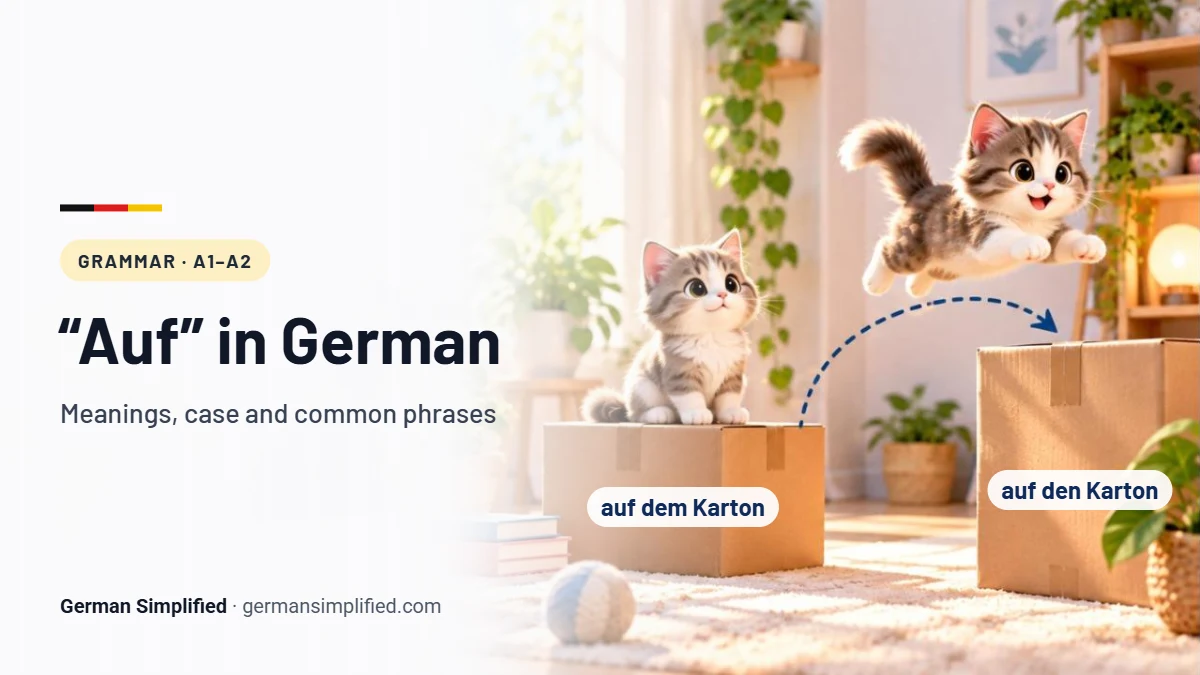
“Auf” in German: Meanings, Case and Common Phrases
What does auf mean in German? On, onto, open and more: when auf takes dative or accusative and…
Months in German: Names, Pronunciation and Prepositions
The 12 months in German with articles and pronunciation, how to use im with months and how to…
Possessive Pronouns in German: Mein, Dein, Sein and Ihr
Possessive pronouns in German: mein, dein, sein, ihr, unser in every case, with charts, ihr vs Ihr and…






A2 German FAQs
How long does it take to go from A1 to A2?
Usually 3-4 months with daily study, or 6-8 weeks in an intensive course.
Is A2 German good enough for a job?
For some hands-on jobs, yes, but most employers in Germany expect at least B1, and roles with customer contact usually need B2.
What is the biggest difference between A1 and A2?
The past tense and the dative case. Once you can say what you did and who you did it for, conversations open up.
Next level → B1 German: the level that changes everything