
A1–A2 Verbs
Werden is one of the hardest-working verbs in German. On its own it means “to become”, but it also builds the future tense, the passive voice and the polite würde (would). That’s four jobs for one verb, which is why it appears in almost every German text you’ll read. In this lesson you’ll learn the full werden conjugation in every tense you need, what werden means in each of its uses, and how to tell them apart in a sentence. There’s a quiz at the end to check yourself.
Quick answer
Werden means “to become” and is irregular: ich werde, du wirst, er/sie/es wird, wir werden, ihr werdet, sie/Sie werden. Its past forms are wurde (Präteritum) and ist geworden (Perfekt). Besides “to become”, werden forms the future (Ich werde arbeiten), the passive (Das Haus wird gebaut) and, as würde, the conditional (Ich würde gern kommen).
This verb is part of our German verbs guide. If you’re still getting used to regular endings, review German verb conjugation in the present tense first.
Werden at a Glance
| Feature | werden |
|---|---|
| Meaning | to become, to get (+ adjective); auxiliary for future and passive |
| Type | irregular (strong) verb and auxiliary verb |
| Präteritum | wurde |
| Partizip II | geworden (full verb) / worden (passive) |
| Auxiliary | sein (ist geworden) |
Meaning
As a full verb, werden describes change: Es wird dunkel (It’s getting dark), Sie wird Ärztin (She’s becoming a doctor). English often uses “get” or “turn” here.
Partizip II
Geworden is the normal past participle: Er ist müde geworden (He got tired). In the passive, the participle shortens to worden: Das Haus ist gebaut worden (The house has been built).
Auxiliary
Werden forms its Perfekt with sein, because it describes a change of state: Ich bin krank geworden, never Ich habe krank geworden.
Present Tense Conjugation
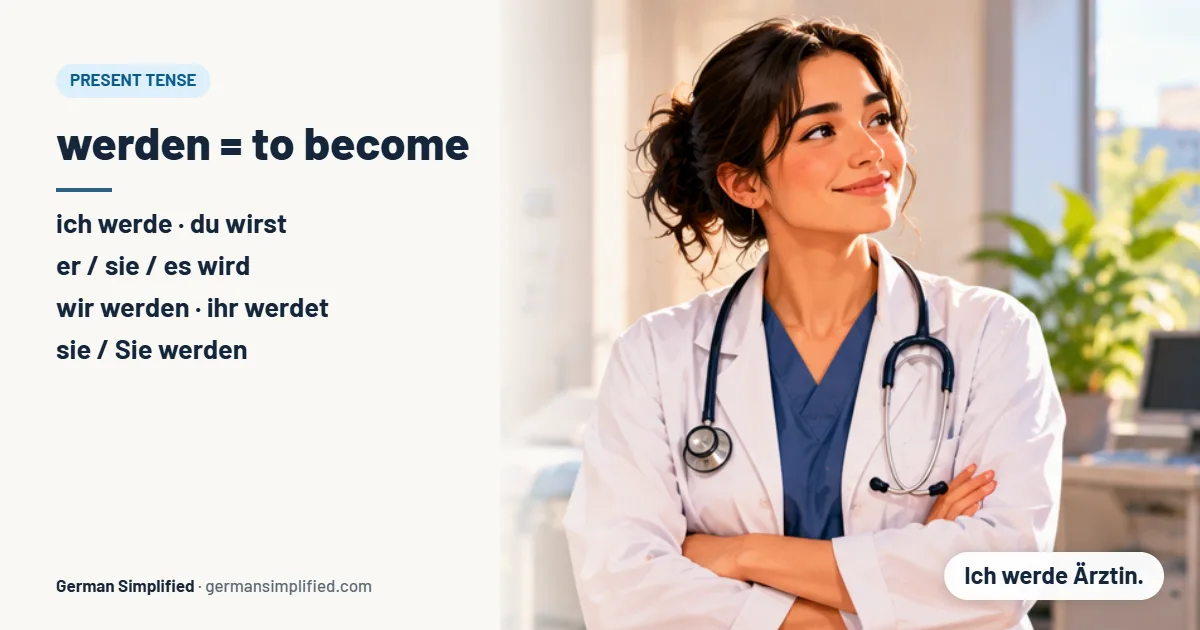
| Person | werden | English |
|---|---|---|
| ich | ich werde | I become |
| du | du wirst | you become (informal) |
| er/sie/es | er wird | he/she/it becomes |
| wir | wir werden | we become |
| ihr | ihr werdet | you all become |
| sie/Sie | sie werden | they / you (formal) become |
The irregular forms are du wirst and er wird: the stem vowel changes from e to i, and er wird has no extra -t. Everything else is regular.
Don’t say “du wirdst”: The du form is wirst, with no d. It’s one of the most common spelling mistakes in German, even among native speakers in text messages.
Past Tenses
Präteritum
| Person | Präteritum |
|---|---|
| ich | wurde |
| du | wurdest |
| er/sie/es | wurde |
| wir | wurden |
| ihr | wurdet |
| sie/Sie | wurden |
The Präteritum of werden is common in both writing and speech, especially for passive sentences and changes: Es wurde spät (It got late), Er wurde 1990 geboren (He was born in 1990).
Perfekt
The Perfekt uses sein + geworden:
| Person | Perfekt |
|---|---|
| ich | bin geworden |
| du | bist geworden |
| er/sie/es | ist geworden |
| wir | sind geworden |
| ihr | seid geworden |
| sie/Sie | sind geworden |
Meine Schwester ist Lehrerin geworden.My sister has become a teacher.
Das Wetter ist schlecht geworden.The weather has turned bad.
Konjunktiv II and Imperative
Konjunktiv II: würde
The Konjunktiv II of werden is würde, the most useful form of the verb for polite and hypothetical German:
| Person | Konjunktiv II |
|---|---|
| ich | würde |
| du | würdest |
| er/sie/es | würde |
| wir | würden |
| ihr | würdet |
| sie/Sie | würden |
Imperative
| Addressee | Imperative |
|---|---|
| du | Werde! / Werd! |
| ihr | Werdet! |
| Sie | Werden Sie! |
The imperative is rare. You’ll mainly see it in wishes like Werd bald gesund! (Get well soon!).
How to Use Werden
1. To become (full verb)
With a noun, adjective or age, werden means “to become” or “to get”:
Ich werde nächste Woche 30.I’m turning 30 next week.
Im Herbst werden die Blätter gelb.In autumn the leaves turn yellow.
Was willst du werden? Ich will Pilot werden.What do you want to be? I want to be a pilot.
Note the missing article with jobs: Ich werde Lehrer, not ein Lehrer.
2. Future tense (Futur I)
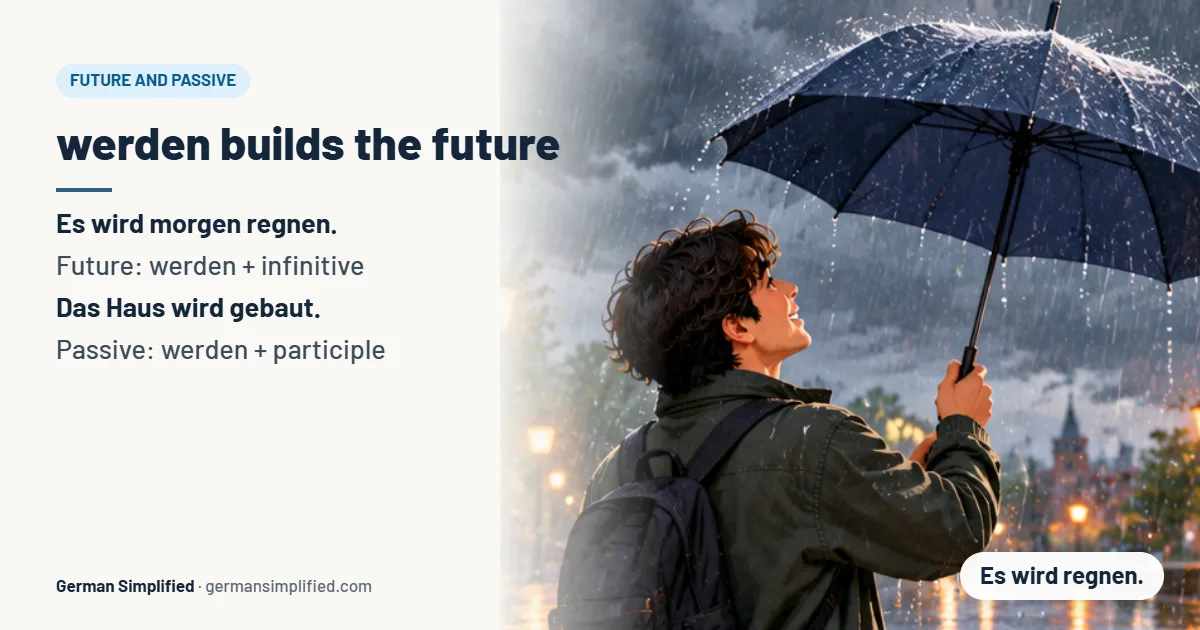
Werden + infinitive (at the end) forms the future: Ich werde morgen arbeiten (I will work tomorrow). In everyday speech, Germans often use the present tense with a time word instead (Ich arbeite morgen). Werden adds emphasis, a promise or a prediction:
Ich werde dich anrufen.I will call you. (a promise)
Es wird morgen regnen.It will rain tomorrow. (a prediction)
It can also express a guess about the present, often with wohl: Er wird wohl krank sein (He’s probably sick).
3. Passive voice
Werden + Partizip II forms the passive, which focuses on the action rather than who does it:
Die Pizza wird geliefert.The pizza is being delivered.
Das Museum wurde 1902 eröffnet.The museum was opened in 1902.
Der Brief ist gestern geschickt worden.The letter was sent yesterday.
4. Würde (would)
Würde + infinitive is the everyday way to say “would” in German:
Ich würde gern einen Kaffee trinken.I’d like to have a coffee.
Würdest du mir bitte helfen?Would you help me, please?
Was würdest du an meiner Stelle machen?What would you do in my place?
How to Tell the Uses Apart
| You see… | It means… | Example |
|---|---|---|
| werden + noun/adjective | to become | Er wird Arzt. |
| werden + infinitive | future (or a guess) | Er wird kommen. |
| werden + Partizip II | passive | Er wird gefragt. |
| würde + infinitive | would | Er würde kommen. |
Why one verb with four jobs isn’t a problem
Your brain is excellent at using context, which is exactly how you handle English words like “get” (get tired, get a letter, get going). Train yourself to look at the second verb. Infinitive? Future. Participle? Passive. Nothing? “Become”.
Is Werden a Modal Verb?
No. Werden is an auxiliary verb (Hilfsverb), like sein and haben, not a modal verb like können or müssen. The confusion comes from the future tense: werden + infinitive looks like a modal construction (Ich kann kommen / Ich werde kommen), and when it expresses a guess (Er wird wohl zu Hause sein), it does behave a bit like a modal. But grammars and dictionaries classify it as an auxiliary. For the real modal verbs, see modal verbs in German.
Example Sentences
Es wird schon dunkel.It’s already getting dark.
Wir werden im Sommer nach Italien fahren.We’re going to travel to Italy in the summer.
Hier wird Deutsch gesprochen.German is spoken here.
Ich wurde müde und ging ins Bett.I got tired and went to bed.
Würden Sie bitte das Fenster schließen?Would you please close the window?
Das Kind ist groß geworden!The child has grown big!
Quiz
1. Du ___ bestimmt eine gute Lehrerin. (werden, present)
wirst
2. Translate: “It’s getting cold.”
Es wird kalt.
3. Which use is this? “Das Auto wird repariert.”
Passive (werden + Partizip II)
4. Perfekt: Er ___ müde ___. (werden)
ist … geworden
5. Make it polite: “Hilfst du mir?”
Würdest du mir helfen?
FAQs
What is the werden conjugation in German?
Present: ich werde, du wirst, er wird, wir werden, ihr werdet, sie werden. Präteritum: wurde. Perfekt: ist geworden.
What does werden mean in English?
To become or to get. It’s also used for the future (will), the passive (is being done) and, as würde, for would.
Is werden a modal verb?
No, it’s an auxiliary verb. It looks similar to modals in the future tense, but grammars classify it with sein and haben.
Does werden take haben or sein in the Perfekt?
Sein: ich bin geworden, er ist geworden.
What’s the difference between geworden and worden?
Geworden is the participle of werden as a full verb (He has become tired). Worden is used only in the passive Perfekt (It has been built: Es ist gebaut worden).
Conclusion
Werden means “to become”, but it does most of its work as a helper: werden + infinitive for the future, werden + participle for the passive, and würde for “would”. Learn the six present forms (watch du wirst and er wird), the past wurde and ist geworden, and always check what the second verb is. Next, compare it with the most important verb of all, sein, in our German verbs guide.
Sources and further reading: Duden: werden, DWDS: werden and Goethe-Institut grammar resources.
Keep learning → Modal verbs in German: können, müssen, wollen and more