A1 Verbs
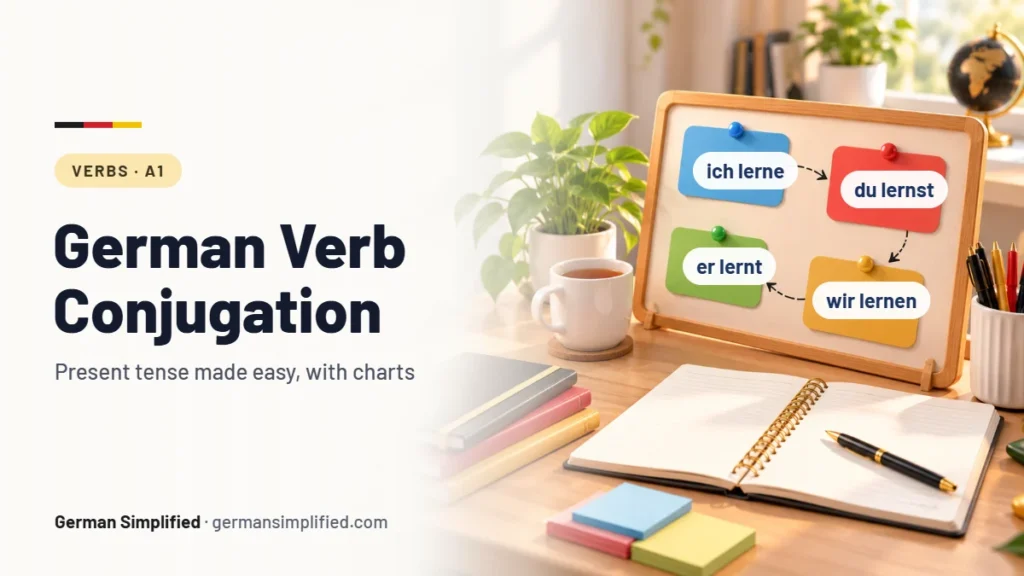
German verb conjugation looks scary in a textbook, but the present tense runs on one small set of endings that you can learn in an afternoon. Once you know them, you can conjugate thousands of verbs, from lernen (to learn) to spielen (to play). In this lesson you’ll learn the six regular present tense endings, the spelling tweaks that trip people up, the stem-changing verbs, the three verbs you must memorize (sein, haben, werden) and the handful of other irregular verbs that come up every day. Charts, examples and a short exercise set are included.
Quick answer
To conjugate a German verb in the present tense, remove -en from the infinitive to find the stem, then add the ending for each person: ich -e, du -st, er/sie/es -t, wir -en, ihr -t, sie/Sie -en. So lernen becomes ich lerne, du lernst, er lernt. Some verbs change their stem vowel in the du and er forms (fahren → du fährst), and a few, like sein and haben, are irregular.
This lesson is part of our complete guide to German verbs. If the words ich, du and er are new to you, take two minutes with German personal pronouns first, because every conjugation depends on them.
What Does “Conjugation” Mean?
Conjugating a verb means changing its form to match the person doing the action. English does this a little: I play, but she plays. German does it a lot more: every person gets its own ending. Fortunately, the endings are almost perfectly regular, so one chart covers most of the verbs you’ll use.
Every German verb has an infinitive (the dictionary form), which nearly always ends in -en or -n: machen, wohnen, wandern. Chop off that ending and you get the stem: mach-, wohn-, wander-. The stem carries the meaning; the ending tells you who is doing it.
Why this sticks better as a pattern
Memory loves patterns more than lists. Instead of learning ich mache, du machst, er macht as separate facts, learn the ending chain once (e, st, t, en, t, en) and say it out loud like a rhythm. Research on “chunking” shows we hold a single rhythmic unit far more easily than six loose items. Then test the chain on a new verb every day.
Regular Present Tense Endings
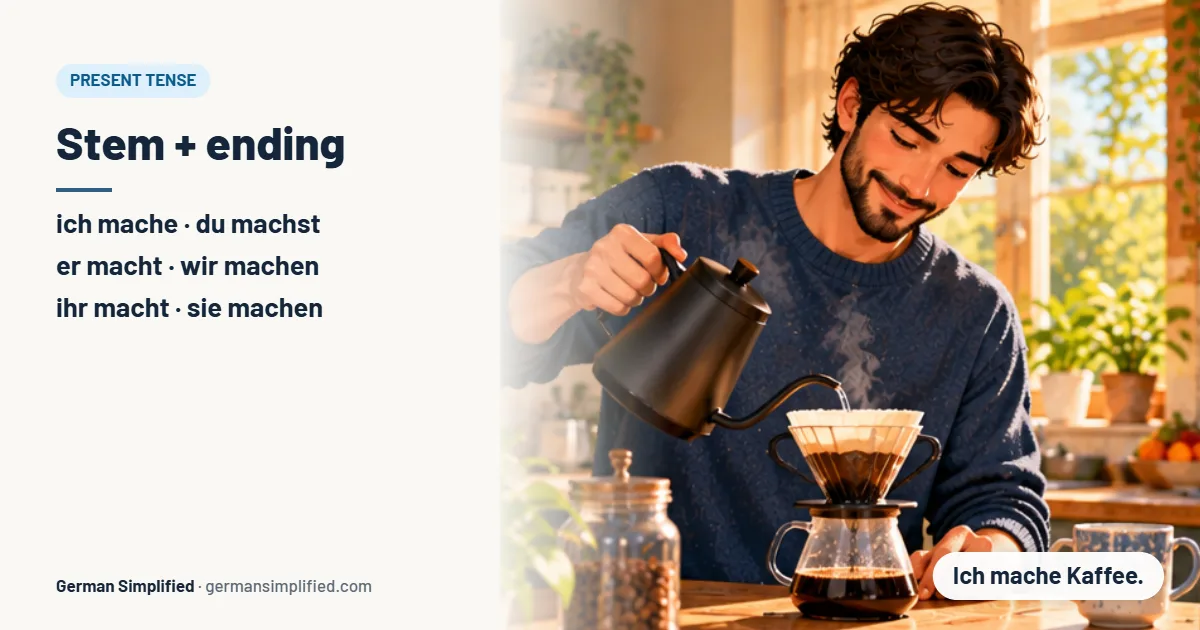
Here are the regular present tense endings (das Präsens) with three common verbs. The pattern is the same for every regular verb.
| Person | Ending | machen (to do/make) | wohnen (to live) | spielen (to play) |
|---|---|---|---|---|
| ich (I) | -e | ich mache | ich wohne | ich spiele |
| du (you, informal) | -st | du machst | du wohnst | du spielst |
| er / sie / es (he/she/it) | -t | er macht | sie wohnt | es spielt |
| wir (we) | -en | wir machen | wir wohnen | wir spielen |
| ihr (you all, informal) | -t | ihr macht | ihr wohnt | ihr spielt |
| sie / Sie (they / you formal) | -en | sie machen | Sie wohnen | sie spielen |
Notice two shortcuts. The wir and sie/Sie forms are always identical to the infinitive for regular verbs. And the er/sie/es form and the ihr form share the same ending, -t.
Present tense covers more than English: Ich lerne Deutsch can mean “I learn German”, “I’m learning German” and, with a time word, even “I’m going to learn German” (Ich lerne morgen Deutsch). German has no separate “-ing” form, so one present tense does all three jobs.
Spelling tweak 1: stems ending in -t, -d or a consonant cluster
If the stem ends in -t or -d (arbeiten, finden), you can’t pronounce du arbeitst or er findt comfortably. German adds an extra -e- before the ending in the du, er/sie/es and ihr forms. The same happens with stems like rechn- (rechnen, to calculate) and öffn- (öffnen, to open).
| Person | arbeiten (to work) | finden (to find) | öffnen (to open) |
|---|---|---|---|
| ich | ich arbeite | ich finde | ich öffne |
| du | du arbeitest | du findest | du öffnest |
| er/sie/es | er arbeitet | sie findet | es öffnet |
| wir | wir arbeiten | wir finden | wir öffnen |
| ihr | ihr arbeitet | ihr findet | ihr öffnet |
| sie/Sie | sie arbeiten | Sie finden | sie öffnen |
Spelling tweak 2: stems ending in -s, -ß, -z or -x
If the stem already ends in an “s” sound, the du form only adds -t, not -st. That’s why it is du heißt (your name is), du tanzt (you dance) and du reist (you travel). The same rule explains the famous textbook oddity du furzt: the stem furz- already ends in z, so the du form is just -t.
Wie heißt du?What’s your name?
Du tanzt sehr gut.You dance very well.
Spelling tweak 3: verbs ending in -eln and -ern
Verbs like wandern (to hike) and sammeln (to collect) end in -n, not -en. Their wir and sie forms just add -n: wir wandern, sie sammeln. In the ich form, -eln verbs usually drop the e of the stem: ich sammle, not ich sammele.
Stem-Changing Verbs
Some common verbs change their stem vowel in the present tense, but only in the du and er/sie/es forms. Every other form stays regular. This is the “vowel change in the stem” that so many learners search for, and there are only three patterns to know.
| Pattern | Infinitive | du | er/sie/es | Other examples |
|---|---|---|---|---|
| a → ä | fahren (to drive) | du fährst | er fährt | schlafen, tragen, waschen, laufen (au → äu) |
| e → i | sprechen (to speak) | du sprichst | sie spricht | essen, helfen, geben, nehmen |
| e → ie | lesen (to read) | du liest | er liest | sehen, empfehlen, stehlen |
Watch nehmen (to take): it also changes its consonants, du nimmst, er nimmt. And essen becomes du isst, er isst.
Fährst du morgen nach Berlin?Are you driving to Berlin tomorrow?
Sie spricht drei Sprachen.She speaks three languages.
Er liest jeden Abend.He reads every evening.
The stem change never happens with ich, wir, ihr or sie
A classic mistake is ich fähre or wir sprichen. The vowel only changes after du and er/sie/es: ich fahre, du fährst, er fährt, wir fahren. If you remember “only the two singular middle forms”, you’ll get it right every time.
Dictionaries mark stem-changing verbs, so when you learn a new verb, check whether it changes. A good habit is to learn it as a trio: fahren, fährt, fuhr.
sein, haben, werden
Three verbs break the pattern so often that you simply memorize them. They are also the most frequent verbs in the language, so you’ll practise them daily without trying.
| Person | sein (to be) | haben (to have) | werden (to become) |
|---|---|---|---|
| ich | bin | habe | werde |
| du | bist | hast | wirst |
| er/sie/es | ist | hat | wird |
| wir | sind | haben | werden |
| ihr | seid | habt | werdet |
| sie/Sie | sind | haben | werden |
- sein is fully irregular: Ich bin müde (I’m tired), Wir sind hier (We are here).
- haben only drops the b in two forms: du hast, er hat.
- werden changes in the singular: du wirst, er wird. You’ll also need it for the future tense (Ich werde arbeiten). Our full guide to werden conjugation covers its other jobs.
Ich habe einen Bruder und er ist Lehrer.I have a brother and he is a teacher.
Es wird kalt.It’s getting cold.
Common Irregular Verbs
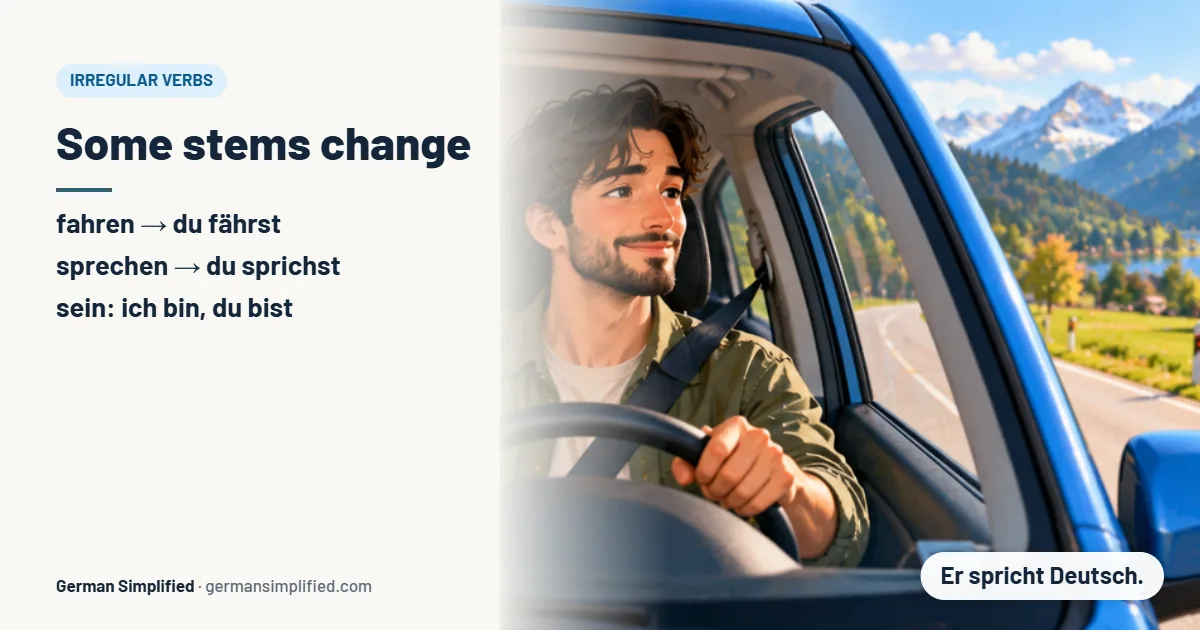
Beyond sein, haben and werden, a small group of everyday verbs are irregular in the present tense. Learn these as fixed forms.
| Person | wissen (to know a fact) | tun (to do) | mögen (to like) |
|---|---|---|---|
| ich | weiß | tue | mag |
| du | weißt | tust | magst |
| er/sie/es | weiß | tut | mag |
| wir | wissen | tun | mögen |
| ihr | wisst | tut | mögt |
| sie/Sie | wissen | tun | mögen |
The modal verbs (können, müssen, wollen, dürfen, sollen, mögen) follow their own pattern: no ending in the ich and er forms, and often a vowel change in the singular (ich kann, du kannst, er kann). They’re important enough to have their own lesson: modal verbs in German.
What about separable verbs?
Verbs like aufstehen (to get up) or anrufen (to call) conjugate exactly like regular verbs, but the prefix jumps to the end of the sentence: Ich stehe um sieben Uhr auf. The conjugation itself doesn’t change, only the word order.
How to Conjugate Any New Verb in 4 Steps
- Take the infinitive: kaufen (to buy).
- Remove -en (or -n): stem = kauf-.
- Check the stem: does it end in -t/-d (add -e-), in an “s” sound (du gets only -t), and is it a stem-changing verb?
- Add the ending for the person: ich kaufe, du kaufst, er kauft, wir kaufen, ihr kauft, sie kaufen.
Run through these four steps with five new verbs a day and conjugation becomes automatic within a couple of weeks. Free reference sites like Duden and the conjugation tables at DWDS are reliable when you want to double-check a form.
Exercises
Fill in the correct present tense form. Click each line to check your answer.
1. Ich ___ in Hamburg. (wohnen)
wohne (regular: ich → -e)
2. Du ___ sehr schnell. (sprechen)
sprichst (stem change e → i in the du form)
3. Er ___ jeden Tag acht Stunden. (arbeiten)
arbeitet (stem ends in -t, so add -e- before -t)
4. Wie ___ du? (heißen)
heißt (stem ends in ß, so du only adds -t)
5. Wir ___ keine Zeit. (haben)
haben (wir form = infinitive)
6. ___ ihr müde? (sein)
Seid (irregular: ihr seid)
7. Sie (she) ___ ein Buch. (lesen)
liest (stem change e → ie)
FAQs
What are the German present tense endings?
-e, -st, -t, -en, -t, -en for ich, du, er/sie/es, wir, ihr and sie/Sie. Add them to the verb stem (the infinitive minus -en).
Does the German present tense end with -e or -t?
Both. The ich form ends in -e (ich lerne), while the er/sie/es and ihr forms end in -t (er lernt, ihr lernt).
Which German verbs change their vowel in the stem?
Strong verbs such as fahren (du fährst), sprechen (du sprichst) and lesen (du liest). The change only happens in the du and er/sie/es forms.
Why is it “du heißt” and not “du heißst”?
When a stem already ends in s, ß, z or x, the du form only adds -t, because “-sst” would be hard to pronounce. The same rule gives du tanzt and du reist.
How many tenses does German have?
Six: present (Präsens), two past tenses (Perfekt and Präteritum), past perfect (Plusquamperfekt) and two future tenses. Beginners mainly need the present and the Perfekt.
Conclusion
German verb conjugation in the present tense comes down to one ending chain (-e, -st, -t, -en, -t, -en), three spelling tweaks, three stem-change patterns and a short list of irregular verbs led by sein, haben and werden. Learn the chain, practise it aloud with a new verb every day, and you’ll be forming correct sentences almost immediately. Next, explore more verb types in our German verbs guide, and review how articles change with case in our German articles chart.
Sources and further reading: Duden (spelling and verb forms), DWDS (dictionary with conjugation tables) and the Goethe-Institut learning resources.
Keep learning → Modal verbs in German: können, müssen, wollen and more


