
A1 German: Your First Real Steps
A1 is the beginner level of the Common European Framework (CEFR). It’s where you learn to introduce yourself, order a coffee, ask simple questions and understand slow, clear speech. Everything you need for A1 is on this page.
Follow the learning pathSee all A1 lessonsA1 in one sentence
At A1 you can understand and use everyday expressions and very basic phrases, introduce yourself and others, and have a simple conversation if the other person talks slowly and helps you. Most learners reach A1 in about 2-3 months of steady daily study.
What you can do at A1
- Greet people and say goodbye, formally and informally (Guten Tag, Hallo, Tschüss)
- Introduce yourself: name, country, job, languages, age
- Ask and answer simple questions: Wo wohnst du? (Where do you live?)
- Count, say prices, dates and the time
- Order food and drinks, shop and ask for directions in simple words
- Fill in a basic form with your personal details
- Understand short, slow announcements and very simple texts
A1 grammar checklist
| Topic | What you need to know | Lesson |
|---|---|---|
| Alphabet and sounds | 26 letters, ä, ö, ü, ß, ch, r, ei/ie | German alphabet |
| Noun gender | der, die, das and why you learn every noun with its article | Der, die, das |
| Personal pronouns | ich, du, er, sie, es, wir, ihr, sie, Sie | German pronouns |
| Present tense | Regular verbs, sein, haben, a few stem-changing verbs | German verbs |
| Word order | Verb in position 2; yes/no questions start with the verb | German grammar |
| Nominative and accusative | der → den; ein → einen | German grammar |
| Negation | nicht and kein | German grammar |
| Modal verbs (basic) | können, möchten, müssen | German verbs |
| Separable verbs (basic) | aufstehen, einkaufen, anrufen | German verbs |
A1 vocabulary: how many words?
A1 learners typically know around 500-700 words. That sounds small, but the most frequent few hundred words make up a large share of everyday speech. Start with our list of the 100 most common German words, then add topic lists: numbers, family, food, home, time and the days of the week. Browse them all in German Vocabulary.
Golden rule
Never learn a German noun alone. Learn der Tisch, die Tische (the table, the tables) as one unit. Fixing the article later is much harder than learning it right the first time.
Phrases every A1 learner needs
| German | English |
|---|---|
| Guten Tag! Ich heiße … | Hello! My name is … |
| Wie geht’s? | How are you? |
| Danke schön. – Bitte schön. | Thank you very much. – You’re welcome. |
| Ich verstehe das nicht. | I don’t understand that. |
| Können Sie das bitte wiederholen? | Could you repeat that, please? |
| Was kostet das? | How much does that cost? |
| Ich hätte gern einen Kaffee. | I’d like a coffee. |
More in German Phrases & Greetings, including when to say Guten Tag and how to say thank you.
A 10-week A1 study plan
| Weeks | Focus |
|---|---|
| 1 | Alphabet, pronunciation, greetings, introducing yourself |
| 2-3 | Noun gender, articles, personal pronouns, present tense of regular verbs, sein and haben |
| 4-5 | Numbers, time, days, questions (W-questions), word order |
| 6-7 | Accusative case, nicht vs kein, food and shopping vocabulary |
| 8-9 | Modal verbs, separable verbs, daily routine, family and home |
| 10 | Review, practice test, speaking practice |
About 30-45 minutes a day is enough. Split it: 10 minutes of vocabulary review with spaced repetition, 15 minutes of one new grammar point, 10 minutes of listening or speaking.
Why A1 feels hard (and why that’s normal)
At the start, your brain has no “hooks” to hang new German words on, so everything feels slippery. After a few weeks, patterns appear: -ung words are feminine, the verb goes second. Each pattern makes the next word easier to store.
A1 exams
If you need proof of A1, for example for a spouse visa to Germany, the most common certificates are the Goethe-Zertifikat A1: Start Deutsch 1, telc Deutsch A1 and ÖSD Zertifikat A1. All test listening, reading, writing and speaking. Compare them in our guide to German language exams.
All A1 lessons

German Greetings: How to Say Hello, Goodbye and More
All the German greetings you need: formal and informal ways to say hello, greetings by time of day,…
How to Introduce Yourself in German (With Example Dialogues)
How to introduce yourself in German step by step: your name, age, where you’re from, your job or…
Modal Verbs in German: Können, Müssen, Wollen and More
The six German modal verbs (können, müssen, dürfen, sollen, wollen, mögen) plus möchten: a full conjugation chart, the…
The Accusative Case in German: Rules and Examples
The accusative case in German (Akkusativ) explained: what it does, how articles and pronouns change, n-nouns, accusative prepositions,…
Goodbye in German: Tschüss, Auf Wiedersehen and 12 More
How to say bye in German: tschüss, auf Wiedersehen, ciao and 12 more goodbyes, from formal to casual…
How Are You in German? Wie geht’s and 10 Ways to Answer
How to say how are you in German: Wie geht’s?, Wie geht es Ihnen? and casual alternatives like…
Negation in German: Nicht vs Kein
Nicht vs kein explained: the one rule that tells you which to use, how kein declines in every…
German Cases Explained: Nominative, Accusative, Dative, Genitive
The four German cases explained simply: what a case is, when to use nominative, accusative, dative and genitive,…
German Pronunciation Mistakes: The Sounds English Speakers Get Wrong
The most common German pronunciation mistakes English speakers make, and how to fix each one: vowel length, umlauts,…
Happy New Year in German: Frohes Neues Jahr and Guten Rutsch
How to say Happy New Year in German: frohes neues Jahr, guten Rutsch (and why), what to say…
“Werden” in German: Conjugation, Meanings and Uses
Werden conjugation in every tense (present, Präteritum, Perfekt, Konjunktiv II, imperative) and its four jobs: to become, the…
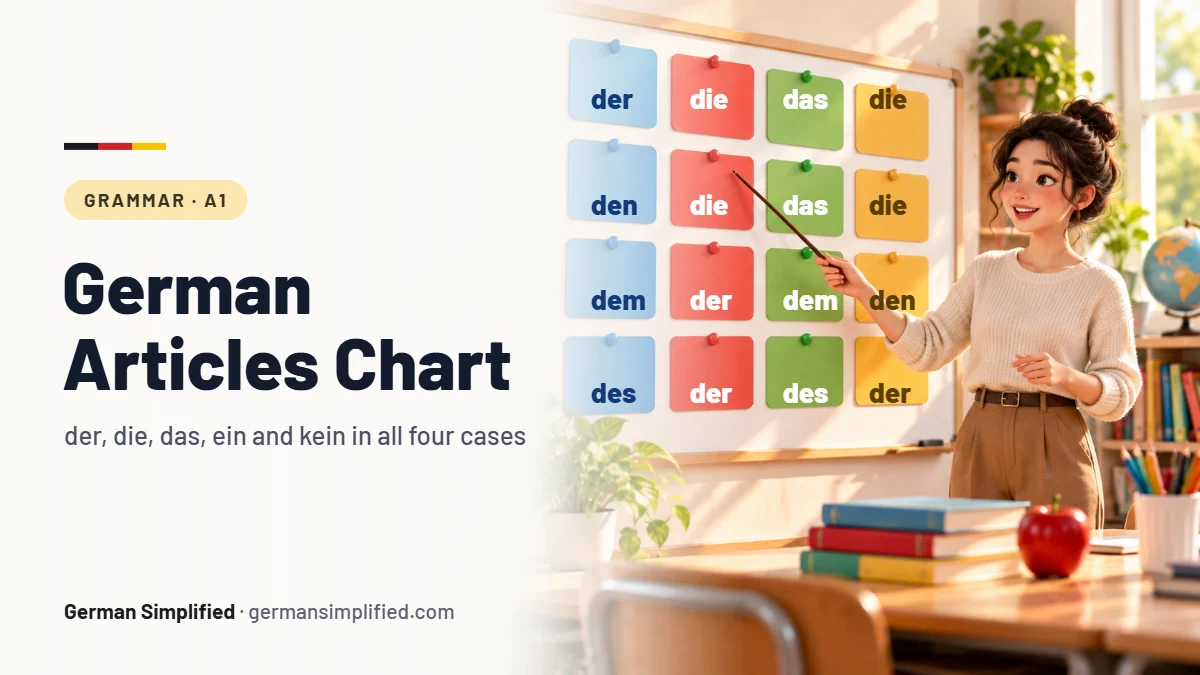
German Articles Chart: Definite and Indefinite Articles in All Four Cases
The complete German articles chart: definite articles (der, die, das), indefinite articles (ein, eine), kein and the zero…








A1 German FAQs
How long does it take to reach A1 in German?
With 30-60 minutes of daily study, most English speakers reach A1 in 2-3 months. An intensive course (around 20 hours a week) can get you there in 4-8 weeks.
Can I learn A1 German by myself?
Yes. A1 is very learnable alone with structured lessons, a spaced repetition app for vocabulary and regular listening. Add speaking practice with a tutor or tandem partner before an exam.
Is A1 German enough to live in Germany?
A1 lets you handle simple, predictable situations. For work, official appointments and real friendships you will want B1, which is also the level required for German citizenship.
What comes after A1?
A2 German: past tense (Perfekt), dative case, more vocabulary and longer conversations about your daily life.
Next level → A2 German: grammar, vocabulary and study plan