
A1 Phrases
Your first real German conversation will almost certainly start with an introduction: in a language class, at work, at a party or on a video call with a tandem partner. Knowing how to introduce yourself in German takes only a handful of sentences, and it makes a good first impression. Below are the lines you need for your name, age, origin, job, studies, hobbies and languages, the questions Germans will ask you back, and three complete sample introductions for casual, classroom and job-interview situations. Click any phrase to hear it.
Quick answer
To introduce yourself in German, say Hallo, ich heiße … (Hello, my name is …) or Ich bin … (I’m …), then add where you’re from (Ich komme aus …), where you live (Ich wohne in …) and what you do (Ich bin Studentin / Ich arbeite als …). Finish with Freut mich! (Nice to meet you!). In formal settings, use Guten Tag and Mein Name ist ….
This lesson is part of our guide to German phrases and greetings. If you need help with the greeting itself, see German greetings.
Basic Phrases
Your name
| German | English | Register |
|---|---|---|
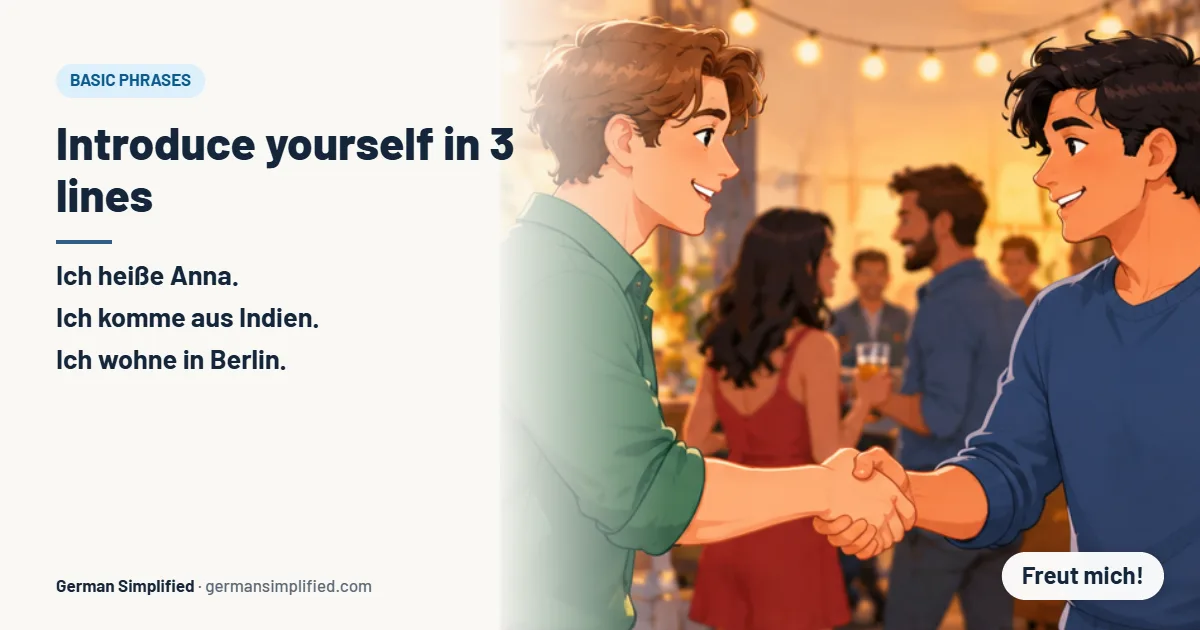
| Ich heiße Anna. | My name is Anna. (lit. I’m called Anna.) | neutral, most common |
| Ich bin Anna. | I’m Anna. | casual |
| Mein Name ist Anna Weber. | My name is Anna Weber. | formal |
| Mein Vorname ist Anna, mein Nachname ist Weber. | My first name is Anna, my surname is Weber. | forms, offices |
Formal introductions use your surname: At work or in official situations, Germans often introduce themselves with their full name or surname: Guten Tag, Weber. or Mein Name ist Anna Weber. With friends and classmates, first names are fine.
Your age
Ich bin 28 Jahre alt.I’m 28 years old.
Ich bin 28.I’m 28.
Don’t say Ich habe 28 Jahre: unlike Spanish or French, German uses sein for age. Need help with the numbers? See German numbers.
Nice to meet you
| German | English | Register |
|---|---|---|
| Freut mich! | Nice to meet you! | neutral, very common |
| Schön, dich kennenzulernen! | Nice to meet you! | informal |
| Es freut mich, Sie kennenzulernen. | Pleased to meet you. | formal |
| Ganz meinerseits. | The pleasure’s mine. | polite reply |
Talking About Where You Are From
| German | English |
|---|---|
| Ich komme aus Indien. | I’m from India. |
| Ich komme aus Mumbai, in Indien. | I’m from Mumbai, in India. |
| Ich bin Inder. / Ich bin Inderin. | I’m Indian. (man / woman) |
| Ich wohne in Berlin. | I live in Berlin. |
| Ich wohne seit zwei Jahren in Deutschland. | I’ve been living in Germany for two years. |
Most countries have no article: aus Deutschland, aus Kanada, aus Brasilien. A few do, and then the article changes to the dative after aus:
- die Schweiz → Ich komme aus der Schweiz.
- die Türkei → Ich komme aus der Türkei.
- die USA (plural) → Ich komme aus den USA.
- der Iran → Ich komme aus dem Iran.
Job and Studies
Your job
| German | English |
|---|---|
| Ich bin Ingenieur. / Ich bin Ingenieurin. | I’m an engineer. (m / f) |
| Ich arbeite als Krankenpflegerin. | I work as a nurse. |
| Ich arbeite bei Siemens. | I work at Siemens. |
| Ich bin selbstständig. | I’m self-employed. |
| Ich suche gerade eine Stelle. | I’m looking for a job at the moment. |
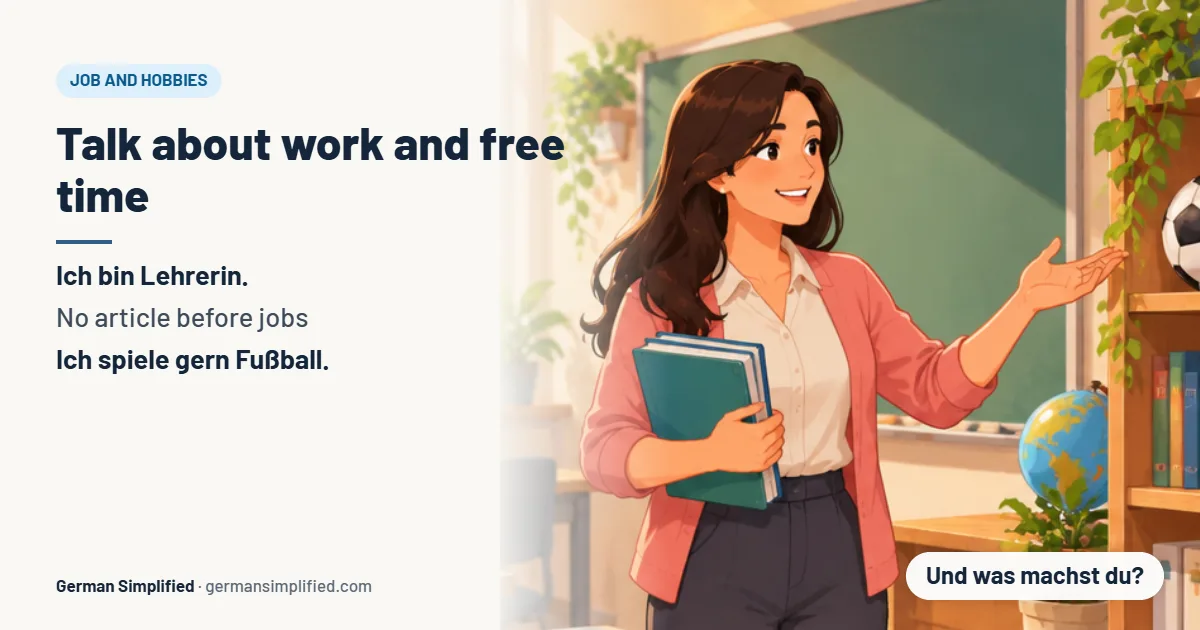
No “a” before jobs
In English you say “I’m a teacher”. In German, there’s no article: Ich bin Lehrer, not Ich bin ein Lehrer. Also add -in for women in most jobs: Lehrer → Lehrerin, Arzt → Ärztin.
Your studies
| German | English |
|---|---|
| Ich bin Student. / Ich bin Studentin. | I’m a student. (m / f, university) |
| Ich studiere Informatik. | I study computer science. |
| Ich studiere an der Universität Hamburg. | I study at the University of Hamburg. |
| Ich mache eine Ausbildung als Koch. | I’m training to be a chef (vocational training). |
| Ich gehe noch zur Schule. | I’m still at school. |
Hobbies
The easiest way to talk about hobbies is verb + gern (to like doing something):
Ich lese gern.I like reading.
Ich spiele gern Fußball.I like playing football.
In meiner Freizeit koche ich gern und gehe wandern.In my free time I like cooking and going hiking.
Meine Hobbys sind Musik, Reisen und Fotografie.My hobbies are music, travel and photography.
Notice the word order in the third example: when you start with In meiner Freizeit, the verb (koche) comes second and the subject (ich) moves after it.
Languages and family
Ich spreche Englisch, Hindi und ein bisschen Deutsch.I speak English, Hindi and a little German.
Ich lerne seit sechs Monaten Deutsch.I’ve been learning German for six months.
Ich bin verheiratet und habe zwei Kinder.I’m married and have two children.
The Questions People Will Ask You
| Informal (du) | Formal (Sie) | English |
|---|---|---|
| Wie heißt du? | Wie heißen Sie? | What’s your name? |
| Woher kommst du? | Woher kommen Sie? | Where are you from? |
| Wo wohnst du? | Wo wohnen Sie? | Where do you live? |
| Was machst du (beruflich)? | Was machen Sie beruflich? | What do you do (for work)? |
| Wie alt bist du? | — | How old are you? (rarely asked to adults) |
| Was sind deine Hobbys? | Was machen Sie in Ihrer Freizeit? | What are your hobbies? |
Use du with people your age in casual settings, classmates and anyone who offers it; use Sie with strangers, older people and at work unless told otherwise. After introductions, the next natural question is how are you in German.
Script it, then practise it
Introductions are predictable, which makes them perfect for a pre-written script. Write five to seven sentences about yourself, read them aloud daily for a week, then try them without notes. Rehearsed speech reduces anxiety because your brain doesn’t have to plan grammar under pressure.
Sample Introductions
Casual
At a party or meeting a tandem partner:
Hi! Ich bin Ravi. Ich komme aus Indien, aus Pune.Hi! I’m Ravi. I’m from India, from Pune.
Ich wohne seit einem Jahr in München und arbeite als Programmierer.I’ve been living in Munich for a year and work as a programmer.
In meiner Freizeit spiele ich gern Cricket und koche viel. Und du?In my free time I like playing cricket and I cook a lot. And you?
Class
On the first day of a German course:
Hallo zusammen! Ich heiße Sofia und ich bin 24 Jahre alt.Hello everyone! My name is Sofia and I’m 24 years old.
Ich komme aus Brasilien und wohne jetzt in Köln.I’m from Brazil and I live in Cologne now.
Ich bin Studentin, ich studiere Architektur.I’m a student; I study architecture.
Ich lerne Deutsch, weil ich in Deutschland arbeiten möchte.I’m learning German because I’d like to work in Germany.
Job interview
Formal, with Sie and a focus on experience:
Guten Tag, mein Name ist Daniel Okafor. Vielen Dank für die Einladung.Good afternoon, my name is Daniel Okafor. Thank you for the invitation.
Ich komme aus Nigeria und lebe seit drei Jahren in Frankfurt.I’m from Nigeria and have been living in Frankfurt for three years.
Ich habe Maschinenbau studiert und arbeite seit fünf Jahren als Ingenieur.I studied mechanical engineering and have been working as an engineer for five years.
Ich spreche Englisch, Deutsch auf B2-Niveau und ein wenig Französisch.I speak English, German at B2 level and a little French.
A short dialogue
A: Hallo, ich bin Lena. Wie heißt du?A: Hi, I’m Lena. What’s your name?
B: Ich heiße Kenji. Freut mich!B: My name is Kenji. Nice to meet you!
A: Freut mich auch! Woher kommst du?A: Nice to meet you too! Where are you from?
B: Ich komme aus Japan, aus Osaka. Und du?B: I’m from Japan, from Osaka. And you?
A: Ich komme aus Hamburg. Was machst du hier in Berlin?A: I’m from Hamburg. What are you doing here in Berlin?
B: Ich studiere Musik.B: I’m studying music.
Your Introduction Template
Fill in the blanks and you have a complete introduction:
- Hallo! Ich heiße ___.
- Ich bin ___ Jahre alt.
- Ich komme aus ___ und wohne in ___.
- Ich bin ___ / Ich arbeite als ___ / Ich studiere ___.
- In meiner Freizeit ___ ich gern.
- Ich lerne seit ___ Deutsch.
- Freut mich!
FAQs
How do you introduce yourself in German?
Say Hallo, ich heiße … (Hello, my name is …), then add Ich komme aus … (I’m from …), Ich wohne in … (I live in …) and Ich bin … / Ich arbeite als … (your job).
What’s the difference between “Ich heiße” and “Mein Name ist”?
Both mean “my name is”. Ich heiße is the most common and works everywhere; Mein Name ist sounds a little more formal.
How do you say “nice to meet you” in German?
Freut mich! is the everyday way. Formally: Es freut mich, Sie kennenzulernen.
Do you need an article before your job in German?
No. Say Ich bin Lehrer or Ich bin Ärztin, without ein or eine.
Can you give an example of a German introduction?
Hallo! Ich heiße Maria. Ich bin 30 Jahre alt und komme aus Spanien. Ich wohne in Berlin und arbeite als Designerin. Freut mich!
Conclusion
To introduce yourself in German, you only need a few building blocks: Ich heiße …, Ich bin … Jahre alt, Ich komme aus …, Ich wohne in …, Ich bin / arbeite als … and Freut mich! Leave out the article before your job, use gern for hobbies, and switch to Sie and Mein Name ist … in formal situations. Write your own script with the template above and practise it aloud until it feels natural. Next, make sure you can say your age, phone number and address with confidence.
Sources and further reading: Goethe-Institut A1 course materials, DWDS and Duden.
Keep learning → German numbers 1 to 1000: how to count, say prices and dates