
A1–A2 Verbs
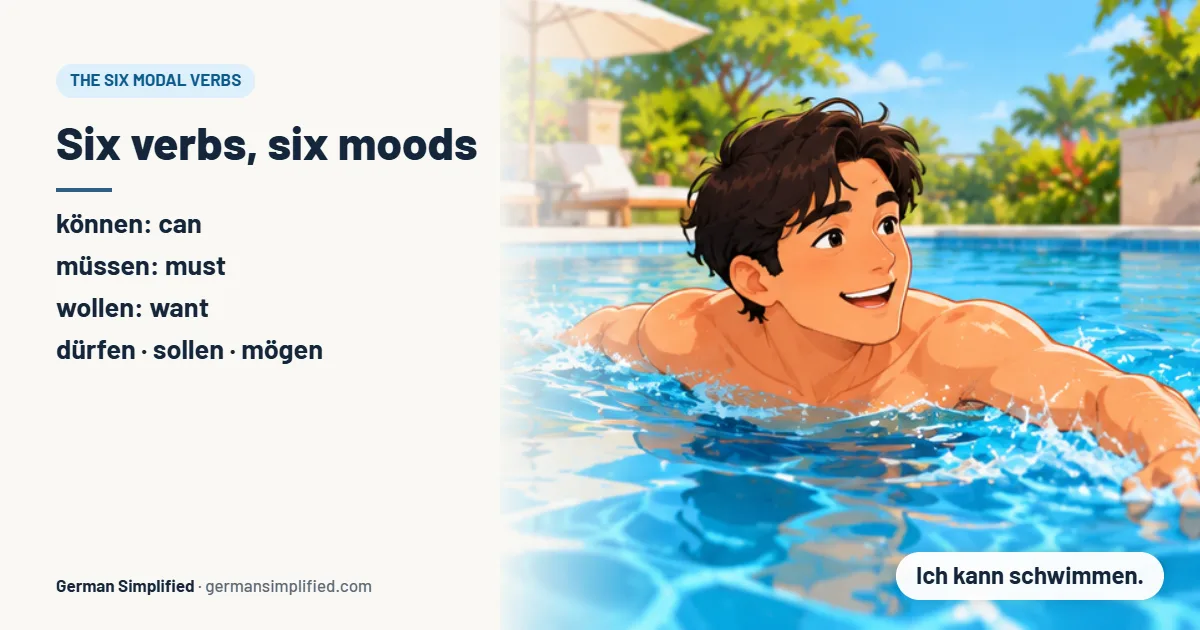
You can’t get far in German without modal verbs. They’re how you say what you can, must, may, should and want to do: Ich kann schwimmen, Wir müssen gehen, Darf ich fragen? There are only six of them (seven if you count möchten), and they all follow the same small set of patterns. Below you’ll find a conjugation chart, what each one means (including the müssen vs dürfen trap), the word order rule, the past tense and the polite Konjunktiv II forms. There’s a quiz at the end.
Quick answer
German has six modal verbs: können (can), müssen (must, have to), dürfen (may, be allowed to), sollen (should, be supposed to), wollen (want to) and mögen (to like), plus möchten (would like). The modal verb is conjugated in position 2 and the main verb goes to the end as an infinitive: Ich kann heute nicht kommen. In the ich and er/sie/es forms, modals have no ending (ich kann, er kann).
This lesson is part of our German verbs guide. If you’re new to verb endings, start with German verb conjugation in the present tense.
The Six Modal Verbs
| Modal verb | Meaning | Example | English |
|---|---|---|---|
| können | can, to be able to | Ich kann Deutsch sprechen. | I can speak German. |
| müssen | must, to have to | Wir müssen jetzt gehen. | We have to go now. |
| dürfen | may, to be allowed to | Darf ich hier parken? | May I park here? |
| sollen | should, to be supposed to | Du sollst mehr schlafen. | You’re supposed to sleep more. |
| wollen | to want to | Sie will Ärztin werden. | She wants to become a doctor. |
| mögen | to like | Ich mag Schokolade. | I like chocolate. |
| möchten | would like | Ich möchte einen Tee. | I’d like a tea. |
Möchten is technically a Konjunktiv II form of mögen, but it’s used so often that textbooks teach it as its own modal verb.
Conjugation Chart
| Person | können | müssen | dürfen | sollen | wollen | mögen | möchten |
|---|---|---|---|---|---|---|---|
| ich | kann | muss | darf | soll | will | mag | möchte |
| du | kannst | musst | darfst | sollst | willst | magst | möchtest |
| er/sie/es | kann | muss | darf | soll | will | mag | möchte |
| wir | können | müssen | dürfen | sollen | wollen | mögen | möchten |
| ihr | könnt | müsst | dürft | sollt | wollt | mögt | möchtet |
| sie/Sie | können | müssen | dürfen | sollen | wollen | mögen | möchten |
Three patterns make this chart easy:
- No ending in ich and er/sie/es. It’s ich kann, er muss, never ich kanne or er musst. The two forms are always identical.
- The vowel changes in the singular (ich, du, er) for all modals except sollen: können → kann, müssen → muss, dürfen → darf, wollen → will, mögen → mag.
- The plural is regular: wir and sie use the infinitive, ihr adds -t.
Learn three forms per verb: infinitive, ich form and wir form: können – kann – können, müssen – muss – müssen. With those three, you can produce every present tense form.
Meaning Differences
können: ability and possibility
Können covers what you’re able to do and what’s possible: Ich kann gut kochen (I can cook well), Kann ich Ihnen helfen? (Can I help you?). It’s also used for languages without a main verb: Kannst du Deutsch? (Do you speak German?)
müssen vs sollen
Both express obligation, but the source is different:
- müssen = necessity or a strong obligation, often from circumstances or yourself: Ich muss heute arbeiten (I have to work today).
- sollen = an obligation, advice or expectation coming from another person or a rule: Der Arzt sagt, ich soll mehr Wasser trinken (The doctor says I should drink more water).
Ich muss den Zug um 8 Uhr nehmen.I have to take the 8 o’clock train.
Du sollst deine Mutter anrufen.You’re supposed to call your mother. (someone asked for this)
For the softer “should” in advice, Germans use the Konjunktiv II sollte: Du solltest mehr schlafen (You ought to sleep more).
dürfen vs müssen in the negative
This is the biggest trap for English speakers:
| German | English | Meaning |
|---|---|---|
| Du musst nicht kommen. | You don’t have to come. | it’s not necessary |
| Du darfst nicht kommen. | You mustn’t come. | it’s forbidden |
English “must not” = German nicht dürfen. If you say Du musst nicht rauchen, a German hears “You don’t need to smoke”, which isn’t what a “no smoking” sign means. That’s Hier darf man nicht rauchen.
“Will” doesn’t mean “will”
German ich will means “I want”, not “I will”. Ich will nach Hause = I want to go home. The future tense uses werden: Ich werde nach Hause gehen. See werden in German for more.
wollen vs möchten
Both express wishes. Wollen is direct and strong; möchten is polite. In a café, Ich möchte einen Kaffee is perfect; Ich will einen Kaffee sounds like a demanding child. Use wollen for plans and intentions: Wir wollen nächstes Jahr nach Japan reisen.
mögen
Mögen usually stands alone with a noun: Ich mag Hunde (I like dogs), Magst du Sushi? With activities, Germans normally use gern + verb instead: Ich schwimme gern (I like swimming).
Word Order
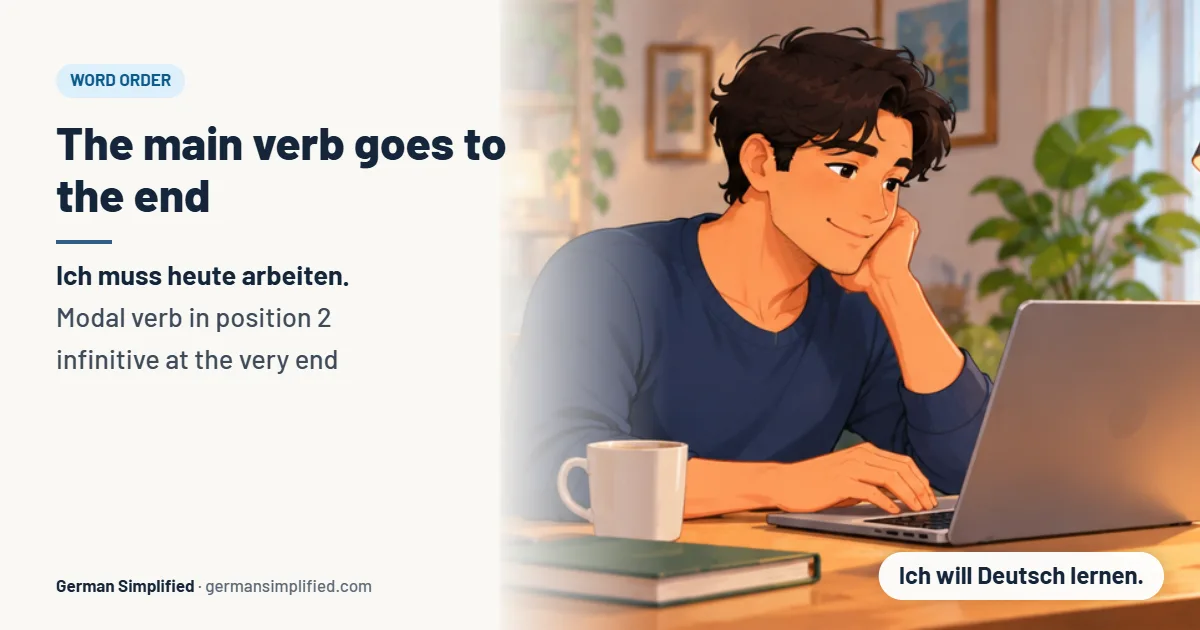
Modal verbs create a sentence bracket (Satzklammer): the modal is the conjugated verb in position 2, and the main verb goes to the very end in the infinitive, without zu.
| Position 1 | Modal (pos. 2) | Middle | Infinitive (end) |
|---|---|---|---|
| Ich | kann | heute leider nicht | kommen. |
| Wir | müssen | morgen früh | aufstehen. |
| Am Wochenende | will | Lisa ihre Oma | besuchen. |
In questions, the modal moves to the front: Kannst du mir helfen? In subordinate clauses (after weil, dass, wenn), the modal goes to the very end, after the infinitive: …, weil ich heute arbeiten muss.
Sometimes the main verb is left out when it’s obvious, especially with verbs of movement: Ich muss jetzt nach Hause (I have to go home now), Ich will das nicht (I don’t want that).
The bracket helps your brain, too
German word order can feel like waiting for the punchline, because the main verb comes last. But this structure gives your listener a clear frame: the modal tells them the “mode” (ability, duty, wish) up front, and the infinitive completes the picture. Practise saying sentences with a pause before the last word. It trains your working memory to “hold” the verb, a skill you’ll need for all German sentences.
Past Tense of Modals
Präteritum (the one you’ll actually use)
For modal verbs, Germans prefer the Präteritum, even in speech. Note that the umlauts disappear:
| Person | können | müssen | dürfen | sollen | wollen | mögen |
|---|---|---|---|---|---|---|
| ich | konnte | musste | durfte | sollte | wollte | mochte |
| du | konntest | musstest | durftest | solltest | wolltest | mochtest |
| er/sie/es | konnte | musste | durfte | sollte | wollte | mochte |
| wir | konnten | mussten | durften | sollten | wollten | mochten |
| ihr | konntet | musstet | durftet | solltet | wolltet | mochtet |
| sie/Sie | konnten | mussten | durften | sollten | wollten | mochten |
Gestern konnte ich nicht schlafen.Yesterday I couldn’t sleep.
Als Kind durfte ich keine Cola trinken.As a child I wasn’t allowed to drink cola.
Möchten has no past tense; use wollte: Ich wollte dich anrufen (I wanted to call you).
Perfekt (less common)
The Perfekt of modals uses haben and a “double infinitive” when there’s a main verb: Ich habe arbeiten müssen (I had to work). Without a main verb, the participle is gekonnt, gemusst, gedurft, gesollt, gewollt, gemocht: Das habe ich nicht gewollt. Both are correct, but the Präteritum is simpler and more natural.
Konjunktiv II (polite and hypothetical)
| Modal | Konjunktiv II | Use |
|---|---|---|
| können | könnte | polite requests, possibility: Könnten Sie mir helfen? |
| müssen | müsste | hypothetical necessity: Ich müsste mehr lernen. |
| dürfen | dürfte | polite permission: Dürfte ich kurz stören? |
| sollen | sollte | advice: Du solltest zum Arzt gehen. |
| wollen | wollte | same as Präteritum |
| mögen | möchte | would like: Ich möchte bezahlen. |
Quiz
1. Ich ___ heute nicht kommen. (können)
kann
2. Er ___ morgen früh arbeiten. (müssen)
muss
3. “You mustn’t park here.” in German?
Hier darfst du nicht parken. (Hier darf man nicht parken.)
4. Put the verbs in order: “Wir / wollen / ins Kino / gehen / heute.”
Wir wollen heute ins Kino gehen.
5. Past: Ich ___ gestern nicht schlafen. (können)
konnte
6. Polite: ___ Sie mir bitte helfen? (können, Konjunktiv II)
Könnten
FAQs
What are the German modal verbs?
können, müssen, dürfen, sollen, wollen and mögen, plus the very common möchten.
Where does the infinitive go with modal verbs?
At the end of the clause: Ich muss heute lange arbeiten. In subordinate clauses, the modal comes after it: …weil ich arbeiten muss.
What is the difference between müssen and sollen?
Müssen is necessity (I have to); sollen is an obligation or advice from someone else (I’m supposed to).
How do you say “must not” in German?
nicht dürfen: Du darfst das nicht. “Du musst das nicht” means “You don’t have to.”
Do modal verbs have endings in the ich form?
No. ich kann, ich muss, ich will: the ich and er/sie/es forms have no ending.
Conclusion
The German modal verbs follow a tidy system: no ending in the ich and er forms, a vowel change in the singular, the modal in position 2 and the infinitive at the end. Learn the meanings carefully, especially müssen nicht (don’t have to) vs dürfen nicht (mustn’t) and wollen (want) vs werden (will), use möchte to be polite, and use the Präteritum (konnte, musste) for the past. Next, see how werden builds the future and the passive.
Sources and further reading: Duden, DWDS and the Goethe-Institut A1–A2 grammar resources.
Keep learning → Werden in German: conjugation, meanings and uses