B2 German: Towards Real Fluency
B2 is the upper-intermediate level. You can talk with native speakers without either side straining, follow most TV and podcasts, and work in German. It’s the level many employers, nursing programs and universities ask for.
See all B2 lessonsReview B1B2 in one sentence
At B2 you can understand the main ideas of complex texts, including technical discussions in your field, interact fluently and spontaneously with native speakers, and write clear, detailed texts explaining the pros and cons of an issue. Expect 6-9 months of study after B1.
What you can do at B2
- Join discussions at work, defend your point of view and react to objections
- Follow news, documentaries and most films without subtitles
- Read newspaper articles, reports and contemporary fiction
- Write structured essays, complaints, applications and reports
- Switch between formal and informal German appropriately
- Understand common idioms and many regional accents
B2 grammar checklist
| Topic | Examples |
|---|---|
| Passive in all tenses, with modal verbs | Das muss erledigt werden. |
| Zustandspassiv | Die Tür ist geschlossen. |
| Konjunktiv II in the past | Wenn ich das gewusst hätte, … |
| Konjunktiv I for indirect speech | Er sagt, er habe keine Zeit. |
| N-declension | den Kollegen, dem Studenten |
| Participles as adjectives | der schlafende Hund, das gekaufte Auto |
| Advanced connectors | indem, sodass, falls, sofern, obwohl, trotzdem |
| Nominal style (introduction) | nach dem Essen, bei der Ankunft |
| Funktionsverbgefüge | eine Entscheidung treffen, in Frage kommen |
| Modal particles | doch, ja, mal, halt, eben, wohl |
B2 vocabulary
B2 learners typically know 4,000 words or more. This is where synonyms and nuance matter: nutzen vs benutzen, fühlen vs spüren, Ding vs Sache. Collect phrases rather than single words, and learn the vocabulary of your own field. Our German Words Explained series is built for this stage.
How to study at B2
- Input every day: 30-60 minutes of German podcasts, news or series on topics you care about.
- Write and get feedback: one short opinion text a week, corrected by a tutor or teacher.
- Speak about abstract topics: technology, environment, work culture, not just your weekend.
- Fix fossilized mistakes: keep a list of your typical errors (adjective endings, word order in side clauses) and review it weekly.
The intermediate plateau is real
Progress feels slower at B2 because each new word is rarer and each gain is subtler. That’s normal. Measure progress in what you can do (follow a meeting, read a novel) rather than in grammar topics ticked off. Seeing concrete wins keeps motivation alive.
B2 exams
Popular certificates are the Goethe-Zertifikat B2, telc Deutsch B2 (including telc Deutsch B1-B2 Pflege for nurses) and ÖSD Zertifikat B2. Requirements vary by employer, profession and university, so check what your target institution accepts. See German language exams explained.
All B2 lessons

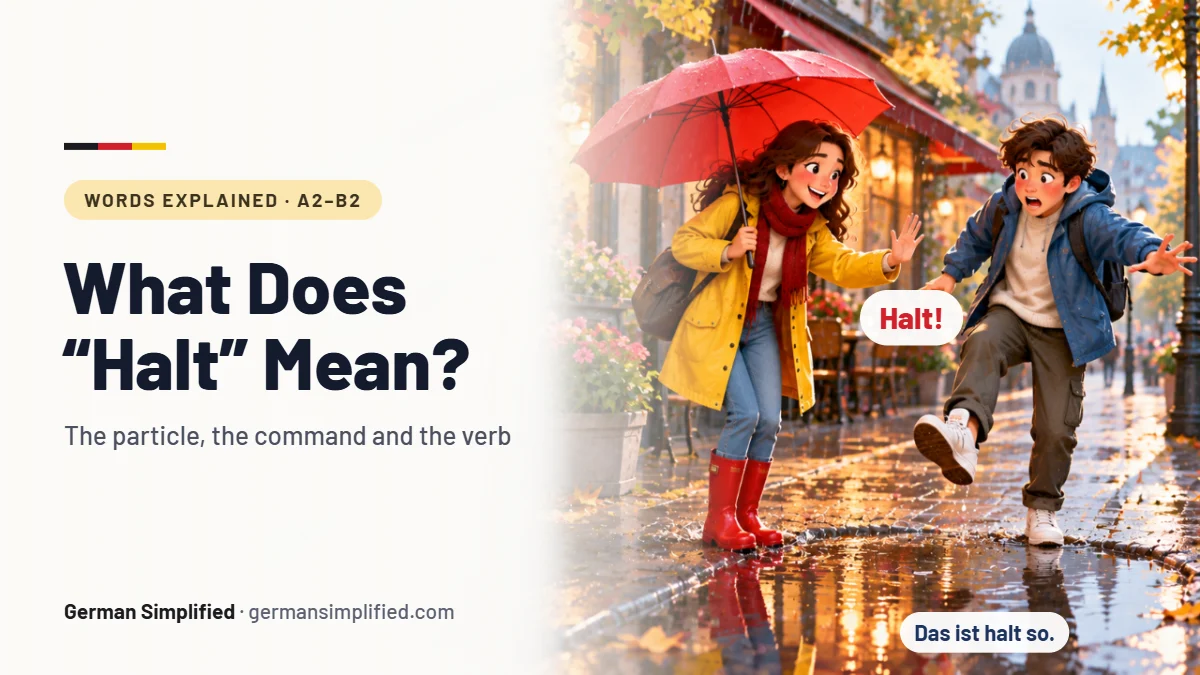
What Does “Halt” Mean in German? The Particle, the Command and the Verb
Halt in German explained: Halt! as “stop”, the shrugging particle halt (“just”, “simply”), halt vs eben, and the…
What Does “Genau” Mean in German? Exactly, and Why Germans Say It So Much
Genau means “exactly” or “precisely”, but Germans also use it to agree, to fill pauses and in phrases…
What Language Is Spoken in Austria? Austrian German Explained
Austria’s official language is German, in its Austrian standard variety. Learn how Austrian German differs from German German…


B2 German FAQs
Is B2 German considered fluent?
B2 is often described as the start of fluency: conversations flow without much effort on either side, although you will still make mistakes and miss some idioms.
Can I study at a German university with B2?
Some programs accept B2, especially in English-taught or international tracks, but most German-taught degrees ask for C1-level proof such as TestDaF or DSH-2.
How long does B2 take?
From zero, about 15-24 months of consistent study for most English speakers.
Next level → C1 German: advanced and confident