A1–B2 Learn German
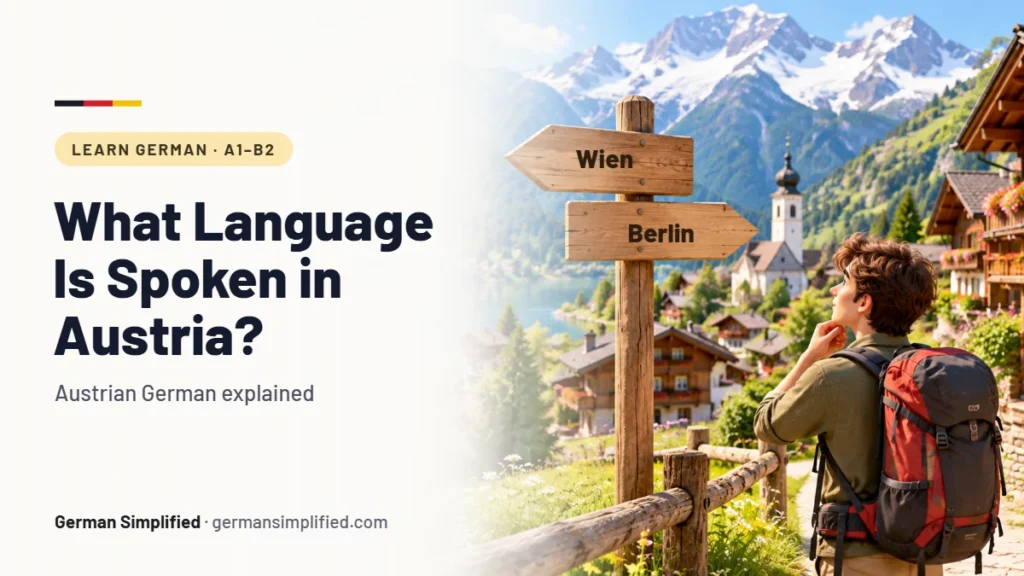
Planning a trip to Vienna, a semester in Graz or a job in Salzburg? Then you’ve probably wondered what language is spoken in Austria, and whether the German you’re learning will work there. The short answer is yes. The longer answer is more interesting: Austria speaks its own standard variety of German, with its own words for everyday things (from potatoes to January), its own greetings and a recognizably softer sound. This guide explains the Austria language situation with a vocabulary table, greetings, pronunciation differences and advice for learners.
Quick answer
The official language of Austria is German, specifically Austrian German (Österreichisches Deutsch), a standard variety of German with its own vocabulary and pronunciation. Around 9 in 10 people in Austria speak German as their first language. Croatian, Slovenian and Hungarian are official regional minority languages, and Austrian Sign Language is recognized in the constitution.
This article is part of our Learn German guide, which explains how to go from A1 to C2 step by step.
Official Language: Austrian German
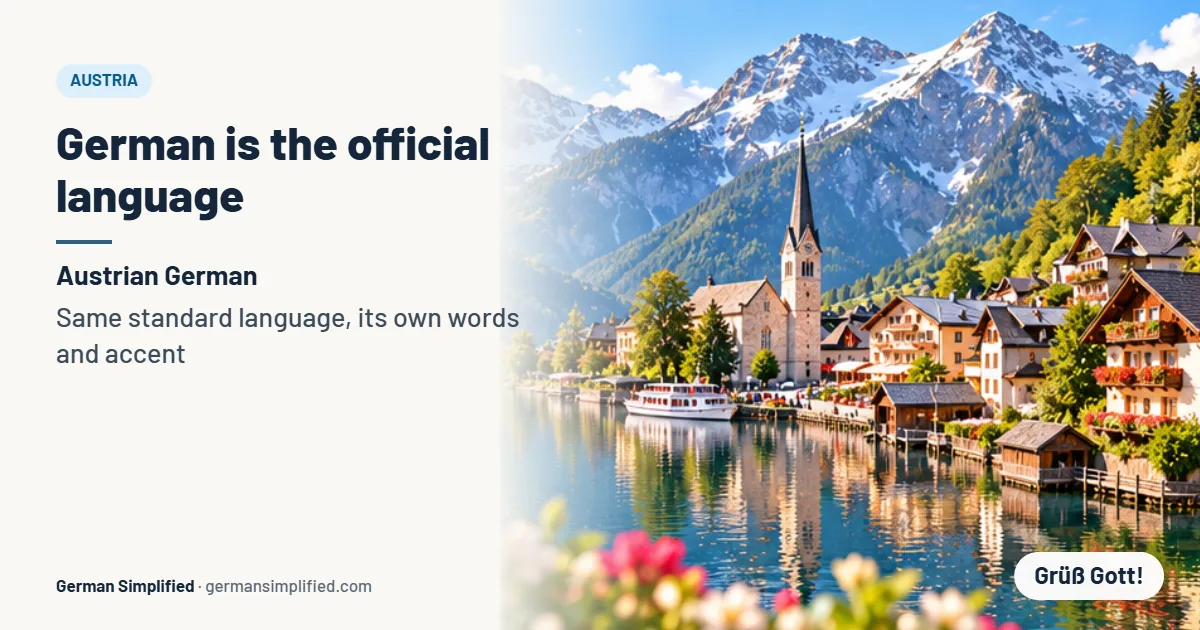
Article 8 of the Austrian Federal Constitution states that German is the official language of the republic, “without prejudice to the rights granted by federal law to linguistic minorities.” So when you deal with officials, read a newspaper or watch the news on ORF, the national broadcaster, it’s in German.
But it’s not quite the German of Berlin or Hamburg. Linguists describe German as a pluricentric language: it has several standard varieties, each correct in its own country. Germany, Austria and Switzerland each have one. Austrian Standard German has its own official dictionary, the Österreichisches Wörterbuch, which is used in Austrian schools, and when Austria joined the EU in 1995, it even secured a protocol recognizing 23 Austrian food words (such as Erdäpfel and Paradeiser) as equal to their German German equivalents.
For learners, two points matter:
- Standard Austrian German is fully understandable to anyone who speaks standard German. Differences are mostly vocabulary and accent, like British vs American English.
- Dialects are another matter. In everyday life, many Austrians speak a Bavarian-based dialect (Austro-Bavarian), or Alemannic in the western state of Vorarlberg, and these can be hard to follow even for Germans.
Good news for learners: Austrians switch to standard German easily when they notice you’re a learner. If you don’t understand someone, a friendly Können Sie bitte Hochdeutsch sprechen? (Could you speak standard German, please?) almost always works.
Austrian vs German Words
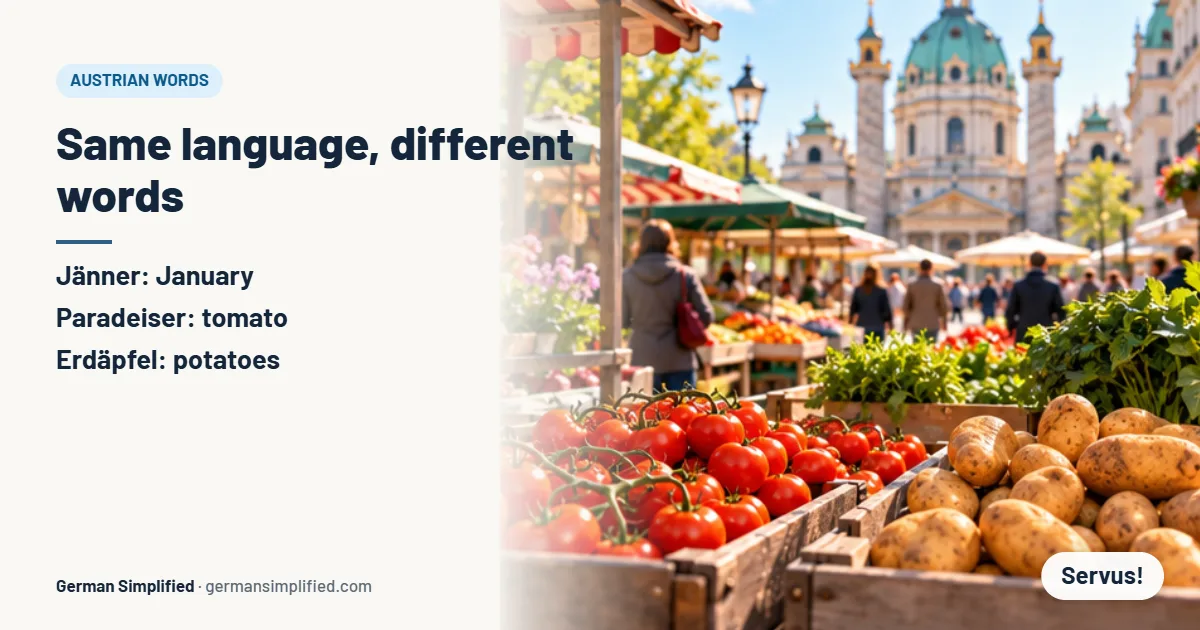
Food and daily life are where you’ll notice the difference first. Here are the words you’re most likely to meet in Austria:
| Austrian German | German German | English |
|---|---|---|
| Jänner | Januar | January |
| heuer | dieses Jahr | this year |
| die Erdäpfel | die Kartoffeln | potatoes |
| die Paradeiser | die Tomaten | tomatoes |
| die Marille | die Aprikose | apricot |
| der Karfiol | der Blumenkohl | cauliflower |
| das Schlagobers | die Schlagsahne | whipped cream |
| der Topfen | der Quark | quark, curd cheese |
| die Semmel | das Brötchen | bread roll |
| das Sackerl | die Tüte | (plastic) bag |
| der Kasten | der Schrank | cupboard, wardrobe |
| die Stiege | die Treppe | stairs |
| das Spital | das Krankenhaus | hospital |
| die Matura | das Abitur | school-leaving exam |
| der Sessel | der Stuhl | chair |
That last one surprises many learners: in Germany, a Sessel is an armchair, but in Austria it’s an ordinary chair. Likewise, the month names differ: you’ll often see Jänner (and sometimes Feber) instead of Januar and Februar. See our list of months in German for the full set.
Small grammar differences
Austrian German also has a few grammar habits you’ll hear every day:
- Perfekt with sein for position verbs: Austrians say Ich bin gesessen (I sat) and Ich bin gestanden (I stood), where Germans in the north say Ich habe gesessen.
- The -erl diminutive: instead of -chen, Austrians often use -erl: das Sackerl (little bag), das Stamperl (shot glass), das Busserl (little kiss).
- Some different genders: das Cola and das Joghurt are common in Austria, while Germany prefers die Cola and der Joghurt.
Ich hätte gern zwei Semmeln und ein Sackerl, bitte.I’d like two bread rolls and a bag, please.
Heuer fahren wir im Jänner Ski.This year we’re going skiing in January.
Greetings: Servus, Grüß Gott, Baba
Greetings are the quickest way to sound Austrian, and the easiest way to get confused if you only know Hallo and Guten Tag.
| Greeting | Meaning | When to use it |
|---|---|---|
| Grüß Gott | Hello (literally “greet God”) | Polite and very common, also in shops and offices |
| Servus | Hi / bye | Informal, with friends and colleagues; works as hello and goodbye |
| Griaß di / Griaß eich | Hello to you / to you all | Dialect form of Grüß Gott, informal |
| Habe die Ehre | Hello (lit. “I have the honor”) | Old-fashioned, warm, often in Vienna |
| Baba | Bye | Very informal, typical of Vienna |
| Pfiat di / Pfiat eich | Bye (lit. “God protect you”) | Informal goodbye, rural and western Austria |
| Auf Wiederschauen | Goodbye | Polite, more common than Auf Wiedersehen |
Standard German greetings like Guten Tag and Tschüss are understood everywhere, but Grüß Gott will make you sound local instantly. For a full overview, read our guide to German greetings.
Why learning “local” words boosts motivation
A sense of belonging, imagining yourself as part of a community of speakers, is a strong long-term motivator. Learning a few local words like Servus and Semmel before a trip turns the language from a school subject into something that’s yours. Even three or four words can change how locals respond to you, and that positive feedback keeps you going.
Pronunciation Differences
You’ll understand Austrian Standard German easily, but it sounds noticeably different. The main features:
- Softer consonants: p, t, k are often less aspirated (less breathy) than in northern Germany, so Tag can sound closer to “Dag”.
- Voiceless s at the start: Sonne (sun) and sehen often begin with a sharp [s], not the buzzing [z] of northern German.
- -ig as “ik”: words like König (king) and wichtig (important) usually end in a [k] sound, not the soft “ch” of standard German.
- “Ch” as “k”: Chemie and China are often pronounced with a “k”: “Kemie”, “Kina”.
- Different stress: Kaffee is stressed on the second syllable in Austria (Ka-FFEE), on the first in Germany (KA-ffee).
- Long vowels and melody: Austrian German often sounds more melodic, with some vowels lengthened and a gentler sentence rhythm.
None of these are mistakes. If you learn standard German pronunciation, you’ll be understood perfectly in Austria. Our German pronunciation guide covers the core sounds.
Regional and Minority Languages
German is spoken by the vast majority, but Austria is officially multilingual in some regions. Austrian law recognizes six autochthonous ethnic groups, each with its own language:
| Language | Main region | Status |
|---|---|---|
| Burgenland Croatian | Burgenland | Official regional language in some municipalities |
| Slovenian | Carinthia (Kärnten), parts of Styria | Official regional language in some municipalities |
| Hungarian | Burgenland, Vienna | Official regional language in some municipalities |
| Czech | Vienna | Recognized minority language |
| Slovak | Vienna | Recognized minority language |
| Romani | Burgenland, Vienna | Recognized minority language |
In bilingual parts of Carinthia and Burgenland you’ll see place-name signs in two languages. Austrian Sign Language (Österreichische Gebärdensprache, ÖGS) has been recognized in the constitution since 2005. And thanks to immigration, you’ll also hear Turkish, Bosnian, Croatian, Serbian, Romanian and many other languages in Vienna and other cities. English is widely spoken among younger people and in tourism, but German is the language of daily life, work and bureaucracy.
Should You Learn Austrian German?
For almost every learner, the answer is: learn standard German, then add Austrian words. Here’s why:
- Textbooks, apps and courses teach standard German, and it’s understood everywhere in Austria.
- Austrian Standard German is mostly the same grammar with different vocabulary, so the switch is small.
- If you’re moving to Austria, learn the local food words, greetings and month names early. They come up every day.
- Exams are pluricentric. The Austrian ÖSD exam accepts all standard varieties, and so do Goethe and telc. Read more in German language exams explained.
If you’re living in Austria long-term, listening to ORF radio and Austrian podcasts is the best way to tune your ear to the accent. Dialect comes last, and slowly, through real conversations.
FAQs
What language is spoken in Austria?
German. Austria’s official language is German in its Austrian standard variety. Croatian, Slovenian and Hungarian are official in some regions.
Is Austrian German different from German?
Slightly. The grammar is almost identical, but vocabulary (Jänner, Erdäpfel, Paradeiser), greetings (Grüß Gott, Servus) and pronunciation differ, much like British and American English.
Can Germans understand Austrians?
Yes, when Austrians speak standard German. Strong dialects, especially in rural areas or Vorarlberg, can be hard even for Germans.
What are typical Austrian German greetings?
Grüß Gott and Servus for hello, Baba and Pfiat di for bye, and Auf Wiederschauen as a polite goodbye.
Do people in Austria speak English?
Many do, especially younger people and those in tourism and business. But German is needed for work, official matters and everyday life outside tourist areas.
Should I learn Austrian German or standard German?
Learn standard German first. It’s understood everywhere in Austria. Then add Austrian vocabulary and greetings if you plan to live or travel there.
Conclusion
The language of Austria is German, in its own Austrian standard variety. It shares the grammar you’re learning, adds its own words (Jänner, Erdäpfel, Semmel), its own greetings (Grüß Gott, Servus, Baba) and a softer accent, and lives alongside minority languages like Croatian, Slovenian and Hungarian. Learn standard German, sprinkle in a few Austrian words, and you’ll be understood from Vienna to Innsbruck.
Sources and further reading: Austrian Federal Constitution (B-VG), Article 8, via RIS, Österreichisches Wörterbuch, ÖSD exams and Duden.
Keep learning → German greetings: how to say hello, goodbye and more