
A1–A2 Grammar
German prepositions are small words like mit (with), für (for) and auf (on), and they cause more mistakes than almost anything else in German. The trouble is that every preposition decides the case of the noun after it, and that case changes the article. Learn which group a preposition belongs to and you’ll fix most of those errors at once. This guide gives you the complete list of prepositions in German, grouped by case, with a chart, example sentences, the common contractions (im, am, zum) and a quiz.
Quick answer
German prepositions fall into four groups by case. Accusative: durch, für, gegen, ohne, um. Dative: aus, außer, bei, mit, nach, seit, von, zu, gegenüber. Two-way (accusative for movement, dative for location): an, auf, hinter, in, neben, über, unter, vor, zwischen. Genitive: während, wegen, trotz, statt, innerhalb, außerhalb.
This lesson is part of our complete German grammar guide. If cases are still fuzzy, read German cases explained first; it takes ten minutes and makes everything below easier.
Why Prepositions Change the Article
In English, “with the man” and “for the man” use the same “the”. In German they don’t: mit dem Mann (dative) but für den Mann (accusative). The preposition is the boss: it chooses the case, and the case chooses the article ending. Here’s a quick reminder of the articles you’ll see most often after prepositions:
| Case | Masculine | Feminine | Neuter | Plural |
|---|---|---|---|---|
| Accusative | den / einen | die / eine | das / ein | die / – |
| Dative | dem / einem | der / einer | dem / einem | den (+ -n) |
| Genitive | des / eines (+ -s) | der / einer | des / eines (+ -s) | der |
For the full grid, including the nominative and kein, see our German articles chart.
Accusative Prepositions
Five prepositions always take the accusative case. A popular memory hook is DOGFU: durch, ohne, gegen, für, um.
| Preposition | Meaning | Example | English |
|---|---|---|---|
| durch | through | Wir gehen durch den Park. | We walk through the park. |
| für | for | Das Geschenk ist für meinen Vater. | The present is for my father. |
| gegen | against; around (time) | Er ist gegen den Plan. | He is against the plan. |
| ohne | without | Ich trinke Kaffee ohne Zucker. | I drink coffee without sugar. |
| um | around; at (clock time) | Der Kurs beginnt um acht Uhr. | The course starts at eight. |
Two more belong here: bis (until, as far as), which is usually followed by another preposition or no article (bis Montag, bis zum Bahnhof), and entlang (along), which normally comes after the noun: Wir fahren den Fluss entlang.
Only masculine nouns show it: The accusative only changes the masculine article (der → den, ein → einen). Feminine, neuter and plural stay the same as the nominative. So after für, durch or ohne, focus on masculine nouns.
Dative Prepositions
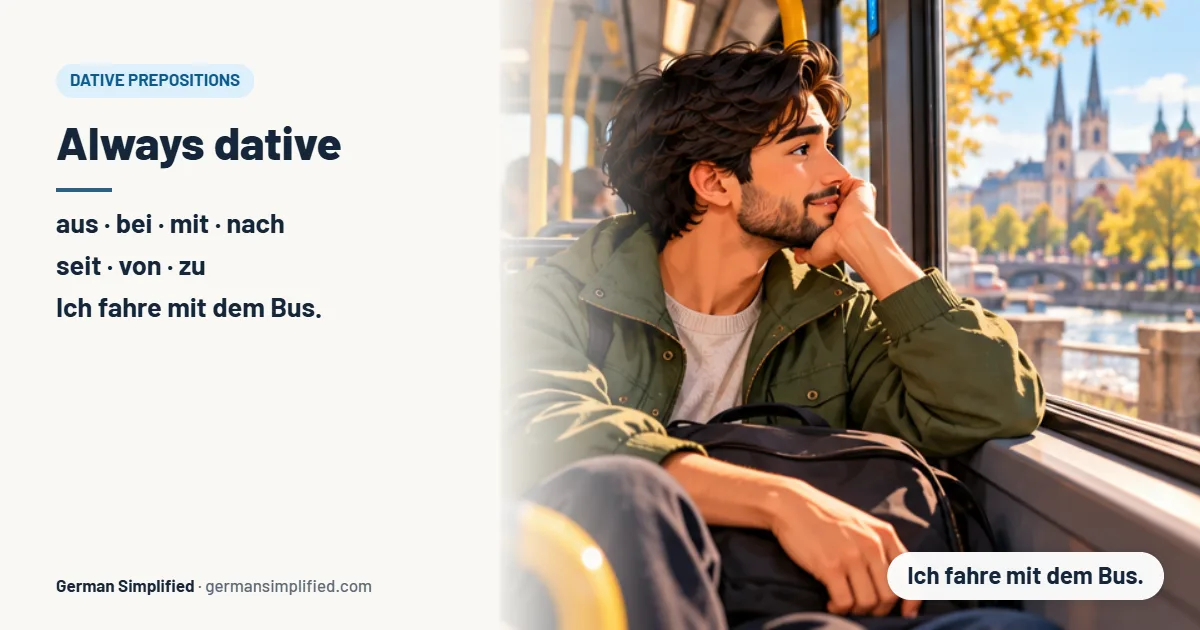
These nine prepositions always take the dative. Many learners sing them to the tune of the “Blue Danube” waltz: aus, außer, bei, mit, nach, seit, von, zu (plus gegenüber).
| Preposition | Meaning | Example | English |
|---|---|---|---|
| aus | from (origin), out of | Sie kommt aus der Türkei. | She comes from Turkey. |
| außer | except, besides | Alle außer meinem Bruder kommen. | Everyone except my brother is coming. |
| bei | at (someone’s place), near | Ich wohne bei meiner Tante. | I live at my aunt’s. |
| mit | with; by (transport) | Ich fahre mit dem Bus. | I go by bus. |
| nach | to (cities, countries); after | Nach dem Essen fahren wir nach Wien. | After the meal we go to Vienna. |
| seit | since, for (time) | Ich lerne seit einem Jahr Deutsch. | I’ve been learning German for a year. |
| von | from, of, by | Das ist ein Brief von meiner Mutter. | That’s a letter from my mother. |
| zu | to (people, places) | Ich gehe zum Arzt. | I’m going to the doctor. |
| gegenüber | opposite, across from | Die Bank ist gegenüber dem Bahnhof. | The bank is opposite the station. |
seit uses the present tense
English says “I have been learning German for a year”. German uses the present tense with seit: Ich lerne seit einem Jahr Deutsch. Saying Ich habe seit einem Jahr Deutsch gelernt sounds as if you’ve stopped.
nach vs zu: two ways to say “to”
Use nach for cities, countries without an article and directions (nach Berlin, nach Hause, nach links). Use zu for people, buildings and events (zu meiner Freundin, zum Supermarkt, zur Party). For countries with an article, like die Schweiz, use in + accusative: in die Schweiz.
Two-Way Prepositions
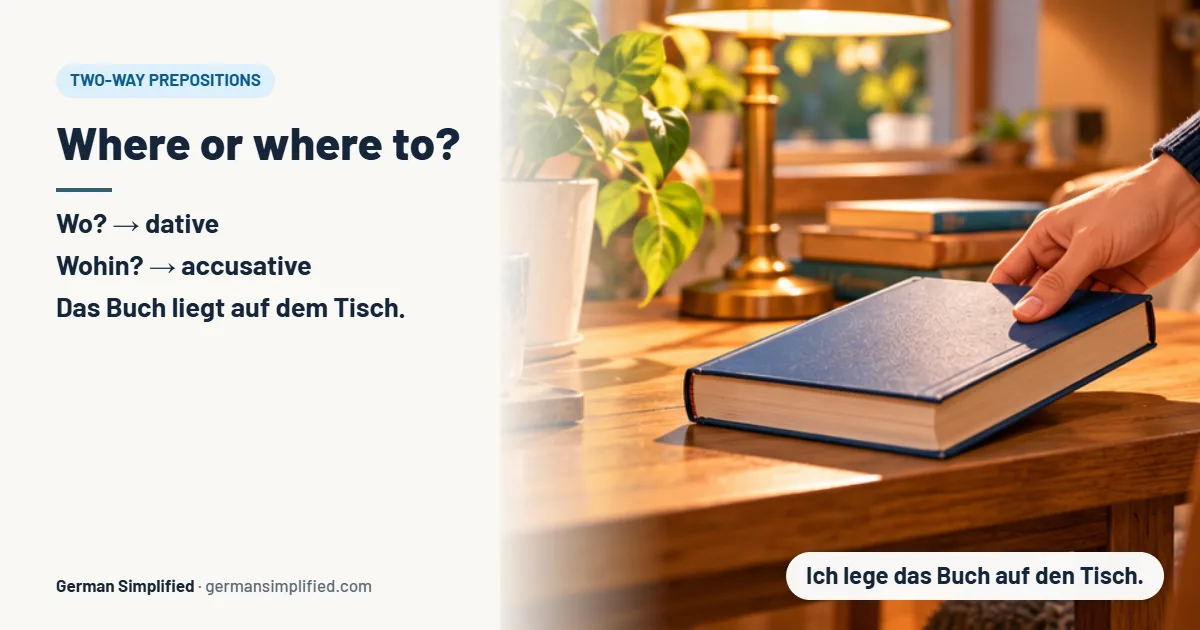
Nine prepositions can take either the accusative or the dative. They’re called two-way prepositions (Wechselpräpositionen) and they mostly describe place.
- Accusative when there’s movement towards a destination. Question: Wohin? (Where to?)
- Dative when something is in a location, or moving within it. Question: Wo? (Where?)
| Preposition | Meaning | Wohin? (accusative) | Wo? (dative) |
|---|---|---|---|
| an | at, on (vertical), to | Ich hänge das Bild an die Wand. | Das Bild hängt an der Wand. |
| auf | on (horizontal) | Leg das Buch auf den Tisch. | Das Buch liegt auf dem Tisch. |
| hinter | behind | Die Katze läuft hinter das Sofa. | Die Katze schläft hinter dem Sofa. |
| in | in, into | Wir gehen in die Küche. | Wir sind in der Küche. |
| neben | next to | Stell dich neben mich. | Er sitzt neben mir. |
| über | over, above; about | Das Flugzeug fliegt über die Stadt. | Die Lampe hängt über dem Tisch. |
| unter | under, below | Der Ball rollt unter den Stuhl. | Der Ball liegt unter dem Stuhl. |
| vor | in front of; before, ago | Er stellt das Auto vor das Haus. | Das Auto steht vor dem Haus. |
| zwischen | between | Setz dich zwischen uns. | Sie sitzt zwischen uns. |
Notice the verb pairs that make this easier: legen/liegen (to lay / to lie), stellen/stehen (to put upright / to stand), hängen (to hang something / to be hanging), setzen/sitzen (to sit down / to be sitting). The first verb of each pair usually means movement (accusative); the second means position (dative). For the many meanings of one of these, see our guide to auf in German.
Picture it, don’t memorize it
Two-way prepositions are easier to learn as images than as rules. When you meet a new example, picture it: an arrow means accusative, a dot means dative. Your visual memory stores “the ball rolling under the chair” and “the ball lying under the chair” as two different scenes, and the case comes along with the picture. This is called dual coding: words plus an image beat words alone.
Time expressions with two-way prepositions
When an, in and vor describe time, they take the dative: am Montag (on Monday), im Juli (in July), vor einer Woche (a week ago). That’s one less thing to decide.
Genitive Prepositions
A smaller group takes the genitive. You’ll meet them mostly in writing, news and formal speech.
| Preposition | Meaning | Example | English |
|---|---|---|---|
| während | during | Während des Films war es still. | During the film it was quiet. |
| wegen | because of | Wegen des Regens bleiben wir zu Hause. | Because of the rain we’re staying home. |
| trotz | despite | Trotz des Wetters gehen wir spazieren. | Despite the weather we go for a walk. |
| (an)statt | instead of | Statt eines Autos kauft er ein Fahrrad. | Instead of a car he buys a bike. |
| innerhalb | within, inside | Innerhalb einer Woche | Within a week |
| außerhalb | outside of | Außerhalb der Stadt | Outside the city |
In everyday speech many Germans use the dative after wegen, trotz and statt: wegen dem Regen. You’ll hear it constantly, but in exams and formal writing, stick to the genitive: wegen des Regens.
Contractions (im, am, zum)
Some prepositions merge with the article dem, der or das. These contractions are standard and usually required in everyday German.
| Contraction | Full form | Example |
|---|---|---|
| am | an dem | am Montag, am Fenster |
| ans | an das | Wir fahren ans Meer. |
| im | in dem | im Sommer, im Kino |
| ins | in das | Gehen wir ins Kino? |
| beim | bei dem | beim Arzt, beim Essen |
| vom | von dem | vom Bahnhof |
| zum | zu dem | zum Arzt, zum Glück |
| zur | zu der | zur Schule, zur Arbeit |
You’ll also hear aufs (auf das), fürs (für das) and ums (um das) in casual speech. Don’t contract when you want to stress the article (in dem Haus, nicht in dem anderen: in that house, not the other one) or when a relative clause follows.
All German Prepositions at a Glance
| Accusative | Dative | Two-way | Genitive |
|---|---|---|---|
| durch | aus | an | während |
| für | außer | auf | wegen |
| gegen | bei | hinter | trotz |
| ohne | mit | in | (an)statt |
| um | nach | neben | innerhalb |
| bis | seit | über | außerhalb |
| entlang | von | unter | |
| zu | vor | ||
| gegenüber | zwischen |
Save this chart or screenshot it. If you’re unsure about a preposition, the Duden dictionary lists the case for each one.
Quiz
Choose the correct article. Click to see the answer.
1. Ich fahre mit ___ Zug. (der Zug)
dem (mit + dative)
2. Das ist für ___ Bruder. (mein Bruder)
meinen (für + accusative)
3. Wir gehen in ___ Stadt. (die Stadt, movement)
die (in + accusative for direction)
4. Das Handy liegt auf ___ Tisch. (der Tisch, location)
dem (auf + dative for location)
5. Seit ___ Woche regnet es. (eine Woche)
einer (seit + dative)
6. Wegen ___ Streiks fährt kein Bus. (der Streik)
des (wegen + genitive in formal German)
FAQs
How many prepositions are there in German?
Well over a hundred exist, but about 30 cover almost everything you’ll say: 5–7 accusative, 9 dative, 9 two-way and a handful of genitive prepositions.
Which German prepositions take the dative?
aus, außer, bei, mit, nach, seit, von, zu and gegenüber always take the dative. The two-way prepositions take the dative for location.
Which German prepositions take the accusative?
durch, für, gegen, ohne and um (plus bis and entlang). Two-way prepositions take the accusative for movement towards a place.
How do I know if a two-way preposition takes accusative or dative?
Ask Wohin? (where to) for accusative and Wo? (where) for dative. Movement to a destination means accusative; a fixed location means dative.
Is it “wegen dem” or “wegen des”?
Standard written German uses the genitive: wegen des Regens. Wegen dem Regen is very common in speech but counts as informal.
Conclusion
German prepositions become manageable once you sort them into four boxes: accusative (DOGFU), dative (aus, außer, bei, mit, nach, seit, von, zu), two-way (Wo? dative, Wohin? accusative) and genitive (während, wegen, trotz, statt). Learn the groups, practise with the chart, and let the contractions im, am and zum become automatic. Next, dig into how the accusative works on its own in the accusative case in German.
Sources and further reading: Duden, DWDS and the Goethe-Institut A1–A2 grammar overviews.
Keep learning → The accusative case in German: rules and examples