

The Dative Case in German: Articles, Pronouns, Verbs and Prepositions
Who receives the book? Learn the German dative case step by step: article endings, pronouns, dative verbs, dative prepositions and two-way prepositions.
German grammar made simple: articles, cases, prepositions, pronouns, adjective endings and sentence structure.
Who receives the book? Learn the German dative case step by step: article endings, pronouns, dative verbs, dative prepositions and two-way prepositions.

The accusative case in German (Akkusativ) explained: what it does, how articles and pronouns change, n-nouns, accusative prepositions, verbs and time expressions that take it, plus exercises.

Nicht vs kein explained: the one rule that tells you which to use, how kein declines in every case, exactly where nicht goes in a sentence, partial negation with sondern, and answering negative questions with doch.

The four German cases explained simply: what a case is, when to use nominative, accusative, dative and genitive, the master chart of articles and pronouns, how to identify the case in any sentence, and exercises.
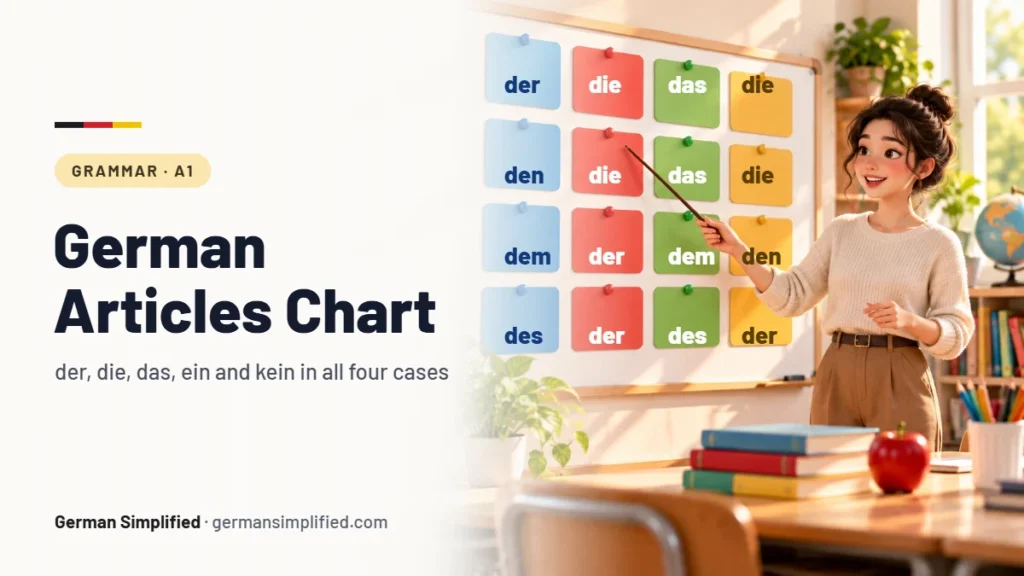
The complete German articles chart: definite articles (der, die, das), indefinite articles (ein, eine), kein and the zero article in all four cases, colour-coded, with examples, memory tricks and exercises.

Every common German preposition in one place, grouped by the case it takes: accusative, dative, two-way and genitive, plus contractions like im, am and zum, a chart and a quiz.

What does auf mean in German? On, onto, open and more: when auf takes dative or accusative and the phrases you need.

Possessive pronouns in German: mein, dein, sein, ihr, unser in every case, with charts, ihr vs Ihr and examples.

German adjective endings (Adjektivdeklination) explained: why they change, weak, mixed and strong tables, a one-rule shortcut and exercises.

The complete German personal pronouns chart: nominative, accusative, dative and reflexive forms, with rules for word order and practice exercises.