
A1–A2 Grammar
“My”, “your”, “his”, “her”: in German these little words are possessive pronouns (more precisely, possessive articles), and they’re everywhere: mein Name, deine Familie, Ihr Ausweis. They look scary at first because they change their endings, but if you know the endings of ein and kein, you already know them. This lesson gives you the complete chart, explains the most confusing pair (sein vs ihr), sorts out ihr, ihre and Ihr, and shows you how to say “mine” and “yours”.
Quick answer
The German possessive articles are mein (my), dein (your, informal), sein (his/its), ihr (her), unser (our), euer (your, plural), ihr (their) and Ihr (your, formal). The word depends on the owner; the ending depends on the noun that follows and its case, using the same endings as ein/kein: mein Vater, meine Mutter, mit meinem Bruder.
The Possessive Articles
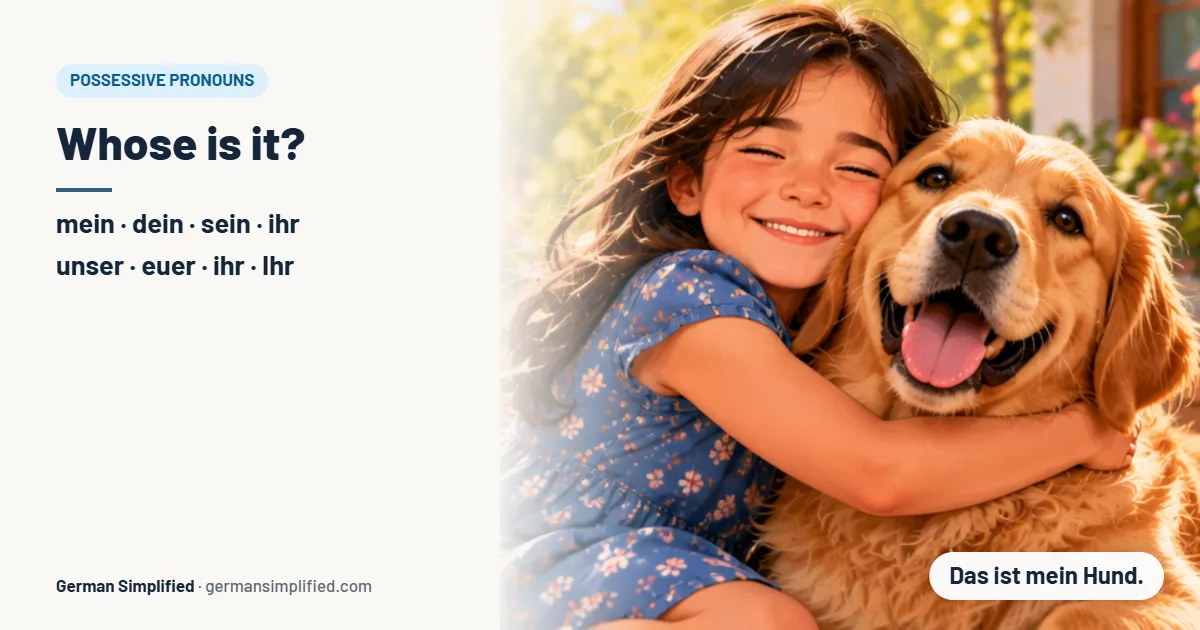
First choose the right word for the owner. Each personal pronoun has its own possessive:
| Personal pronoun | Possessive | English | Example |
|---|---|---|---|
| ich | mein | my | mein Handy |
| du | dein | your (informal) | dein Auto |
| er | sein | his | sein Hund |
| sie | ihr | her | ihr Buch |
| es | sein | its | sein Name |
| wir | unser | our | unser Haus |
| ihr | euer | your (plural, informal) | euer Lehrer |
| sie | ihr | their | ihr Garten |
| Sie | Ihr | your (formal) | Ihr Pass |
If you need a refresher on ich, du, er, sie and their cases, see German personal pronouns in all cases.
Endings by Case

Now the ending. It depends on three things about the noun that follows: its gender (der, die, das), whether it’s plural, and its case. The endings are exactly those of ein in the singular and kein in the plural. Here’s mein:
| Case | Masculine (der) | Feminine (die) | Neuter (das) | Plural (die) |
|---|---|---|---|---|
| Nominative | mein | meine | mein | meine |
| Accusative | meinen | meine | mein | meine |
| Dative | meinem | meiner | meinem | meinen |
| Genitive | meines | meiner | meines | meiner |
Every other possessive works the same way. Just swap the stem: deinen Bruder, seiner Schwester, unserem Haus, Ihre Kinder.
Examples in every case
- Nominative (subject): Mein Bruder wohnt in Berlin. (My brother lives in Berlin.)
- Accusative (direct object): Ich besuche meinen Bruder. (I’m visiting my brother.)
- Dative (indirect object, after mit, bei, von…): Ich fahre mit meinem Bruder. (I’m travelling with my brother.)
- Genitive (of): Das ist das Auto meines Bruders. (That’s my brother’s car.)
The “no ending” trap: Masculine nominative and neuter nominative/accusative have no ending: mein Vater, mein Kind. Learners often add an -e by mistake (meine Vater is wrong). If the noun is der or das, check the case before adding anything.
Two spelling quirks: euer and unser
euer loses its middle e as soon as it gets an ending: euer Haus, but eure Mutter, euren Vater, eurem Kind. unser keeps it: unsere Mutter, unseren Vater. (In speech you’ll sometimes hear unsre, but write unsere.)
Learn one chart, not eight
Our brains love reusing patterns. Rather than memorising separate tables for mein, dein, sein and the rest, learn the ein/kein endings once and treat every possessive as “a different stem on the same chart”. This is called chunking: fewer, bigger units are much easier to hold in memory than many small ones.
sein vs ihr
This is the classic mistake for English speakers. In English, “his” and “her” depend on the owner, and German works the same way: the owner decides the word. But the noun after it decides the ending. Keep those two jobs apart:
| German | Owner | Noun | English |
|---|---|---|---|
| Peter und seine Mutter | Peter (male) → sein | die Mutter → -e | Peter and his mother |
| Anna und ihr Vater | Anna (female) → ihr | der Vater → no ending | Anna and her father |
| Anna und ihre Mutter | Anna → ihr | die Mutter → -e | Anna and her mother |
| Das Kind und sein Spielzeug | das Kind (neuter) → sein | das Spielzeug → no ending | The child and its toy |
So seine doesn’t mean “her”, even though it has an -e. The -e comes from die Mutter, not from the owner.
ihr, ihre, Ihr: which is which?
ihr is one of the most overloaded words in German. Context and capitalisation tell you what it means:
- ihr = “her” or “their” (possessive): ihr Hund (her/their dog)
- ihre = the same word with an ending: ihre Katze (her/their cat)
- Ihr / Ihre with a capital I = “your” (formal Sie): Ist das Ihr Koffer? (Is that your suitcase?)
- ihr as a personal pronoun = “you all” (informal plural): Ihr seid toll! (You guys are great!)
- ihr as dative of sie = “(to) her”: Ich gebe ihr das Buch. (I give her the book.)
As Standalone Pronouns: “mine”, “yours”
When the noun is left out, as in “That’s mine”, the possessive stands alone and takes der-word endings, so it shows the gender clearly:
| Case | Masculine | Feminine | Neuter | Plural |
|---|---|---|---|---|
| Nominative | meiner | meine | meins (meines) | meine |
| Accusative | meinen | meine | meins (meines) | meine |
| Dative | meinem | meiner | meinem | meinen |
- Wem gehört der Schlüssel? – Das ist meiner. (Whose key is it? – It’s mine.)
- Ist das deine Tasche? – Nein, das ist ihre. (Is that your bag? – No, it’s hers.)
- Mein Auto ist alt. Deins ist neu. (My car is old. Yours is new.)
All Possessives at a Glance
Here’s every possessive in the forms you’ll use most: the nominative (before der/das nouns), the -e form (before die and plural nouns), and the accusative masculine. Print it or save it; it covers most everyday sentences.
| Owner | der / das (nom.) | die / plural | der (acc.) | der / das (dat.) |
|---|---|---|---|---|
| ich | mein | meine | meinen | meinem |
| du | dein | deine | deinen | deinem |
| er / es | sein | seine | seinen | seinem |
| sie | ihr | ihre | ihren | ihrem |
| wir | unser | unsere | unseren | unserem |
| ihr | euer | eure | euren | eurem |
| sie (plural) | ihr | ihre | ihren | ihrem |
| Sie | Ihr | Ihre | Ihren | Ihrem |
Genitive or “von”? How Germans Really Say “My Brother’s Car”
In writing, the genitive is correct and elegant: das Auto meines Bruders. But in everyday speech most Germans use von + dative instead:
- Written: das Auto meines Bruders
- Spoken: das Auto von meinem Bruder
Both mean “my brother’s car”. If you’re an A1 or A2 learner, the von version is perfectly natural and much easier. Learn to recognise the genitive when you read it, and use whichever feels comfortable when you speak.
Names are easy: With a person’s name, just add -s and no apostrophe: Annas Handy, Peters Wohnung. Germans only use an apostrophe when the name already ends in an s-sound: Max’ Fahrrad.
Common Mistakes
These come up in almost every beginner class. If you can avoid them, you’re ahead of most learners:
- “Meine Vater”. Vater is masculine, so the nominative has no ending: mein Vater.
- Choosing sein/ihr by the noun. Anna und seine Mutter means Anna and his mother, someone else’s. For Anna’s own mother: ihre Mutter.
- “Euere”. The middle e drops: eure, euren, eurem.
- Forgetting the dative after mit, bei, von, zu. mit mein Freund → mit meinem Freund.
- A small “ihr” for formal “your”. In an email to your landlord, write Ihre Nachricht with a capital I. A small i would mean “her” or “their”.
Practice: Talk About Your Family
The best way to make possessives automatic is to use them about your own life. Read this short text, then write five sentences about your family in the same style.
Das ist meine Familie. Mein Vater heißt Raj und meine Mutter heißt Priya. Mein Bruder wohnt in Berlin. Seine Frau ist Lehrerin, und ihre Kinder gehen in den Kindergarten. Am Wochenende besuche ich meinen Bruder und spiele mit seinen Kindern.This is my family. My father is called Raj and my mother is called Priya. My brother lives in Berlin. His wife is a teacher, and their children go to kindergarten. At the weekend I visit my brother and play with his children.
Notice every ending: meine Familie (die), mein Vater (der, nominative), meinen Bruder (der, accusative), seinen Kindern (plural, dative after mit, with an extra -n on the noun too).
Why personal sentences stick
Memory research has a name for this: the self-reference effect. Information connected to yourself is remembered much better than neutral examples. “Meine Schwester wohnt in Delhi” will stay with you far longer than “Peters Hund ist braun”, simply because it’s yours.
Quiz
1. Ich liebe ___ Mutter. (my)
meine (die Mutter, accusative → -e)
2. Er fährt mit ___ Auto. (his)
seinem (das Auto, dative after mit → -em)
3. Lisa ruft ___ Bruder an. (her)
ihren (der Bruder, accusative → -en)
4. Wo ist ___ Lehrerin? (your, plural informal)
eure (euer loses its e when it takes an ending)
5. Ist das Ihr Stift? – Ja, das ist ___. (mine)
meiner (der Stift, standalone → -er)
FAQs
What are the possessive pronouns in German?
mein, dein, sein, ihr, sein, unser, euer, ihr and Ihr, meaning my, your, his, her, its, our, your (plural), their and your (formal).
Are possessive pronouns and possessive articles the same?
Textbooks often use both terms. Strictly, a possessive article goes before a noun (mein Buch), and a possessive pronoun stands alone (meins). Many learners and teachers call both “possessive pronouns”.
What is the difference between ihr and ihre?
They’re the same word with different endings. Ihr is used before masculine or neuter nouns in the nominative (ihr Vater), ihre before feminine and plural nouns (ihre Mutter, ihre Kinder).
When do I use sein and when ihr?
Look at the owner: a male or neuter owner takes sein, a female owner or plural owners take ihr. Then add the ending that fits the noun after it.
How do you say “their” in German?
ihr, with the usual endings: ihr Haus, ihre Kinder, mit ihrem Hund.
What is meine in the accusative and dative?
For feminine and plural nouns, the accusative stays meine. The dative is meiner (feminine) and meinen (plural).
Conclusion
Possessive pronouns in German follow one simple idea: the owner picks the word (mein, dein, sein, ihr, unser, euer, ihr, Ihr) and the noun picks the ending, using the familiar ein/kein pattern. Watch the “no ending” forms, remember that euer becomes eure, and keep ihr and Ihr apart. For the bigger picture, see the German grammar guide, and if articles still feel shaky, review der, die, das.
Sources and further reading: grammis (Leibniz Institute for the German Language) and German declension on Wikipedia.
Next lesson → German adjective endings (Adjektivdeklination) made simple