
A1–A2 Grammar
Auf is one of the most common words in German, and one of the most flexible. It can mean “on”, “onto”, “to”, “at”, “in” and even “open”, it takes two different cases, it teams up with dozens of verbs, and it hides inside words like aufstehen and Auf Wiedersehen. This guide untangles all of it: the main meanings, the dative vs accusative rule, the verbs that need auf, auf as a separable prefix, and the everyday phrases you’ll hear constantly.
Quick answer
Auf (auf) most often means “on” (on top of a surface) or “onto”. It’s a two-way preposition: use the dative for location (Wo? – auf dem Tisch) and the accusative for movement (Wohin? – auf den Tisch). It’s also used for some places (auf die Post), languages (auf Deutsch), many verbs (warten auf) and separable verbs (aufstehen).
The Main Meanings of Auf
| Meaning | Example | English |
|---|---|---|
| on (surface) | Das Handy liegt auf dem Tisch. | The phone is on the table. |
| onto | Leg das Handy auf den Tisch. | Put the phone on(to) the table. |
| to (some places and events) | Ich gehe auf die Post. | I’m going to the post office. |
| at (events) | Wir sind auf einer Party. | We’re at a party. |
| in (a language) | Wie sagt man das auf Deutsch? | How do you say that in German? |
| in (open spaces) | Sie wohnt auf dem Land. | She lives in the countryside. |
| open (colloquial) | Die Tür ist auf. | The door is open. |
| up / let’s go | Auf geht’s! | Let’s go! |
auf or an? Both can translate as “on”. Use auf for horizontal surfaces you can put something on top of (auf dem Tisch), and an for vertical surfaces or edges (an der Wand, on the wall).
Auf + Accusative vs Auf + Dative
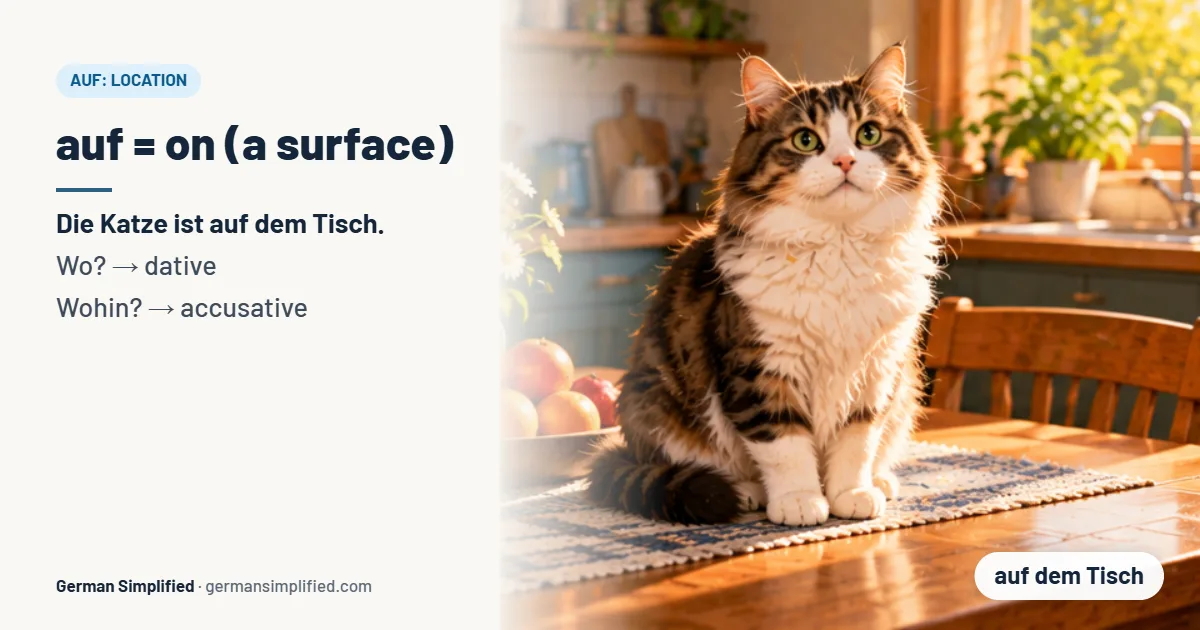
Auf is one of the nine two-way prepositions (Wechselpräpositionen). The case depends on one question:
- Wo? (where?) → location, no change of place → dative
- Wohin? (where to?) → movement to a new place → accusative
| Wo? (dative) | Wohin? (accusative) |
|---|---|
| Die Katze sitzt auf dem Sofa. The cat is sitting on the sofa. | Die Katze springt auf das Sofa. The cat jumps onto the sofa. |
| Das Buch liegt auf dem Tisch. | Ich lege das Buch auf den Tisch. |
| Wir sind auf der Party. | Wir gehen auf die Party. |
| Das Glas steht auf dem Regal. | Ich stelle das Glas auf das Regal. |
Notice the verb pairs: liegen / legen, stehen / stellen, sitzen / setzen. The first in each pair describes a position (dative); the second describes putting something somewhere (accusative). The articles change accordingly: if you need a refresher, see the der, die, das guide.
Contractions
In speech, auf das often becomes aufs: Ich gehe aufs Land (I’m going to the countryside). Auf dem is not contracted in standard German.
Picture it, don’t parse it
Grammar rules are slow to apply in real time. Images are fast. For auf, imagine an arrow: if there’s an arrow (something moves onto the surface), use the accusative; if there’s no arrow (it’s just there), use the dative. After a week of “seeing the arrow”, most learners stop thinking about the rule at all.
Verbs With Auf
Many verbs and adjectives are fixed with auf. Here the meaning of auf is no longer “on”, so learn each verb with its preposition as one unit. In these fixed combinations, auf almost always takes the accusative.
| German | English | Example |
|---|---|---|
| warten auf | to wait for | Ich warte auf den Bus. |
| sich freuen auf | to look forward to | Ich freue mich auf das Wochenende. |
| aufpassen auf | to look after, watch | Kannst du auf meine Tasche aufpassen? |
| achten auf | to pay attention to | Achte auf die Aussprache! |
| antworten auf | to reply to | Sie antwortet auf die E-Mail. |
| sich konzentrieren auf | to concentrate on | Ich konzentriere mich auf die Prüfung. |
| sich verlassen auf | to rely on | Du kannst dich auf mich verlassen. |
| Lust haben auf | to feel like (having) | Ich habe Lust auf Pizza. |
| stolz sein auf | to be proud of | Wir sind stolz auf dich. |
| sauer sein auf | to be annoyed with | Er ist sauer auf seinen Chef. |
sich freuen auf vs sich freuen über: auf looks forward (Ich freue mich auf die Ferien, the holidays are coming); über is about something now or in the past (Ich freue mich über das Geschenk, I’m happy about the present).
Asking and answering: worauf and darauf
To ask about a thing with these verbs, use worauf; to refer back to it, use darauf:
- Worauf wartest du? (What are you waiting for?) – Ich warte darauf, dass der Regen aufhört. (I’m waiting for the rain to stop.)
- For people, use auf wen and auf ihn/sie: Auf wen wartest du? – Auf Anna.
Auf as a Separable Prefix
Add auf to the front of a verb and you get a new verb, often with the idea of “up” or “open”. In a normal sentence, the prefix splits off and goes to the end:
| Verb | Meaning | In a sentence |
|---|---|---|
| aufstehen | to get up | Ich stehe um sieben Uhr auf. |
| aufwachen | to wake up | Wann wachst du auf? |
| aufmachen | to open | Mach bitte das Fenster auf. |
| aufhören | to stop | Hör auf! |
| aufräumen | to tidy up | Wir räumen die Küche auf. |
| aufschreiben | to write down | Schreib die Nummer auf. |
| aufpassen | to pay attention | Pass auf! |
In the perfect tense, ge- goes between the prefix and the verb: aufgestanden, aufgemacht, aufgehört. In the infinitive with zu: aufzustehen.
Common Phrases With Auf
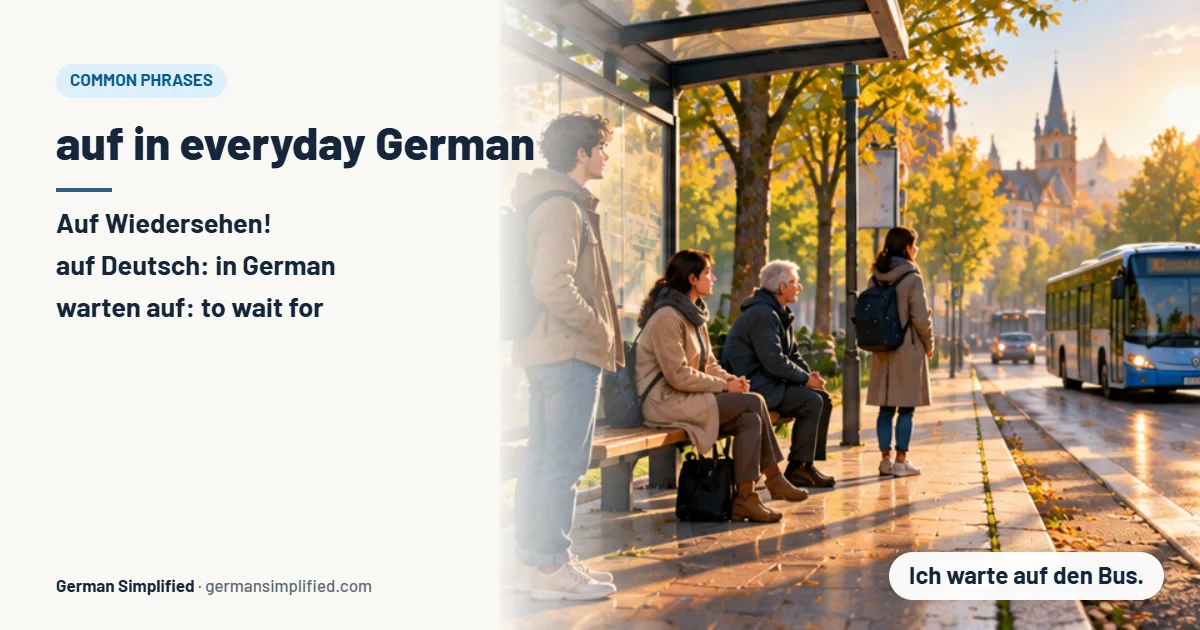
| German | English |
|---|---|
| Auf Wiedersehen! | Goodbye! (lit. until we see each other again) |
| auf Deutsch | in German |
| auf jeden Fall | definitely, in any case |
| auf keinen Fall | no way, under no circumstances |
| auf einmal | suddenly; all at once |
| auf der Straße | in the street |
| auf der Arbeit | at work (colloquial) |
| Auf geht’s! | Let’s go! |
| auf Wiederhören! | Goodbye! (on the phone) |
| Bis auf Weiteres | until further notice |
Auf, In or Zu? Going Places
“I’m going to …” is where auf confuses learners most, because German uses three different prepositions for places. There’s no perfect rule, but these patterns cover most situations:
| Preposition | Used for | Examples |
|---|---|---|
| auf | open areas, events, some public offices | auf den Markt, auf eine Party, auf die Post, auf die Bank, aufs Land |
| in | buildings you go inside, countries with an article | ins Kino, in die Schule, in die Stadt, in die Schweiz |
| zu | people, shops, specific places (very common in speech) | zum Arzt, zu meiner Oma, zum Bahnhof, zur Post |
Notice that both auf die Post and zur Post are correct; zur Post is more common in everyday German today. When you’re unsure, zu is usually the safest choice for a specific place.
Auf with places: Wo? and Wohin?
- Wohin? Ich gehe auf den Markt. (I’m going to the market.) – Wo? Ich bin auf dem Markt. (I’m at the market.)
- Wohin? Wir ziehen aufs Land. (We’re moving to the countryside.) – Wo? Wir wohnen auf dem Land. (We live in the countryside.)
More Adjectives With Auf
Feelings directed at someone or something often use auf + accusative. These are worth learning as phrases:
- gespannt sein auf: to be curious/excited about. Ich bin gespannt auf den Film.
- neugierig sein auf: to be curious about. Sie ist neugierig auf die neue Stadt.
- eifersüchtig sein auf: to be jealous of. Er ist eifersüchtig auf seinen Bruder.
- angewiesen sein auf: to depend on. Wir sind auf deine Hilfe angewiesen.
Common Mistakes
- “Ich warte für den Bus.” English “wait for” tempts you to use für. In German it’s always warten auf: Ich warte auf den Bus.
- Dative after verbs like warten. Ich warte auf dem Bus means you’re standing on top of the bus! The fixed verb combinations take the accusative.
- “Das Bild hängt auf der Wand.” Walls are vertical, so it’s an der Wand.
- Forgetting the prefix. Ich stehe um sieben just means “I stand at seven”. You need the auf at the end: Ich stehe um sieben auf.
- “In Deutsch”. To say “in German”, use auf Deutsch: Wie heißt das auf Deutsch?
Dialogue: Auf in Action
Tim: Worauf wartest du?Tim: What are you waiting for?
Sara: Auf meine Schwester. Wir gehen heute Abend auf eine Party.Sara: For my sister. We’re going to a party tonight.
Tim: Schön! Freust du dich darauf?Tim: Nice! Are you looking forward to it?
Sara: Auf jeden Fall! Aber ich muss morgen früh aufstehen.Sara: Definitely! But I have to get up early tomorrow.
Tim: Dann pass auf, dass du nicht zu lange bleibst!Tim: Then make sure you don’t stay too long!
In five lines, auf appears as a verb partner (warten auf, sich freuen auf), a place word (auf eine Party), a fixed phrase (auf jeden Fall) and a separable prefix (aufstehen, aufpassen).
Quiz
1. Das Bild hängt ___ der Wand. (auf or an?)
an. A wall is a vertical surface.
2. Ich stelle die Vase auf ___ Tisch. (den or dem?)
den. Movement onto the table → accusative.
3. Die Vase steht auf ___ Tisch.
dem. Position → dative.
4. Translate: “I’m looking forward to the holidays.”
Ich freue mich auf die Ferien.
5. Put the verb in the right place: (aufstehen) Ich ___ um 6 Uhr ___.
Ich stehe um 6 Uhr auf.
6. How do you say “definitely” with auf?
auf jeden Fall
FAQs
What does auf mean in German?
Mainly “on” or “onto”. Depending on context it can also mean to, at, in (a language), open, or up.
Does auf take dative or accusative?
Both. Dative for location (Wo? – auf dem Tisch), accusative for movement (Wohin? – auf den Tisch). In fixed verb combinations like warten auf, it’s almost always accusative.
What is the difference between auf and an?
Auf is for horizontal surfaces (on top of), an for vertical surfaces and edges (on the wall, at the window).
What does Auf Wiedersehen mean?
Goodbye. Literally “until (we) see (each other) again”. On the phone, Germans say Auf Wiederhören.
Is auf a separable prefix?
Yes. In verbs like aufstehen, aufmachen and aufhören, auf separates and goes to the end of the clause: Ich stehe früh auf.
Conclusion
Auf is “on” at heart: use the dative when something is on a surface (auf dem Tisch) and the accusative when it moves onto it (auf den Tisch). Learn the common verbs as fixed pairs (warten auf, sich freuen auf), watch the prefix jump to the end in aufstehen, and use phrases like auf Deutsch and auf jeden Fall every day. For the full system, see the German grammar guide or review possessive pronouns.
Sources and further reading: DWDS: auf and grammis (Leibniz Institute for the German Language).
Keep learning → German verbs: conjugation, tenses and the verbs you need most