
A1 Grammar
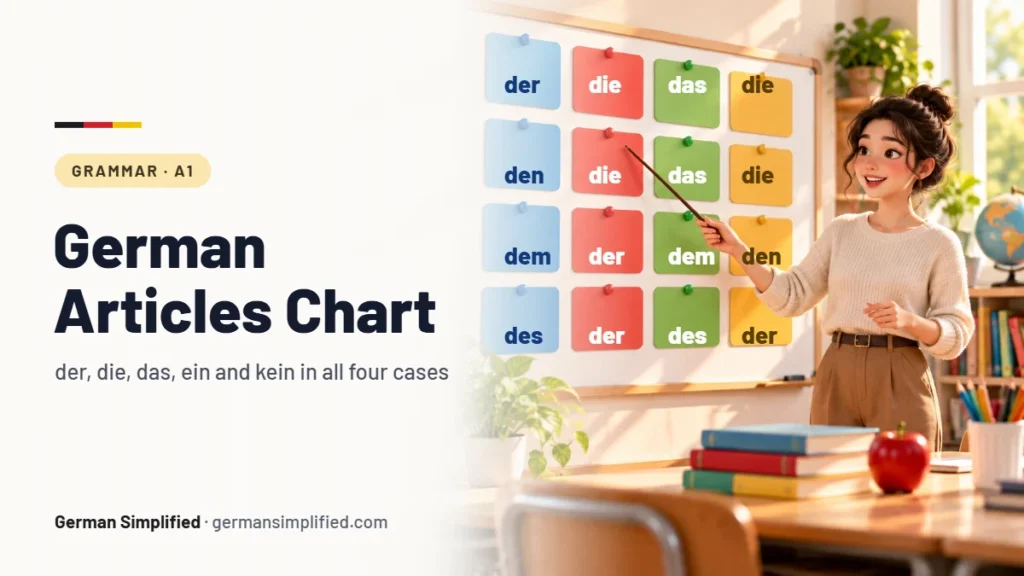
German has six words for “the”, and that’s before you count a, an and no. That sounds like chaos, but a German articles chart shows that they follow one tidy grid: three genders plus plural, across four cases. Once you can see the whole chart, the “random” changes (der becoming den, dem or des) turn out to be predictable. This page gives you the complete German articles chart for definite articles, indefinite articles, the negative article kein and the zero article, all colour-coded, with examples and a short practice set. Bookmark it; you’ll come back to it.
Quick answer
German articles change with gender (masculine, feminine, neuter, plural) and case (nominative, accusative, dative, genitive). The definite articles are der, die, das, die in the nominative, den, die, das, die in the accusative, dem, der, dem, den in the dative and des, der, des, der in the genitive. Indefinite articles follow the same endings: ein, eine, ein → einen, eine, ein → einem, einer, einem → eines, einer, eines.
This chart is part of our German grammar guide. If you still need to work out which gender a noun has, start with der, die, das: how to know the gender of German nouns. Colour code used on this site: blue = masculine (der), red = feminine (die), green = neuter (das).
Definite Articles (der, die, das) in Every Case
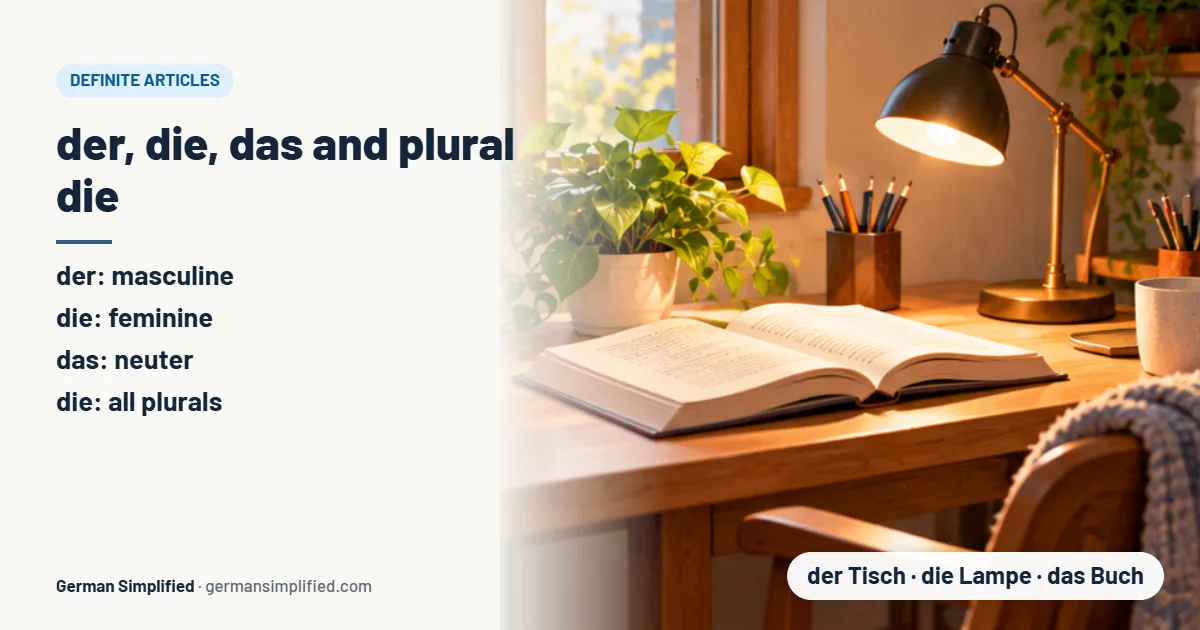
The definite article means “the”. Here it is in every case:
| Case | Masculine | Feminine | Neuter | Plural |
|---|---|---|---|---|
| Nominative (subject) | der Mann | die Frau | das Kind | die Kinder |
| Accusative (direct object) | den Mann | die Frau | das Kind | die Kinder |
| Dative (indirect object) | dem Mann | der Frau | dem Kind | den Kindern |
| Genitive (possession) | des Mannes | der Frau | des Kindes | der Kinder |
Look for the patterns rather than memorizing 16 boxes:
- Feminine and plural barely move. Feminine is die, die, der, der. Plural is die, die, den, der.
- Neuter copies masculine in the dative and genitive (dem, des), and copies itself in the accusative (das).
- Only masculine changes in the accusative: der → den. Everything else stays as in the nominative.
- Dative plural adds -n to the noun if it doesn’t already end in -n or -s: den Kindern, den Freunden, but den Autos.
- Genitive masculine and neuter add -s or -es to the noun: des Mannes, des Autos.
Der Mann gibt der Frau das Buch.The man gives the woman the book.
Ich sehe den Hund des Nachbarn.I see the neighbor’s dog.
Wir helfen den Kindern.We help the children.
The “r-s-m-n” trick: The last letter of the definite article tells you the case for masculine nouns: der (nominative), den (accusative), dem (dative), des (genitive). These same endings reappear on ein, kein, mein and adjectives, so learning them here pays off everywhere.
Indefinite Articles (ein, eine) in Every Case
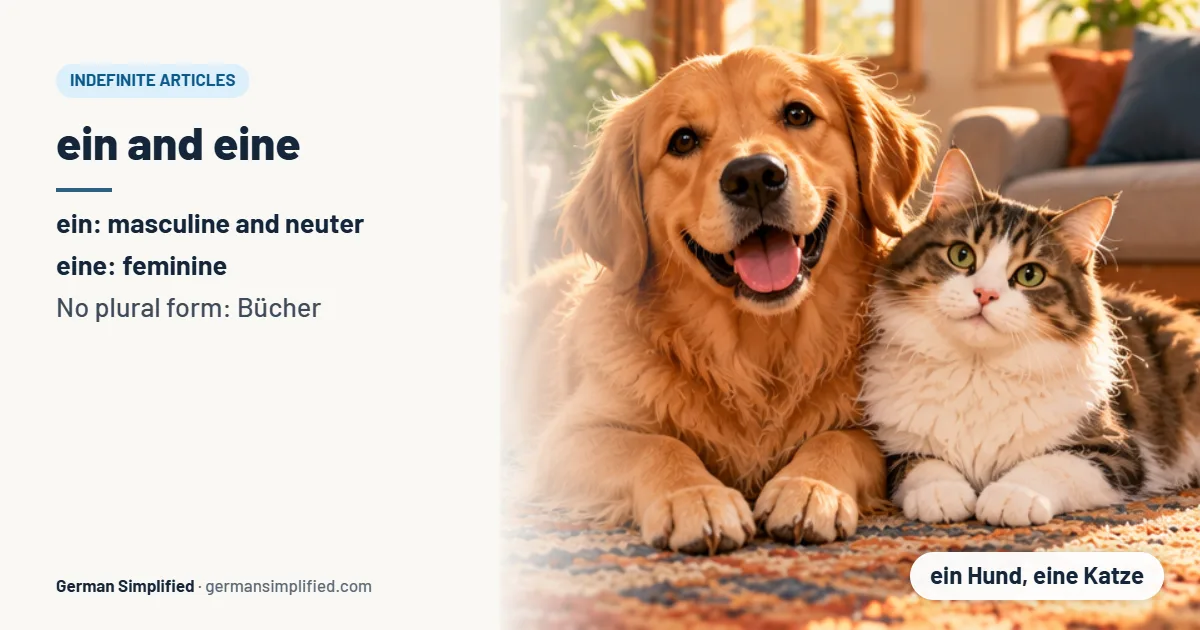
The indefinite article means “a” or “an”. It has no plural (just like English: “a dog”, but “dogs”).
| Case | Masculine | Feminine | Neuter | Plural |
|---|---|---|---|---|
| Nominative | ein Mann | eine Frau | ein Kind | Kinder |
| Accusative | einen Mann | eine Frau | ein Kind | Kinder |
| Dative | einem Mann | einer Frau | einem Kind | Kindern |
| Genitive | eines Mannes | einer Frau | eines Kindes | (von) Kindern |
Compare it with the definite chart: the endings are the same as der/die/das, except in three boxes where ein has no ending at all (masculine nominative, neuter nominative and neuter accusative). That’s why ein Mann and ein Kind look identical, while der Mann and das Kind don’t.
Ich habe einen Bruder und eine Schwester.I have a brother and a sister.
Sie wohnt in einem kleinen Dorf.She lives in a small village.
Negative Article kein
Kein means “no” or “not a/any” and negates nouns. It takes exactly the same endings as ein, and unlike ein it has a plural.
| Case | Masculine | Feminine | Neuter | Plural |
|---|---|---|---|---|
| Nominative | kein | keine | kein | keine |
| Accusative | keinen | keine | kein | keine |
| Dative | keinem | keiner | keinem | keinen (+ -n) |
| Genitive | keines | keiner | keines | keiner |
Ich habe keinen Hunger.I’m not hungry. (literally: I have no hunger.)
Das ist keine gute Idee.That’s not a good idea.
When do you use kein and when nicht? That has its own clear rule, explained in nicht vs kein.
Possessive articles use the same endings
Words like mein (my), dein (your), sein (his) and unser (our) decline exactly like kein: mein Vater, meinen Vater, meinem Vater, meines Vaters. Learn one row and you’ve learned them all. See possessive pronouns in German for the details.
Free: German Grammar Cheat Sheet
All the gender endings, the full article chart and the four cases on one printable page. Download the free PDF.
The Zero Article (Nullartikel)
Sometimes German uses no article at all. Grammar books call this the Nullartikel (zero article). The main cases:
- Plural of indefinite nouns: Ich kaufe Äpfel. (I’m buying apples.)
- Uncountable nouns (materials, food, liquids): Ich trinke Wasser. Sie braucht Zeit.
- Jobs, nationalities and religions after sein/werden: Er ist Lehrer. Ich bin Inderin. (Not ein Lehrer, unlike English “a teacher”.)
- Most names of people, cities and countries: Berlin ist groß. Anna kommt aus Spanien.
- Many fixed expressions: Ich habe Hunger / Durst / Angst. Wir fahren Auto.
Countries with articles: A few countries do take an article: die Schweiz, die Türkei, der Iran, die USA (plural), die Niederlande. So it’s Ich komme aus der Schweiz, but Ich komme aus Deutschland.
All Articles at a Glance
Here is the whole system in one master chart: definite, then indefinite/kein.
| Case | Masc. | Fem. | Neut. | Plural |
|---|---|---|---|---|
| Nominative | der / (k)ein | die / (k)eine | das / (k)ein | die / keine |
| Accusative | den / (k)einen | die / (k)eine | das / (k)ein | die / keine |
| Dative | dem / (k)einem | der / (k)einer | dem / (k)einem | den / keinen |
| Genitive | des / (k)eines | der / (k)einer | des / (k)eines | der / keiner |
If you’re not sure what each case does, our overview of German cases explains how to recognize the nominative, accusative, dative and genitive in a sentence.
How to Memorize the Chart
- Learn columns, not boxes. Say each gender down the cases like a chant: der, den, dem, des · die, die, der, der · das, das, dem, des · die, die, den, der.
- Learn nouns with their article. Always learn der Tisch, never just Tisch. The gender is the hard part; the case endings are predictable.
- Use the colour code. Write masculine nouns in blue, feminine in red, neuter in green in your notebook or flashcards.
- Spot the case in real sentences. When you read German, pause on articles and ask: why dem here? Five sentences a day trains your eye fast.
- Start with nominative and accusative. At A1, that’s 90% of what you need. Add the dative next, and the genitive last.
Why the chart feels hard (and how memory works)
A 16-box grid overloads working memory, which can only juggle around four new items at once. That’s why staring at the full chart rarely works. Chunk it: learn one column (four forms) until it’s automatic, then add the next. Spaced repetition, reviewing a column after one day, then three days, then a week, moves it into long-term memory with far less effort than one long session.
Practice Exercises
Fill in the correct article. Click to check.
1. ___ Hund schläft. (der Hund, nominative)
Der
2. Ich sehe ___ Hund. (der Hund, accusative)
den
3. Ich gebe ___ Katze Milch. (die Katze, dative)
der
4. Das ist das Auto ___ Lehrers. (der Lehrer, genitive)
des
5. Er hat ___ Schwester. (eine Schwester, accusative)
eine (feminine accusative stays the same)
6. Wir haben ___ Zeit. (kein, feminine, accusative)
keine
7. Sie hilft ___ Kindern. (die Kinder, dative plural)
den
FAQs
What are the articles in German?
Definite articles (der, die, das and their case forms), indefinite articles (ein, eine) and the negative article kein. They change with gender and case.
How many ways are there to say “the” in German?
Six forms: der, die, das, den, dem and des. Which one you use depends on the noun’s gender, number and case.
What is the Nullartikel in English?
The zero article: using no article at all, for example before uncountable nouns (Wasser), plural indefinite nouns (Äpfel), jobs (Er ist Arzt) and most country names.
Is there a rule for which article a noun takes?
There are many reliable patterns based on noun endings (for example -ung is feminine, -chen is neuter), covered in our der, die, das guide. Otherwise, learn each noun with its article.
Why does “ein” have no ending sometimes?
In the masculine nominative and neuter nominative/accusative, ein has no ending. Everywhere else it takes the same endings as der/die/das.
Conclusion
The German articles chart is a 4 × 4 grid with clear patterns: feminine and plural barely change, masculine changes in every case (der, den, dem, des), and ein, kein and mein share the same endings. Learn one column at a time, always learn nouns with their article, and practise spotting cases in real sentences. Next, put the endings to work with real verbs in German verb conjugation.
Sources and further reading: Duden, DWDS and the Goethe-Institut A1 grammar materials.
Keep learning → German verb conjugation: present tense made easy