
A1–A2 Grammar
English has one main way to say no: “not” (I don’t have a car, it’s not big). German has two, nicht and kein, and learners mix them up constantly. Luckily, the choice follows one clear rule, and where nicht goes in a sentence follows a handful of predictable patterns. In this lesson you’ll learn when to use nicht vs kein, how kein changes its endings, exactly where to put nicht, how sondern works with negation, and how to answer negative questions with doch. There’s a quiz at the end.
Quick answer
Use kein to negate a noun that would otherwise have ein or no article: Ich habe ein Auto → Ich habe kein Auto. Use nicht for everything else: verbs, adjectives, adverbs, and nouns with der/die/das, a possessive or a name: Ich komme nicht, Das ist nicht teuer, Das ist nicht mein Auto.
This lesson is part of our German grammar guide. Kein takes the same endings as ein, so a quick look at the German articles chart will help.
The Basic Rule
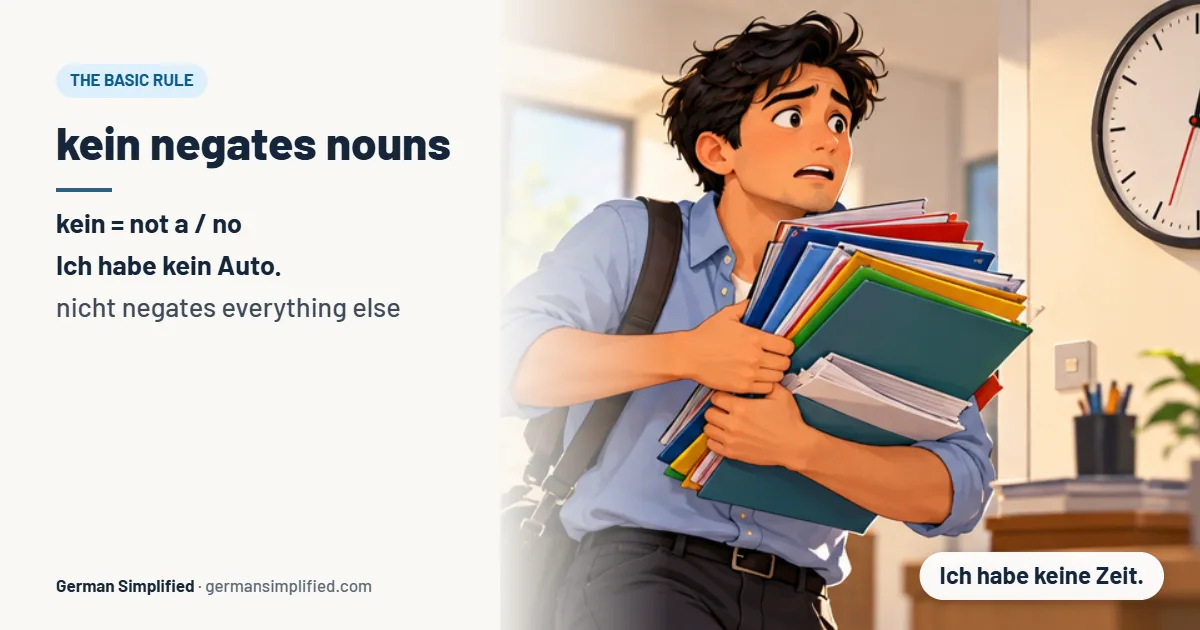
Ask one question: would the noun have “ein” or no article in the positive sentence? If yes, use kein. If no, use nicht.
| Positive | Negative | Why |
|---|---|---|
| Ich habe ein Fahrrad. | Ich habe kein Fahrrad. | noun with ein → kein |
| Ich trinke Kaffee. | Ich trinke keinen Kaffee. | noun with no article → kein |
| Wir haben Zeit. | Wir haben keine Zeit. | noun with no article → kein |
| Ich kenne den Mann. | Ich kenne den Mann nicht. | noun with der/die/das → nicht |
| Das ist mein Handy. | Das ist nicht mein Handy. | noun with a possessive → nicht |
| Ich arbeite. | Ich arbeite nicht. | verb → nicht |
| Das Essen ist gut. | Das Essen ist nicht gut. | adjective → nicht |
| Er wohnt in Berlin. | Er wohnt nicht in Berlin. | place → nicht |
Think of kein as “not a” or “no” fused into one word: kein Auto = not a car / no car. Because it’s an article, it sits right in front of the noun (and any adjective): Ich habe keine große Wohnung.
Jobs and nationalities: German doesn’t use ein before jobs (Ich bin Lehrer), so the negative is kein: Ich bin kein Lehrer. You’ll also hear Ich bin nicht Lehrer, but kein is the standard choice.
Using kein
Kein declines exactly like ein, but unlike ein it also has a plural form (keine):
| Case | Masculine | Feminine | Neuter | Plural |
|---|---|---|---|---|
| Nominative | kein | keine | kein | keine |
| Accusative | keinen | keine | kein | keine |
| Dative | keinem | keiner | keinem | keinen |
| Genitive | keines | keiner | keines | keiner |
The form learners need most is the accusative masculine keinen, because so many everyday nouns are objects: Ich habe keinen Hunger (I’m not hungry), keinen Hund, keinen Führerschein.
Ich habe keine Geschwister.I don’t have any siblings.
Heute gibt es keinen Unterricht.There’s no class today.
Er hat seit Tagen keinem Menschen geschrieben.He hasn’t written to anyone for days.
kein … mehr and nicht mehr
To say “no more” or “not any longer”, add mehr:
Wir haben keine Milch mehr.We don’t have any milk left.
Ich rauche nicht mehr.I don’t smoke anymore.
Fixed expressions with kein
Many common phrases use kein because the noun has no article: Ich habe keine Ahnung (I have no idea), Kein Problem! (No problem!), keine Lust haben (not to feel like it), auf keinen Fall (no way, under no circumstances).
Placement of nicht

Where nicht goes depends on what you’re negating. There are two kinds of negation.
Whole-sentence negation
When you negate the whole statement, nicht goes towards the end of the sentence: after the conjugated verb, subject, objects and time expressions, but before these elements:
- The second part of the verb: infinitive, participle or separable prefix. Ich kann heute nicht kommen. · Ich habe ihn nicht gesehen. · Der Bus fährt nicht ab.
- Adjectives and nouns after sein/werden/bleiben: Das ist nicht richtig. · Er ist nicht der Chef.
- Prepositional phrases of place or direction: Sie wohnt nicht in München. · Wir fahren nicht nach Hause.
- Adverbs of manner: Er fährt nicht schnell.
- Verbs with a fixed prepositional object: Ich warte nicht auf dich.
If none of these is present, nicht goes at the very end: Ich verstehe dich nicht. · Das Auto funktioniert heute nicht.
| Sentence | Rule |
|---|---|
| Ich komme morgen nicht. | nothing follows → end |
| Ich kann morgen nicht kommen. | before the infinitive |
| Ich habe das Buch nicht gelesen. | before the participle |
| Ich rufe dich heute nicht an. | before the separable prefix |
| Das Hotel ist nicht teuer. | before the adjective |
| Wir gehen nicht ins Kino. | before the direction |
Time words usually come before nicht
Specific time expressions like heute, morgen or am Montag normally stay before nicht: Ich arbeite heute nicht, not Ich arbeite nicht heute (unless you mean “not today, but another day”). Placing nicht before the time word creates partial negation.
Partial negation (and sondern)
To negate just one part of a sentence, put nicht directly before that part, and usually add the correction with sondern (but rather):
Ich fahre nicht heute, sondern morgen.I’m not going today, but tomorrow.
Nicht Anna hat angerufen, sondern ihre Schwester.It wasn’t Anna who called, it was her sister.
Das ist kein Hund, sondern eine Katze.That’s not a dog, it’s a cat.
Use sondern (not aber) after a negative when you’re replacing one thing with another.
Why your brain mixes up nicht and kein
English collapses both into “not” (not a car, not big), so your brain has learned to treat negation as one category. To split it into two, give each word a picture: kein is an empty box where a thing should be (kein Auto: the parking space is empty), nicht is a red line through an action or quality (nicht kommen, nicht gut). Visual anchors like these speed up the choice until it’s automatic.
doch: Answering Negative Questions
When someone asks a negative question and you want to contradict it, German doesn’t use ja. It uses doch:
| Question | You agree (it’s true that not…) | You disagree (it is the case) |
|---|---|---|
| Kommst du nicht mit? (Aren’t you coming?) | Nein, ich komme nicht mit. | Doch, ich komme mit! |
| Hast du keinen Hunger? (Aren’t you hungry?) | Nein, ich habe keinen Hunger. | Doch, ich habe Hunger! |
| Ist das nicht teuer? (Isn’t that expensive?) | Nein, das ist nicht teuer. | Doch, das ist sehr teuer. |
Doch is also used to contradict a negative statement: „Du magst keine Pizza.“ – „Doch!“ (“You don’t like pizza.” – “Yes, I do!”). For more ways to agree and disagree, see yes in German.
More Examples
Ich spreche nicht gut Französisch, aber ich spreche kein Spanisch.I don’t speak French well, and I don’t speak any Spanish.
Das ist nicht meine Tasche.That’s not my bag.
Es gibt hier keinen Supermarkt.There’s no supermarket here.
Wir haben den Film nicht gesehen.We haven’t seen the film.
Sie hat keine Zeit und keine Lust.She has no time and doesn’t feel like it.
Quiz
1. Ich habe ___ Bruder. (no brother)
keinen (der Bruder, accusative)
2. Ich verstehe die Frage ___.
nicht (noun with die → nicht at the end)
3. Das ist ___ gute Idee.
keine (eine gute Idee → keine gute Idee)
4. Put nicht in: “Ich habe die E-Mail gelesen.”
Ich habe die E-Mail nicht gelesen.
5. “Hast du kein Geld?” – You do have money. Answer:
Doch, ich habe Geld.
6. Er ist ___ Arzt, ___ Krankenpfleger.
kein … sondern
FAQs
What is the difference between nicht and kein?
Kein negates nouns that would have ein or no article (kein Auto, keine Zeit). Nicht negates everything else: verbs, adjectives, adverbs and nouns with der/die/das or a possessive.
Where do you place nicht in a German sentence?
For whole-sentence negation, near the end, but before the infinitive or participle, separable prefix, predicate adjective, and place or direction phrases. For partial negation, directly before the word you negate.
Can you put nicht before a noun?
Yes, in partial negation or when the noun has a definite article or possessive: nicht der Bus, sondern der Zug; nicht mein Auto.
Is it kein or keinen?
Keinen is the masculine accusative: Ich habe keinen Hund. Kein is used for masculine nominative and neuter nominative/accusative.
How do you say “no more” in German?
kein … mehr with nouns (keine Zeit mehr) and nicht mehr with verbs and adjectives (Ich arbeite nicht mehr).
Conclusion
Negation in German comes down to one test: if the noun would take ein or no article, use kein (with ein-endings, including plural keine); otherwise use nicht. Put nicht near the end of the sentence for full negation, but before infinitives, participles, prefixes, adjectives and places; put it directly before a word to negate just that word, then correct with sondern. And when you contradict a negative question, say doch. Next, review how the endings of kein work across all four German cases.
Sources and further reading: Duden, DWDS: nicht, DWDS: kein.
Keep learning → German cases explained: nominative, accusative, dative, genitive