A1 Pronunciation
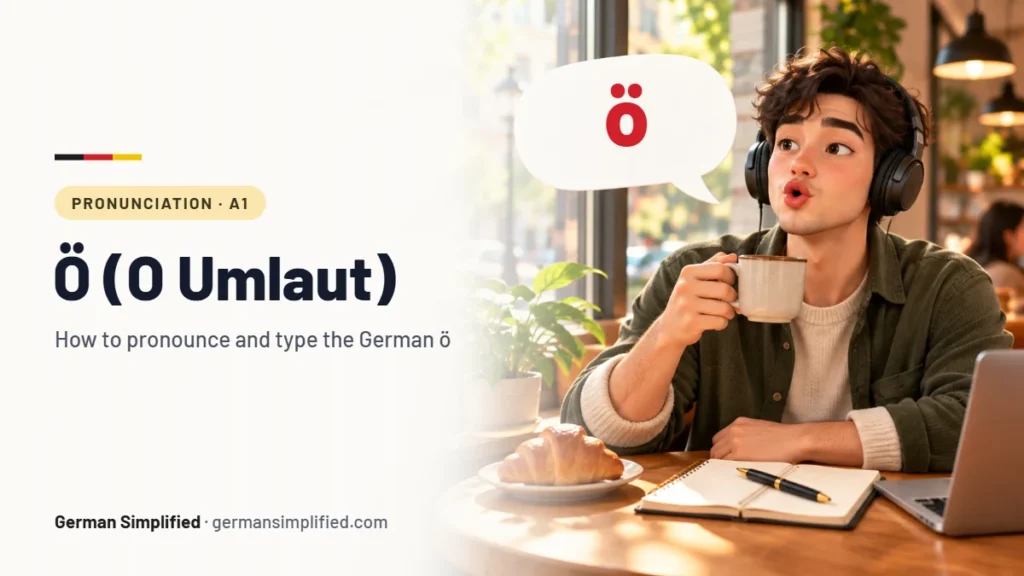
The o umlaut, written ö, is the sound that makes English speakers pause. It appears in some of the most common German words, from schön (beautiful) to können (can) and hören (to hear), and getting it wrong can change the meaning: schon means “already”, schön means “beautiful”. Still, ö is built from two sounds you can already make. This guide shows you the simple lip trick for both long and short ö pronunciation, gives you a word list to practise, and explains how to type ö on any keyboard.
Quick answer
To pronounce ö, say the vowel in English say (for long ö) or bed (for short ö), then round your lips as if for “oo” while keeping your tongue still. Long ö is in schön and hören; short ö is in können and zwölf. To type ö, use Alt+0246 on Windows, Option+u then o on a Mac, or long-press o on a phone. If you can’t type it, write oe.
This lesson is part of our German alphabet and pronunciation guide. For the other umlauts, see the German ä and the German ü.
What Is ö?
Ö is the letter o with an umlaut (two dots), which tells you the vowel is pronounced further forward in the mouth than a plain o. Like ä and ü, it started life as a small e written above the letter, so the official substitute is still oe. That’s why the poet Johann Wolfgang von Goethe writes his name with oe: it’s simply an older spelling of the ö sound.
The umlaut often signals a grammatical change, especially in plurals and comparisons:
| Without umlaut | With ö | What changed |
|---|---|---|
| die Tochter (daughter) | die Töchter (daughters) | plural |
| das Wort (word) | die Wörter (words) | plural |
| groß (big) | größer (bigger) | comparative |
| ich konnte (I could, past) | ich könnte (I could, would be able) | Konjunktiv II |
| schon (already) | schön (beautiful) | a different word |
How to Pronounce ö

There is no ö in standard American English, but the sound sits between two vowels you already know. The secret is that your tongue makes one vowel while your lips make another.
Long ö
Long ö [øː] is in schön, hören, Öl (oil) and böse (angry, evil).
- Say a long German e, like the English ay in say but without the glide at the end: “eeeh”.
- Keep your tongue exactly where it is.
- Now round your lips tightly, as if you were about to whistle or say “oo”.
- The sound that comes out is long ö.
Short ö
Short ö [œ] is in können, zwölf (twelve), öffnen (to open) and Köln (Cologne).
- Say the short e in English bed.
- Hold the tongue still and round your lips, a little more loosely than for long ö.
- Keep it short and crisp.
British English shortcut: If you speak British English (or listen to it), the vowel in bird or her, said without the r, is very close to German short ö. Round your lips a bit more and you’re there.
Mouth position
- Tongue: high and forward, as for “e”. The tip rests behind your bottom teeth.
- Lips: rounded and pushed slightly forward, as for “o” or “oo”.
- Jaw: a little more closed for long ö, a little more open for short ö.
Use a mirror. If your lips are spread in a smile, you’re saying e. If your tongue pulls back, you’re saying o. You need the front tongue with the round lips at the same time.
Don’t swap ö for “o” or “e”
English speakers often say schön as “shown” or “shane”. Both change the word: schon (already) and something that isn’t German at all. Practise the pairs below until you can feel the difference in your lips.
Minimal pairs to practise
| o | ö | e |
|---|---|---|
| schon (already) | schön (beautiful) | — |
| Ofen (oven) | Öfen (ovens) | — |
| konnte (could, past) | könnte (could, would) | kennte (would know) |
| Tochter (daughter) | Töchter (daughters) | — |
| lesen (to read) | lösen (to solve) | — |
The last row compares e and ö: lesen and lösen differ only in lip rounding.
Why the mirror works
Learning a new speech sound means building a new motor habit, and the brain learns motor habits faster with visual feedback. Watching your lips in a mirror gives your brain a second channel of information besides sound. A few minutes a day of “mirror drills” with the minimal pairs above is far more effective than an hour of passive listening.
Common Words With ö
| German | English | Long or short |
|---|---|---|
| schön | beautiful | long |
| hören | to hear, to listen | long |
| das Öl | oil | long |
| böse | angry, evil | long |
| die Möbel | furniture | long |
| Österreich | Austria | long |
| können | can, to be able to | short |
| zwölf | twelve | short |
| öffnen | to open | short |
| der Löffel | spoon | short |
| Köln | Cologne | short |
| möchten | would like | short |
Das ist ein schönes Lied.That’s a beautiful song.
Ich möchte zwölf Brötchen, bitte.I’d like twelve bread rolls, please.
Können Sie bitte das Fenster öffnen?Could you open the window, please?
How to Type ö
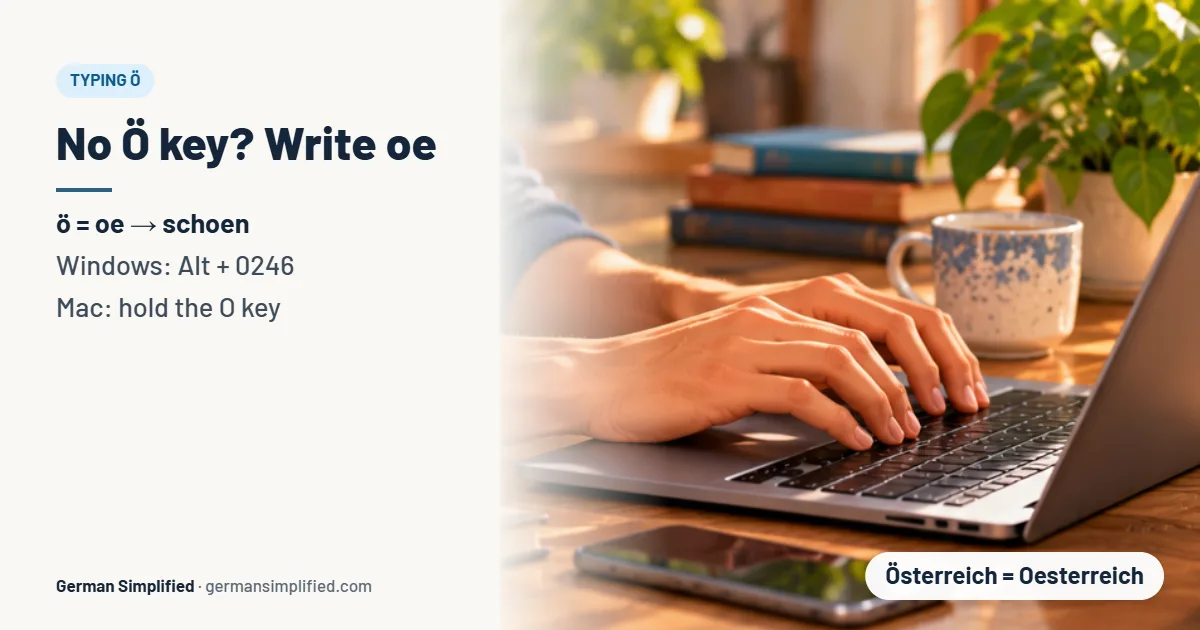
Windows
- ö: hold Alt and type 0246 on the number pad
- Ö: hold Alt and type 0214
- Or add the German (QWERTZ) or United States-International keyboard in Settings › Time & language › Language. With US-International, type ” then o.
Mac
- Press Option+u, release, then press o for ö (or Shift+o for Ö).
- Or press and hold the o key and choose ö from the menu.
Phone (iPhone and Android)
Press and hold the o key until a menu appears, then slide to ö. Adding a German keyboard gives you German autocorrect as well.
For web and code
In HTML, write ö (ö) or Ö (Ö). The Unicode code points are U+00F6 and U+00D6.
Writing “oe” Instead of ö
When umlauts aren’t available, Germans write oe: schoen, hoeren, Koeln. This is the official fallback and is common in web addresses, email addresses and passports. Avoid dropping the dots entirely, because schon and schön are different words. Note that some names, like Goethe or Hoeneß, are always spelled with oe even though they’re pronounced with an ö sound.
Quick Quiz
1. What do you do with your lips for ö?
Round them, as if saying “oo”, while your tongue stays in the “e” position.
2. Is the ö in “zwölf” long or short?
Short. It’s followed by two consonants.
3. What’s the difference between “schon” and “schön”?
schon means “already”; schön means “beautiful”.
4. What is the plural of “das Wort” (in the sense of individual words)?
die Wörter
5. How do you write “Köln” without an umlaut?
Koeln
FAQs
How do you pronounce ö in German?
Say “e” (as in say or bed) and round your lips as for “oo” without moving your tongue. Long ö is in schön; short ö is in können.
What is the IPA for ö?
Long ö is [øː] and short ö is [œ].
Is there an English sound like ö?
Not exactly. The closest is the vowel in British English bird or her, said without the r, which is near short ö.
What is the alt code for ö?
Alt+0246 for ö and Alt+0214 for Ö on the Windows number pad.
Can I write oe instead of ö?
Yes. oe is the standard replacement whenever ö can’t be typed, for example in URLs and email addresses.
Conclusion
The German ö is an “e” with round lips: tongue forward, lips forward, and you’ve got it. Practise with a mirror and the minimal pairs schon/schön and lesen/lösen, set up one typing shortcut, and use oe when you’re stuck. Next, compare it with the German ü, which uses the same trick starting from “ee”, and the open sound of the German ä.
Sources and further reading: DWDS dictionary (pronunciation and audio), Duden and the Unicode Latin-1 Supplement chart.
Keep learning → German pronunciation mistakes English speakers make