
A1 Pronunciation
Most German pronunciation mistakes English speakers make come from a short, predictable list of sounds. Unlike English, German is almost perfectly phonetic. Once you know how a letter or letter combination sounds, you can read nearly any word aloud correctly, even one you’ve never seen. The trouble comes from a handful of sounds that don’t exist in English, plus a few letters that look familiar but sound different. Below are those mistakes and how to fix them: vowel length, umlauts, the famous ch and r, the “w” that sounds like “v”, the ei/ie trap, word stress and quick drills to fix each one. Click any word to hear it.
Quick answer
To pronounce German correctly, focus on six things: (1) long vs short vowels, (2) the umlauts ä, ö, ü, (3) the two ch sounds (soft in ich, throaty in Bach), (4) the uvular r, (5) letters that differ from English: w = v, v = f, z = ts, j = y, and (6) ei = “eye” but ie = “ee”. Most German words are stressed on the first syllable.
For the full overview of every German sound, see our complete German pronunciation guide; this article focuses on the mistakes. If you haven’t learned the letter names yet, start with the German alphabet.
Vowels: Long vs Short

Every German vowel has a long and a short version, and the difference can change the meaning: Staat (state) vs Stadt (city), bieten (to offer) vs bitten (to ask). English speakers tend to make every vowel medium length, which blurs these pairs.
The spelling tells you which one to use:
- Long when the vowel is doubled (Boot, Tee), followed by h (Bahn, Sohn), written ie (Liebe), or followed by a single consonant (Tag, gut).
- Short when followed by a double consonant (Mann, Bett, kommen) or usually by two different consonants (Hand, Wurst).
| Vowel | Long | Short |
|---|---|---|
| a | Bahn (like “father”) | Bann (like “but”, but more open) |
| e | Tee (like “say” without the glide) | Bett (like “bet”) |
| i | Miete (like “meet”) | Mitte (like “mitt”) |
| o | Sohn (like “so” without the glide) | Sonne (like British “sorry”) |
| u | Mus (like “moose”) | muss (like “put”) |
Don’t glide your long vowels
English long vowels slide: “go” is really “go-oo”, “say” is “sa-ee”. German long vowels stay pure from start to finish. Hold Boot or Tee steady, as if singing one note, and you’ll instantly sound less foreign.
The unstressed -e
A final -e is never silent in German: Name is NAH-muh, bitte is BIT-tuh. It’s a short, relaxed “uh” sound (the schwa). The ending -er sounds like a soft “uh” too: Vater is FAH-tuh, Lehrer is LAY-ruh.
Umlaut Sounds
The three umlauts are the vowels most learners struggle with, but each has a simple recipe:
| Umlaut | Recipe | Example |
|---|---|---|
| ä | like “e” in bed (short) or held longer (long) | Mädchen, Männer |
| ö | say “e”, then round your lips | schön, können |
| ü | say “ee”, then round your lips | über, Glück |
The key for ö and ü is that your tongue stays where it is while your lips round. Each umlaut has its own detailed guide: ä (a umlaut), ö (o umlaut) and ü (u umlaut).
The Tricky Consonants
ch
German ch has two sounds, and which one you use depends on the vowel before it:
- The “ich” sound [ç] after e, i, ä, ö, ü, ei, eu, after consonants and in -chen: ich, nicht, Mädchen, Milch. Make it by saying the “h” in huge and pushing more air through, with your tongue close to the roof of your mouth. It is not “sh” and not “k”.
- The “ach” sound [x] after a, o, u, au: Bach, Buch, noch, auch. It’s a soft scraping at the back of the throat, like Scottish loch.
At the start of some loanwords, ch sounds like “k” (Chor, Charakter) or “sh” (Chef, Chance).
Practice trick: Whisper “yes” with the “y” held for a long time: “yyyyyes”. That breathy y is very close to the German ich sound. Now say ich with it.
r
Standard German uses a uvular r [ʁ]: a soft, slightly rough sound made at the back of the mouth, where you gargle. It’s close to the French r. A rolled tongue-tip r is also correct in southern Germany, Austria and Switzerland, so don’t worry if that’s easier.
Two rules make it easier:
- At the start of a syllable, pronounce the r: rot, Reise, Frau.
- After a vowel at the end of a syllable, the r softens into a vowel-like “uh”: der (dair-uh), hier (hee-uh), Bier, Wasser (VASS-uh).
z
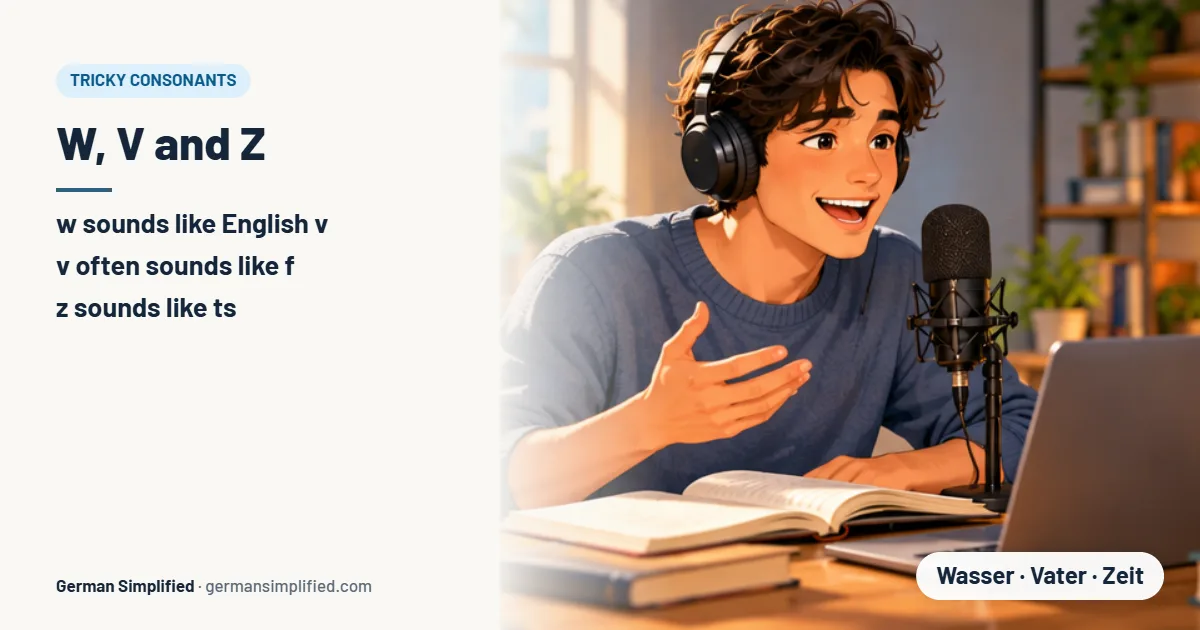
German z is always “ts”, as in English cats: Zeit (tsite), zehn (tsayn), Zug, Pizza. Never pronounce it like an English buzzing z. The combination tz sounds the same: Katze, jetzt.
w and v
These two cause the most “accent” mistakes:
- w sounds like English v: Wasser (VAH-ssuh), wie (vee), Wein (vine).
- v usually sounds like English f: Vater (FAH-tuh), viel (feel), vier. In many loanwords, it’s a “v”: Vase, Klavier, Universität.
s, j and final consonants
- s before a vowel sounds like English z: Sonne (ZON-nuh), Sie. At the end of a word, or as ss/ß, it’s a sharp s: das, Wasser, Straße. See the German ß.
- j sounds like English y: ja, Jahr, jung.
- Final devoicing: b, d, g at the end of a word or syllable sound like p, t, k: Hund (hunt), gelb (gelp), Tag (tahk). The ending -ig sounds like the ich sound: König, wichtig.
Letter Combinations
ei vs ie
The classic beginner mix-up. The rule: say the second letter’s English name.
- ei = “eye” (the name of the letter i): Wein (wine), drei, mein, Zeit.
- ie = “ee” (the name of the letter e): Liebe, vier, Bier, sie.
Meine Freundin Sabine trinkt viel Wein.My friend Sabine drinks a lot of wine.
eu and äu
Both sound like “oy” in boy: neu, heute, Deutsch, Häuser, Bäume. And au sounds like “ow” in how: Haus, Frau.
sch, sp, st
- sch = English “sh”: Schule, schön, Fisch.
- sp and st at the start of a word or word part sound like “shp” and “sht”: sprechen (SHPRE-chen), Stadt (shtat), Straße, verstehen (fer-SHTAY-en).
- In the middle or at the end of a word, they’re normal: Fenster, ist, Wespe.
Other combinations
| Spelling | Sounds like | Example |
|---|---|---|
| pf | “p” + “f” together | Apfel, Pferd |
| qu | “kv” | Quatsch, Qualität |
| th | “t” | Theater, Thema |
| ph | “f” | Physik, Philosophie |
| chs | “ks” | sechs, wachsen |
| ng | as in singer (no hard g) | Finger, lang |
Word Stress
Most native German words are stressed on the first syllable: AR-bei-ten, SPRE-chen, FREUN-din. Three exceptions cover nearly everything else:
- Inseparable prefixes are never stressed: be-, ge-, er-, ver-, zer-, ent-, emp-. So be-SU-chen, ver-STE-hen, ge-MACHT.
- Separable prefixes are always stressed: AN-ru-fen, AUF-ste-hen, MIT-kom-men.
- Loanwords often stress the last syllable, especially with endings like -ieren, -tion, -ie, -ei, -tät: stu-DIE-ren, Na-TION, Fa-mi-LIE, Bä-cke-REI, U-ni-ver-si-TÄT.
Getting stress right makes you easier to understand than getting every vowel perfect.
Why your accent sticks (and how to unstick it)
After childhood, the brain tends to “hear” foreign sounds through the filter of your native language, so ü and u can seem identical at first. The fix is contrast training: listening to and repeating minimal pairs (Mus/muss, Mitte/Miete, Bach/Bäche) until your ear separates them. Short daily sessions work better than long ones, because sleep consolidates what you practised.
Practice Drills to Fix These Mistakes
Say each line aloud three times, slowly, then at normal speed. Record yourself and compare with a dictionary audio such as DWDS.
- Vowel length: Staat – Stadt · bieten – bitten · Ofen – offen · Mus – muss
- Umlauts: schon – schön · Mutter – Mütter · Apfel – Äpfel
- ich vs ach: ich – ach · Licht – lacht · Bücher – Buch · dich – doch
- r: rot · Rose · Frau · Brot · hier · Lehrer
- w, v, z: Wein – vier – Zeit · Wasser – Vater – zehn
- ei vs ie: Wein – Wien · mein – Miene · leider – Lieder
- sp/st: Sport · Stadt · Straße · verstehen · Frühstück
Zwei zahme Ziegen ziehen zehn Zentner Zucker zum Zoo.Two tame goats pull ten hundredweight of sugar to the zoo. (a classic z tongue twister)
Fischers Fritz fischt frische Fische.Fisher’s Fritz fishes fresh fish. (sch and f)
FAQs
What are the most common German pronunciation mistakes?
Gliding long vowels, saying w like English w, z like English z, mixing up ei and ie, using one sound for both ch sounds, and stressing the wrong syllable.
Is German pronunciation hard?
Less than English. German is spelled very consistently, so once you learn the rules you can read almost any word aloud. The new sounds (ü, ö, ch, r) take a few weeks of practice.
How do you pronounce the German ch?
After e, i, ä, ö, ü and consonants it’s a soft, breathy sound like a strong “h” in huge (ich). After a, o, u and au it’s a throaty sound like Scottish loch (Bach).
How do you pronounce the German r?
Standard German uses a soft r at the back of the throat, similar to French. After a vowel at the end of a syllable, it softens into an “uh” (der, hier).
Why does German w sound like v?
The letter w represents the [v] sound in German, so Wasser sounds like “vasser”. The letter v usually sounds like f (Vater).
What’s the difference between ei and ie?
ei sounds like “eye” (Wein), ie sounds like “ee” (Wien). Say the English name of the second letter.
Is there a German dictionary for pronunciation?
Yes. The free DWDS and Duden websites include pronunciation and audio for most words, and Forvo has recordings by native speakers.
Conclusion
Most German pronunciation mistakes disappear with a little focused practice: keep long vowels pure, round your lips for ö and ü, learn the two ch sounds, soften the r after vowels, remember w = v, v = f, z = ts, and say the second letter in ei and ie. Add first-syllable stress and you’ll be understood almost everywhere. Next, master each umlaut in depth, starting with the German ä.
Sources and further reading: DWDS (audio pronunciations), Duden and the Goethe-Institut.
Keep learning → German greetings: how to say hello, goodbye and more