
A2–B2 Words Explained
Spend ten minutes listening to Germans talk and you’ll hear genau again and again: in meetings, on podcasts, in cafés, sometimes three times in one sentence. Textbooks translate it as “exactly”, which is right, but that doesn’t explain why it’s everywhere. In this guide you’ll learn what genau means in each of its four main uses, how it differs from richtig and stimmt, the phrases built on it (genauso, genau genommen), and the mistakes learners make with it. There’s a short quiz at the end.
Quick answer
Genau means “exactly” or “precisely”. As an adjective or adverb it describes accuracy: genau um acht Uhr (at exactly eight o’clock). On its own, Genau! means “Exactly!” or “That’s right!” and is one of the most common ways Germans agree with someone. Example: „Du kommst aus Indien?“ – „Genau.“ (“You’re from India?” – “That’s right.”)
This word is part of our series German words explained, covering the everyday words that textbooks skip.
What Does “genau” Mean? (Quick Answer)
The core meaning of genau is exact, precise, accurate. Everything else grows from that idea. When you say Genau! to someone, you’re literally telling them, “What you said is precise.” Pronounce it guh-NOW, with the stress on the second syllable.
The Main Uses of genau
Exactly / precisely
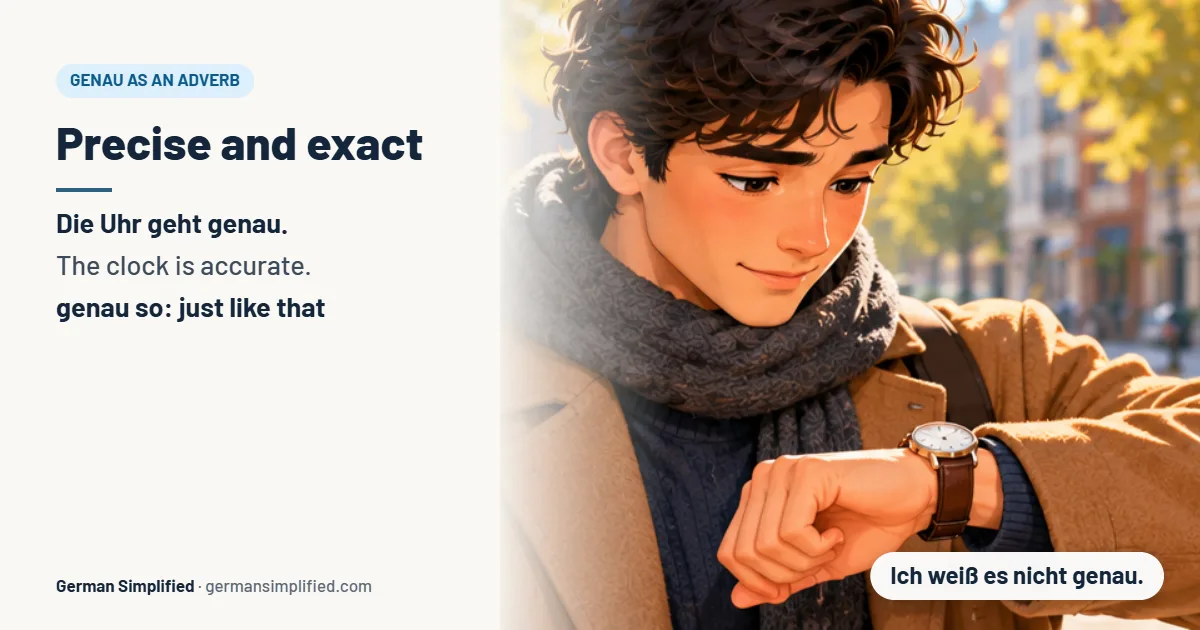
As an adjective or adverb, genau describes precision in time, amount or detail:
Der Zug kommt genau um 9:15 Uhr.The train arrives at exactly 9:15.
Weißt du die genaue Adresse?Do you know the exact address?
Hör mir genau zu!Listen to me carefully!
Das weiß ich nicht genau.I don’t know exactly.
As an adjective before a noun, it takes normal endings: die genaue Zeit, ein genauer Plan, genaue Informationen. For a person, genau means meticulous: Meine Chefin ist sehr genau (My boss is very precise).
Agreement in conversation
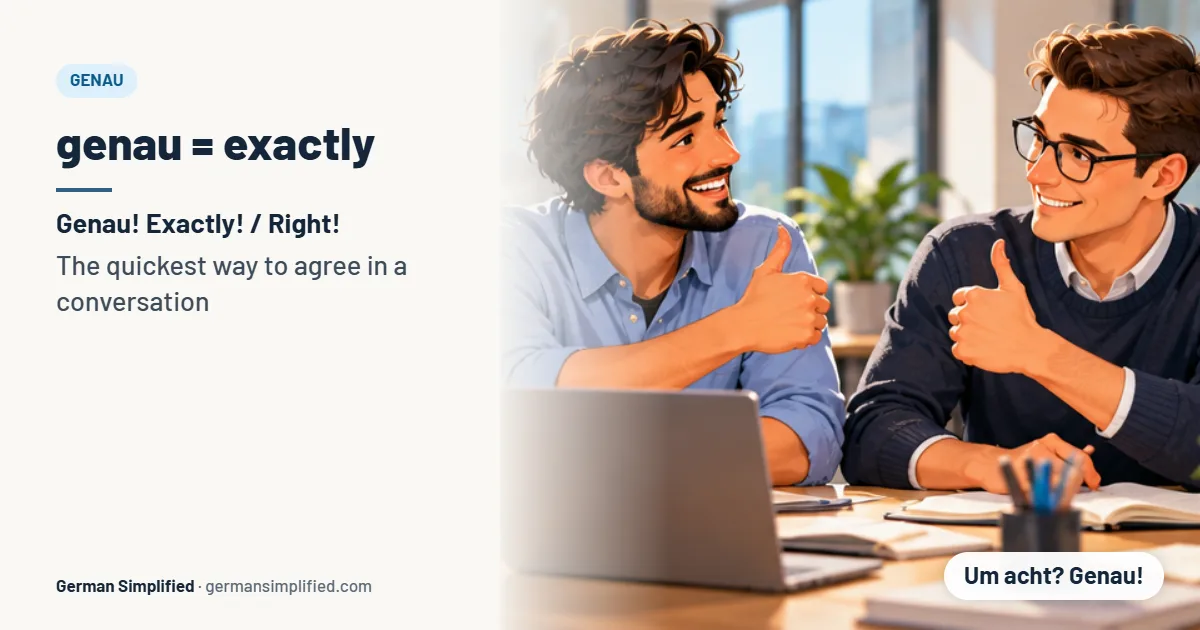
This is the use you’ll hear most. Genau on its own confirms what someone just said: “Exactly”, “Right”, “That’s it”.
„Wir treffen uns also am Freitag?“ – „Genau.““So we’re meeting on Friday?” – “Right.”
„Das heißt, ich muss das Formular unterschreiben?“ – „Ganz genau.““So I have to sign the form?” – “Exactly.”
Germans also use genau as a filler word to keep a conversation flowing or to signal “I’m moving on”: Genau, und dann sind wir nach Hause gefahren. (Right, and then we drove home.) Some speakers use it every few sentences, the way English speakers use “so” or “right”.
Sound more natural: When someone checks that they’ve understood you correctly, answer with Genau rather than Ja. Ja just means yes; Genau means “yes, you’ve got it exactly right”, which is usually what you want to say. For more ways to agree, see yes in German.
Genau vs richtig vs stimmt
All three can mean “that’s right”, but they’re not identical.
| Word | Literal meaning | Best used when… | Example |
|---|---|---|---|
| Genau. | Exactly. | confirming someone has understood you correctly | „Du bist Lehrerin?“ – „Genau.“ |
| Richtig. | Correct. | confirming a fact or an answer, often in teaching | „Ist Berlin die Hauptstadt?“ – „Richtig.“ |
| Stimmt. | (That) is true. | agreeing with an opinion or remembering something | „Das Café ist teuer.“ – „Stimmt.“ |
| Eben. | Precisely (that’s my point). | agreeing that something supports what you’ve been saying | „Es regnet.“ – „Eben, wir bleiben zu Hause.“ |
| Exakt. | Exactly. | the same as genau, a bit more emphatic or formal | „Also 50 Euro?“ – „Exakt.“ |
A useful rule: genau reacts to what you understood, stimmt reacts to what’s true, and richtig reacts to what’s correct. In everyday conversation, they often overlap, and native speakers mix them freely.
Genauso
Genauso means “just as”, “exactly the same way”:
Ich sehe das genauso.I see it exactly the same way.
Sie ist genauso groß wie ihr Bruder.She’s just as tall as her brother.
Mach es genauso wie gestern.Do it exactly like yesterday.
Don’t confuse genauso with gleich (the same, identical): Wir haben das gleiche Auto means we have the same model; Wir fahren genauso schnell means we drive just as fast.
Other useful phrases with genau
| Phrase | Meaning |
|---|---|
| ganz genau | exactly, absolutely right |
| genau genommen | strictly speaking |
| es (nicht so) genau nehmen | (not) to be strict or fussy about something |
| genau das | that’s exactly it, exactly that |
| nicht genau | not exactly, not quite |
| die Genauigkeit | accuracy, precision |
Genau genommen ist eine Tomate eine Frucht.Strictly speaking, a tomato is a fruit.
Mit der Pünktlichkeit nimmt er es nicht so genau.He’s not too fussy about punctuality.
Why Germans say genau so often
Linguists call words like genau “discourse markers”: small words that manage the flow of a conversation. Saying genau tells the other person “we’re in sync, keep going.” Listeners rely on these small signals to feel understood, which is why a well-timed genau makes you sound warm and fluent. Try copying it from podcasts: listen for where speakers put it, then use it in the same spots.
genau in Example Sentences
Was genau meinst du?What exactly do you mean?
Das ist genau das, was ich brauche.That’s exactly what I need.
Ich kann mich nicht genau erinnern.I can’t remember exactly.
„Also links und dann geradeaus?“ – „Genau!““So left and then straight ahead?” – “Exactly!”
Wir müssen die Regeln genau lesen.We need to read the rules carefully.
Common Mistakes
- Using genau to answer open questions. Genau confirms; it doesn’t answer. If someone asks Wo wohnst du?, “Genau” makes no sense. Answer the question instead.
- Agreeing with a negative statement. If someone says Du kommst heute nicht, oder? (You’re not coming today, right?) and you’re not coming, Genau works. If you are coming, you need Doch!
- Overusing it in writing. In emails and essays, genau as a filler looks informal. Use richtig, zutreffend or rephrase.
- Mixing up genauso and gleich. Genauso compares how something is done; gleich means identical (and also “right away”).
- Wrong stress. It’s ge-NAU, not GE-nau.
Quiz
1. Translate: “The film starts at exactly 8 o’clock.”
Der Film beginnt genau um acht Uhr.
2. „Du bist also Studentin?“ – Confirm it in one word.
Genau.
3. Which word fits best to agree with an opinion: „Das Wetter ist heute toll.“ – „___.“
Stimmt. (Genau is also possible in casual speech.)
4. Complete: „Ich denke ___ wie du.“ (just the same as)
genauso
5. What does “genau genommen” mean?
Strictly speaking
FAQs
What does genau mean in English?
Exactly, precisely or accurately. On its own, Genau! means “Exactly!” or “That’s right!”
Why do Germans say genau so much?
It works as a conversation signal meaning “you’ve understood me” or “right, moving on”, similar to how English speakers use “right” or “so”.
Is genau formal or informal?
Both. As “exact/precise” it’s neutral and fine in any text. As a one-word reply or filler it’s conversational.
What’s the difference between genau and stimmt?
Genau confirms that someone understood you correctly; stimmt agrees that a statement is true. In casual speech they often overlap.
What does genauso mean?
Just as or exactly the same way, as in Sie ist genauso alt wie ich (She’s just as old as I am).
Conclusion
Genau starts as a simple word for “exact” and becomes one of the most useful tools in spoken German: a one-word “That’s right!”, a friendly conversation signal and the root of genauso and genau genommen. Use it to confirm understanding, choose stimmt for agreeing with opinions, and keep it out of formal writing. Next, meet another word Germans use constantly in conversation: halt.
Sources and further reading: DWDS: genau and Duden: genau.
Keep learning → What does “halt” mean in German?