
A1–A2 Grammar
If German grammar has a reputation for being hard, the German cases are the reason. But the idea behind them is simple, and you already use it in English without noticing: you say he sees him, not him sees he. German just applies the same idea to articles, so der becomes den, dem or des depending on a word’s job in the sentence. This guide explains the four cases (nominative, accusative, dative and genitive), shows when to use each with clear examples, gives you a master chart, and teaches a three-question method to identify the case in any sentence.
Quick answer
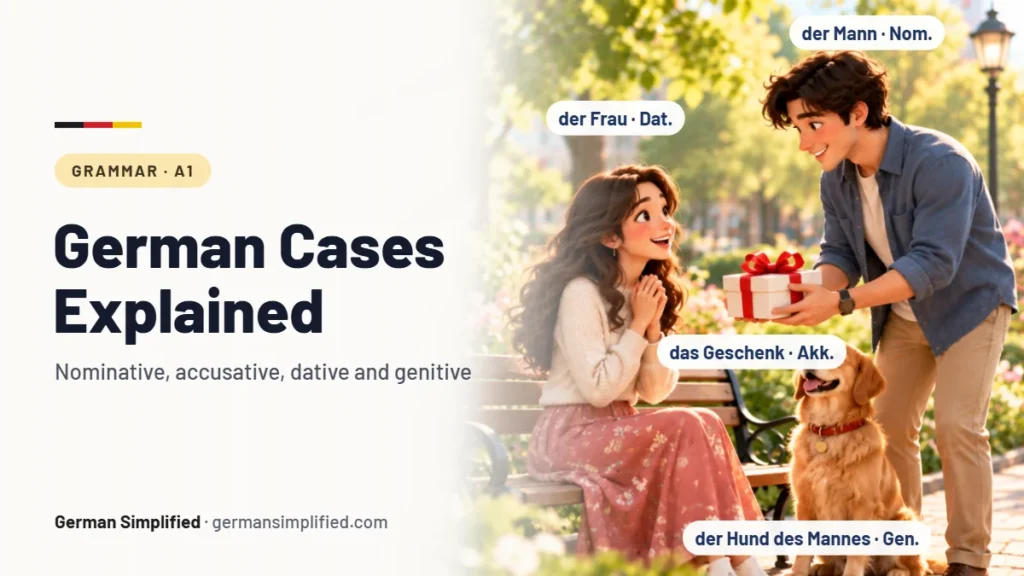
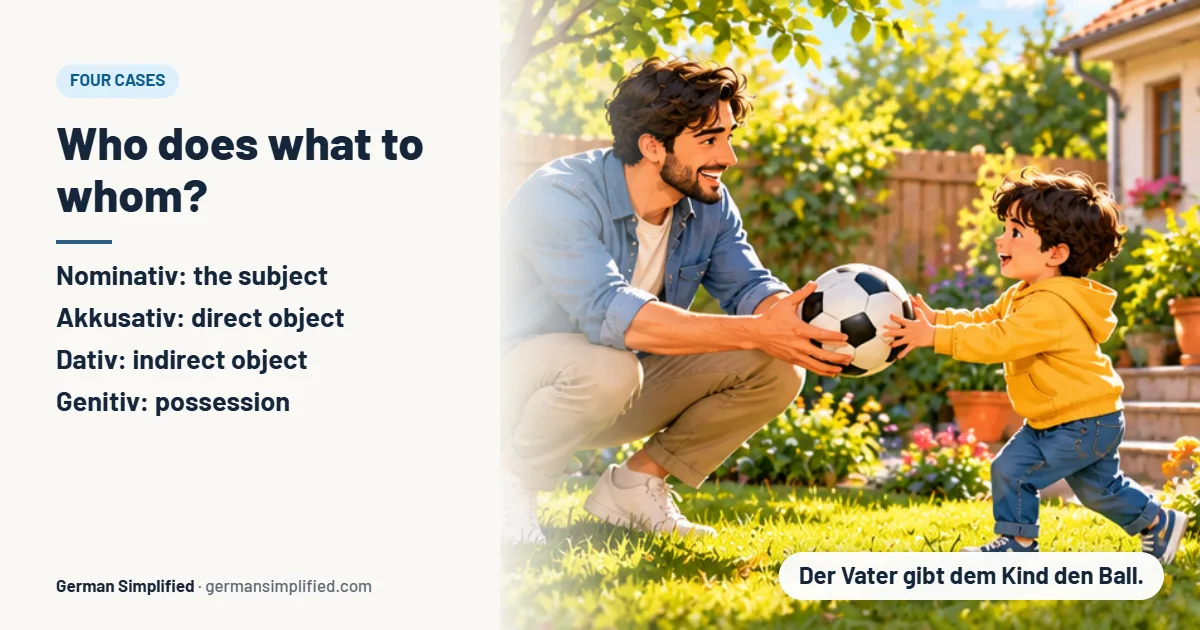
German has four cases, and each one shows a noun’s job in the sentence. Nominative = the subject (who does it: Der Mann schläft). Accusative = the direct object (what or whom it’s done to: Ich sehe den Mann). Dative = the indirect object (to or for whom: Ich gebe dem Mann das Buch). Genitive = possession (whose: das Auto des Mannes). Prepositions and some verbs also decide the case.
This lesson is part of our complete German grammar guide. You’ll get the most out of it if you already know that nouns have a gender; if not, read der, die, das first.
What Is a Case?
A case is a form of a word that shows its role in a sentence. English has almost lost its cases; only pronouns still show them: I/me, he/him, she/her, who/whom, and the possessive ‘s. That’s why English relies on word order: “The dog bites the man” and “The man bites the dog” mean different things only because of the order.
German marks the role on the article (and on pronouns and adjectives), so word order can change without changing the meaning:
Der Hund beißt den Mann.The dog bites the man.
Den Mann beißt der Hund.The dog bites the man. (emphasis on “the man”)
Both sentences mean the dog is biting. Der Hund is nominative (subject), den Mann is accusative (object). The articles tell you who’s doing what, wherever they stand.
Why cases feel hard (and how memory works)
English speakers have no “slot” in their brain for marking roles on articles, so every dem or den requires a conscious decision at first. That’s normal. Over time you stop calculating, because you’ve heard so many correct phrases (mit dem Bus, für meinen Bruder) that the right form starts to sound right. Chunks like these become automatic much sooner than rows in a table.
Nominative
The nominative (der Nominativ) is the case of the subject: the person or thing doing the action. It’s the “dictionary form” of a noun. Question: Wer? (Who?) or Was? (What?)
Der Lehrer erklärt die Grammatik.The teacher explains the grammar. (Wer erklärt? – Der Lehrer.)
Die Sonne scheint.The sun is shining.
The nominative is also used after sein (to be), werden (to become) and bleiben (to stay), because the noun after them describes the subject: Das ist der neue Kollege (That is the new colleague).
Accusative
The accusative (der Akkusativ) marks the direct object: the person or thing that receives the action directly. Question: Wen? (Whom?) or Was? (What?)
Ich kaufe einen Kaffee.I’m buying a coffee. (Was kaufe ich? – Einen Kaffee.)
Wir besuchen den Großvater.We’re visiting the grandfather.
Only masculine articles change in the accusative (der → den, ein → einen). Feminine, neuter and plural look exactly like the nominative.
The accusative is also used after the prepositions durch, für, gegen, ohne, um, after two-way prepositions showing movement (Ich gehe in den Park) and in many time expressions (jeden Tag, nächsten Monat). The full story is in the accusative case in German.
Dative
The dative (der Dativ) marks the indirect object: usually the person who receives something or benefits from the action. Question: Wem? (To/for whom?)
Ich gebe dem Kind ein Eis.I give the child an ice cream. (Wem gebe ich ein Eis? – Dem Kind.)
Sie schreibt ihrer Mutter eine Karte.She writes her mother a card.
In a sentence with two objects, the dative is often the person and the accusative is the thing: Ich zeige dem Freund (dative, person) das Foto (accusative, thing).
The dative also comes after:
- Dative prepositions: aus, außer, bei, mit, nach, seit, von, zu, gegenüber (mit dem Auto, zur Arbeit).
- Two-way prepositions showing location: Ich bin im Park.
- Dative verbs, where the only object is dative: helfen (to help), danken (to thank), gefallen (to please), gehören (to belong to), antworten (to answer).
Kannst du mir helfen?Can you help me?
Das Buch gehört meinem Bruder.The book belongs to my brother.
Genitive
The genitive (der Genitiv) shows possession or belonging, like English ‘s or “of”. Question: Wessen? (Whose?)
Das ist das Auto des Lehrers.That’s the teacher’s car.
Die Farbe der Tür ist rot.The color of the door is red.
Masculine and neuter nouns add -s or -es in the genitive: des Lehrers, des Kindes. With names, German just adds -s with no apostrophe: Annas Buch.
In everyday speech, Germans often replace the genitive with von + dative: das Auto von dem Lehrer → das Auto vom Lehrer. It’s perfectly normal in conversation; in writing and exams, the genitive is preferred. You’ll also see the genitive after prepositions like während, wegen, trotz and statt.
Learning order: At A1, focus on nominative and accusative. Add the dative at A1–A2, especially with prepositions. The genitive can wait until A2–B1; you’ll understand it long before you need to use it.
The Master Chart

Here’s how the articles and personal pronouns change across all four cases.
Articles
| Case | Question | Masculine | Feminine | Neuter | Plural |
|---|---|---|---|---|---|
| Nominative | Wer? Was? | der / ein | die / eine | das / ein | die / – |
| Accusative | Wen? Was? | den / einen | die / eine | das / ein | die / – |
| Dative | Wem? | dem / einem | der / einer | dem / einem | den / – (+n) |
| Genitive | Wessen? | des / eines (+s) | der / einer | des / eines (+s) | der / – |
For kein, mein and the other possessives, see the full German articles chart.
Personal pronouns
| Nominative | Accusative | Dative | English |
|---|---|---|---|
| ich | mich | mir | I / me / to me |
| du | dich | dir | you (informal) |
| er | ihn | ihm | he / him |
| sie | sie | ihr | she / her |
| es | es | ihm | it |
| wir | uns | uns | we / us |
| ihr | euch | euch | you all |
| sie / Sie | sie / Sie | ihnen / Ihnen | they / you (formal) |
For more on pronouns, see German personal pronouns in all cases.
Free: German Grammar Cheat Sheet
All the gender endings, the full article chart and the four cases on one printable page. Download the free PDF.
How to Identify the Case
Ask these three questions, in this order, for every noun or pronoun:
- Is there a preposition in front of it? If yes, the preposition decides: mit → dative, für → accusative, in → depends on movement or location. (See the full list of German prepositions.)
- Is it the subject? Find the verb and ask Wer? or Was? The answer is nominative.
- Is it an object? Ask Wen/Was? for the accusative and Wem? for the dative. If the verb is a dative verb (helfen, danken, gefallen), the object is dative.
And if a noun “belongs” to another noun (the end of the film), it’s genitive.
Let’s try it:
Am Wochenende schenkt mein Vater meiner Schwester einen Hund.At the weekend my father gives my sister a dog.
- am Wochenende: preposition an + time → dative.
- mein Vater: who gives? → nominative.
- meiner Schwester: to whom? → dative.
- einen Hund: what? → accusative.
Exercises
Name the case of the highlighted word, then check.
1. Der Hund schläft.
Nominative (the subject)
2. Ich sehe den Hund.
Accusative (direct object)
3. Ich gebe dem Hund Wasser.
Dative (indirect object: to whom?)
4. Der Ball des Hundes ist rot.
Genitive (whose ball?)
5. Ich gehe mit dem Hund spazieren.
Dative (after mit)
6. Das Geschenk ist für den Hund.
Accusative (after für)
7. Ich helfe meiner Freundin.
Dative (helfen takes the dative)
FAQs
How many cases are there in German?
Four: nominative, accusative, dative and genitive.
When do you use the accusative and dative in German?
The accusative marks the direct object (what or whom); the dative marks the indirect object (to or for whom). Prepositions and some verbs also require one or the other.
What is Akkusativ and Dativ in German?
Akkusativ is the accusative case (direct object, e.g. den Mann) and Dativ is the dative case (indirect object, e.g. dem Mann).
Is the genitive still used in German?
Yes, in writing and formal speech, and in fixed phrases. In casual speech, von + dative often replaces it.
Which case is the easiest to learn first?
Start with the nominative and accusative: only masculine articles change in the accusative (der → den, ein → einen).
Conclusion
The four German cases tell you who does what to whom: nominative for the subject, accusative for the direct object, dative for the indirect object and genitive for possession. Prepositions and certain verbs choose the case too. Use the three-question method, practise with real phrases, and keep the master chart close until the forms feel natural. Next, focus on the nominative and then the accusative, one case at a time.
Sources and further reading: Duden, DWDS and the Goethe-Institut grammar resources.
Keep learning → The accusative case in German: rules and examples