

A1–A2 Vocabulary
The months in German are a gift to English speakers: most of them look almost the same. The real challenges are elsewhere: pronouncing Juni, Juli and März properly, choosing between im, am and no preposition at all, and saying dates out loud. This lesson covers the twelve months with their article and pronunciation, the prepositions you need, how to say dates, the Austrian variations and a short quiz.
Quick answer
The months in German are Januar, Februar, März, April, Mai, Juni, Juli, August, September, Oktober, November, Dezember. All of them are masculine (der Januar) and are written with a capital letter. Use im for “in” a month (im Mai) and am with a date (am 3. Mai).
Tip: Tap each speaker button and repeat the month. Pay special attention to the stress, which isn’t always where English puts it.
The 12 Months
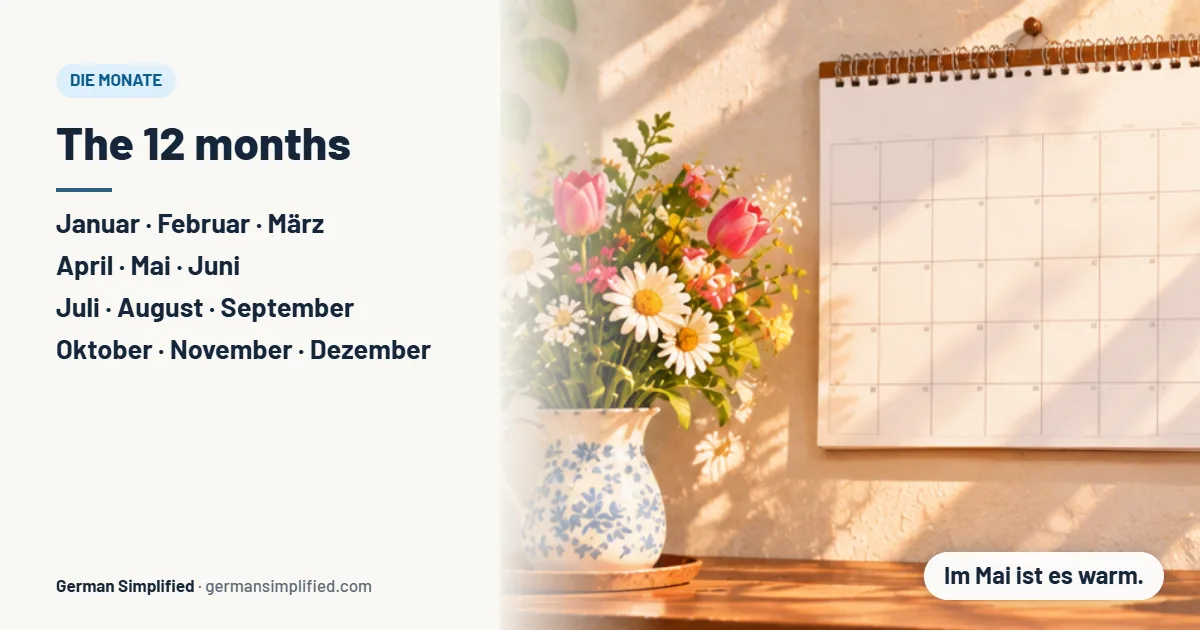
| English | German | Sounds like | Short form |
|---|---|---|---|
| January | der Januar | YAN-oo-ar | Jan. |
| February | der Februar | FAY-broo-ar | Feb. |
| March | der März | mairts | März |
| April | der April | ah-PRIL | Apr. |
| May | der Mai | my | Mai |
| June | der Juni | YOO-nee | Juni |
| July | der Juli | YOO-lee | Juli |
| August | der August | ow-GOOST | Aug. |
| September | der September | zep-TEM-ber | Sept. |
| October | der Oktober | ok-TOH-ber | Okt. |
| November | der November | no-VEM-ber | Nov. |
| December | der Dezember | day-TSEM-ber | Dez. |
Three spelling differences from English: März (with an umlaut), Oktober and Dezember (with k and z). Everything else is almost identical, minus the “-y” endings.
Pronunciation Tips
- J is a “y” sound. Januar, Juni, Juli start like “yes”.
- Stress the end of August. The month is au-GUST. If you stress the first syllable, it sounds like the first name August.
- März has the ä sound (like “e” in “bed”) and a z pronounced “ts”: “mairts”.
- S before a vowel is buzzed: September starts with a “z” sound.
- Ai = “eye”: Mai rhymes with “my”.
- -ber endings: the final -er is a soft “uh”, not a hard English “r”.
Juni or Juli? They sound so similar that many Germans say Juno for June and Julei for July on the phone or when giving dates, so they aren’t confused.
Learn them with a rhythm
Lists in a fixed order are easiest to remember when you attach them to rhythm or melody. That’s why children learn the alphabet with a song. Say the twelve months in German three times in a row, clapping on each one, and you’ll have the order locked in within a day. Then practise starting from a random month (Mai, Juni, Juli …) so you can access them out of order too.
im Januar: Prepositions With Months
Months always use der, so they follow the masculine pattern. These are the patterns you’ll use every day:
| Meaning | German | Example |
|---|---|---|
| in a month | im (= in dem) | Ich habe im Mai Geburtstag. (My birthday is in May.) |
| on a date | am (= an dem) | Wir fliegen am 3. Juli. (We fly on 3 July.) |
| from … to … | von … bis … | Der Kurs geht von Januar bis März. (The course runs from January to March.) |
| since | seit | Ich lerne seit Oktober Deutsch. (I have been learning German since October.) |
| from … on | ab | Ab September arbeite ich in Wien. (From September I am working in Vienna.) |
| until | bis | Das Angebot gilt bis Dezember. (The offer is valid until December.) |
| beginning / middle / end of | Anfang / Mitte / Ende (no preposition) | Ich komme Ende August. (I am coming at the end of August.) |
Common mistake: Don’t say in Mai. It’s always im Mai. And with Anfang, Mitte, Ende no preposition is needed: Anfang Juni, not im Anfang Juni.
Seasons work the same way
The seasons are also masculine and also take im: im Frühling (in spring), im Sommer (in summer), im Herbst (in autumn), im Winter (in winter).
Dates and Ordinals

To say a date, use an ordinal number (first, second, third) before the month. In writing, Germans put a full stop after the number and write the day first:
- Written: der 1. Januar or 1.1.2027
- Said: der erste Januar
- “On” a date: am ersten Januar (the ending changes to -en after am)
| Written | Said (Heute ist …) | Said (am …) |
|---|---|---|
| 3. März | der dritte März | am dritten März |
| 7. Juni | der siebte Juni | am siebten Juni |
| 14. Februar | der vierzehnte Februar | am vierzehnten Februar |
| 24. Dezember | der vierundzwanzigste Dezember | am vierundzwanzigsten Dezember |
| 31. Oktober | der einunddreißigste Oktober | am einunddreißigsten Oktober |
To ask the date: Welches Datum ist heute? or Der Wievielte ist heute? (What’s the date today?). If ordinal numbers are new to you, see German numbers from 1 to 1000.
Months in Austria and Switzerland
In Austria, January is officially Jänner, and you’ll see it on calendars, documents and school timetables. Some Austrians also say Feber for February in casual speech. Switzerland uses the standard names.
What Happens in Each Month: Holidays and Traditions
Linking each month to something that happens in it makes the names much easier to remember. Here’s a German year at a glance:
| Month | What Germans do or celebrate |
|---|---|
| Januar | Neujahr (New Year’s Day, 1 January), good intentions: gute Vorsätze |
| Februar | Karneval / Fasching in many regions, especially Cologne, Mainz and Düsseldorf (sometimes in March) |
| März / April | Ostern (Easter), painted eggs and the Osterhase (Easter bunny) |
| Mai | der Maibaum (maypole) on 1 May, Muttertag on the second Sunday |
| Juni / Juli | Summer festivals, open-air cinema, the start of the school holidays |
| August | Sommerferien (summer holidays) and lake days |
| September | The Oktoberfest in Munich starts here, despite its name |
| Oktober | Tag der Deutschen Einheit (German Unity Day) on 3 October |
| November | Sankt Martin on 11 November, with children’s lantern processions |
| Dezember | Advent, Christmas markets, Weihnachten and Silvester (New Year’s Eve) |
For the December words, see German Christmas words.
Expressions With Months
A few month expressions are so common that you’ll hear them every year:
- April, April!: what you shout after an April Fool’s joke on 1 April.
- das Aprilwetter: changeable weather, sun one minute and hail the next. Der April macht, was er will (“April does what it wants”) is a popular saying.
- der Wonnemonat Mai: an old, poetic name for May, the “month of delight”.
- das Sommerloch: the “summer hole”, the quiet weeks in July and August when there’s little news.
- der Novemberblues: the grey, gloomy mood many people feel in November.
Real-Life Dialogues
Talking about birthdays
Mia: Wann hast du Geburtstag?Mia: When is your birthday?
Leo: Im Juli, am zwölften Juli. Und du?Leo: In July, on the twelfth of July. And you?
Mia: Ich habe im Februar Geburtstag, am achtundzwanzigsten.Mia: My birthday’s in February, on the twenty-eighth.
Making an appointment
Praxis: Wir haben am dritten März noch einen Termin frei.Practice: We still have an appointment free on the third of March.
Sie: Geht auch Anfang April? Im März bin ich im Urlaub.You: Would early April work too? I’m on holiday in March.
Praxis: Ja, am zweiten April um zehn Uhr.Practice: Yes, on the second of April at ten o’clock.
Common Mistakes
- “in Mai” or “in dem Mai”. Always im Mai.
- “am Mai”. Am needs a date: am 5. Mai. For the whole month, use im.
- “Märch” or “Mars”. The month is März. (Mars is the planet.)
- Stressing AU-gust. The month is au-GUST; AU-gust is a man’s name.
- Writing dates English-style. 03.04. means the 3rd of April, not the 4th of March.
- “der zwei Mai”. Dates need ordinal numbers: der zweite Mai.
Writing Dates in Letters and Emails
Formal German letters and some emails put the place and date at the top right. The traditional format uses den (accusative):
- Berlin, den 3. März 2027
- Shorter and very common today: Berlin, 03.03.2027
When you combine a weekday with a date in a sentence, Germans add the date after a comma: am Montag, dem 3. März (on Monday, the 3rd of March). In everyday writing many people simply write am Montag, 3. März, which is also fine.
Months and seasons together
Here’s how Germans usually group the months by season. It’s useful when you talk about the weather or plan a trip:
| Season | Months | Typical weather words |
|---|---|---|
| der Winter | Dezember, Januar, Februar | kalt, der Schnee, es friert (it’s freezing) |
| der Frühling | März, April, Mai | mild, der Regen, die Blumen blühen (the flowers bloom) |
| der Sommer | Juni, Juli, August | warm, heiß, die Sonne scheint |
| der Herbst | September, Oktober, November | windig, neblig (foggy), die Blätter fallen |
Mini challenge: Say one sentence per season about yourself: Im Winter trinke ich viel Tee. Im Sommer fahre ich ans Meer. Four sentences, and you’ve practised months, seasons, im and word order in one go.
Quiz
1. What is the gender of all German months?
Masculine: der Januar, der Mai, der Dezember.
2. Translate: “in August”
im August (stress on the second syllable: au-GUST)
3. Fill in: Ich bin ___ 5. Mai geboren.
am
4. Say “the 1st of April” in German.
der erste April
5. What do Austrians call January?
Jänner
6. Correct the mistake: “Ich komme im Ende Juli.”
Ich komme Ende Juli. (no preposition with Anfang, Mitte, Ende)
FAQs
What are the 12 months in German?
Januar, Februar, März, April, Mai, Juni, Juli, August, September, Oktober, November, Dezember.
Are months capitalised in German?
Yes. They’re nouns, and all German nouns start with a capital letter.
Are months der, die or das?
All months are masculine: der Januar, der Juli. That’s why you say im (in dem) Juli.
How do you say August in German?
August, but pronounced ow-GOOST with the stress on the second syllable.
How do you write dates in German?
Day, month, year, separated by full stops: 24.12.2026. With the month written out: 24. Dezember 2026.
Is it “im Januar” or “in Januar”?
Always im Januar. In combines with the article dem to make im.
Conclusion
You now know all twelve months in German, their (masculine) article, the pronunciation traps (Juni/Juli, März, August), and the key prepositions: im Mai, am 3. Mai, seit, ab, bis and Ende Mai. Practise by saying today’s date out loud every morning. For more everyday words, browse the German vocabulary hub, and get festive with German Christmas words.
Sources and further reading: DWDS: August and Austrian German on Wikipedia.
Keep learning → German numbers 1 to 1000: count, say prices and dates