
A1 Phrase
Entschuldigung is one of the first long German words learners meet, and one of the most useful. It gets you a waiter’s attention, gets you past someone on a crowded train and smooths over small accidents. In this lesson you’ll learn what Entschuldigung means, how to pronounce all five syllables, when to say Entschuldigung and when Entschuldigen Sie, the best alternatives, and how to answer when someone says it to you.
Quick answer
Entschuldigung (Entschuldigung) means “excuse me” or “sorry”. Use it to get someone’s attention (Entschuldigung, wo ist der Bahnhof?) or to apologise for something small, like bumping into someone. The verb form Entschuldigen Sie is more formal; Entschuldige is informal. For a real, heartfelt apology, Germans say Es tut mir leid.
What Does “Entschuldigung” Mean?

The word is built from die Schuld (guilt, fault). Ent- means “taking away”, so entschuldigen is literally “to take the fault away”, to excuse. Die Entschuldigung is the noun: “the excuse” or “the apology”.
In everyday use it covers two English phrases:
- “Excuse me”, to get attention or get past: Entschuldigung, ist hier noch frei? (Excuse me, is this seat free?)
- “Sorry”, for small accidents: you step on someone’s foot and say Oh, Entschuldigung!
Entschuldigung or entschuldigen?
Entschuldigung (capital E, a noun) is the fixed expression you say on its own. Entschuldigen (a verb) is used in full sentences:
| German | Type | Use |
|---|---|---|
| Entschuldigung! | noun, fixed phrase | everyone, any situation |
| Entschuldigen Sie! | verb, formal | strangers, staff, older people |
| Entschuldige! | verb, informal | friends, family, children |
| Ich möchte mich entschuldigen. | verb, reflexive | “I’d like to apologise.” (a real apology) |
| Ich entschuldige mich für die Verspätung. | verb + für | “I apologise for the delay.” |
How to Pronounce It
Break it into five syllables: ent-SCHUL-di-gung, roughly “ent-SHOOL-dee-goong”.
- ent: like the English word “ent” in “rent”.
- schul: sch = English “sh”. The stress goes here.
- di: a short “dee”.
- gung: a hard g, then “oong” as in “book” + ng.
Listen and repeat slowly, then at normal speed: Entschuldigung · Entschuldigen Sie · Tschuldigung
Shortcut: In fast, casual speech many Germans swallow the first syllable and say ‘Tschuldigung. You’ll hear it on every busy street.
When to Use It
Formal
With strangers, shop staff, officials or older people, use Entschuldigung or the slightly more polite Entschuldigen Sie, followed by your question: Entschuldigen Sie, können Sie mir helfen? (Excuse me, can you help me?)
Informal
With friends: Entschuldige!, ‘Tschuldigung! or simply Sorry!, which is extremely common in German today, especially among younger people.
Regional
In Switzerland you’ll hear Exgüsi or Äxgüsi (from French excusez). In Austria and southern Germany, Verzeihung is still used a little more often than in the north.
Careful: it’s not a big apology
Entschuldigung is for small things. If you’ve genuinely hurt or disappointed someone, it can sound too light. Use Es tut mir (wirklich) leid, “I’m (really) sorry”, instead.
Alternatives
| German | English | Formality |
|---|---|---|
| Verzeihung. | Pardon me. | ●●●●● formal, a bit old-fashioned |
| Entschuldigen Sie. | Excuse me. (Sie) | ●●●●○ |
| Entschuldigung. | Excuse me. / Sorry. | ●●●○○ works everywhere |
| Es tut mir leid. | I’m sorry. | ●●●○○ real apology, any register |
| Darf ich mal vorbei? | May I get past? | ●●●○○ on trains and in queues |
| Entschuldige. | Sorry. / Excuse me. (du) | ●●○○○ |
| Sorry! | Sorry! | ●○○○○ very casual |
How to stop freezing on long words
Long words feel hard mainly because we try to plan all the syllables at once. Practise Entschuldigung by “back-chaining”: say -gung, then -digung, then -schuldigung, then the whole word. Building from the end means you always finish on familiar ground, and the full word comes out smoothly after a few rounds.
How to Respond
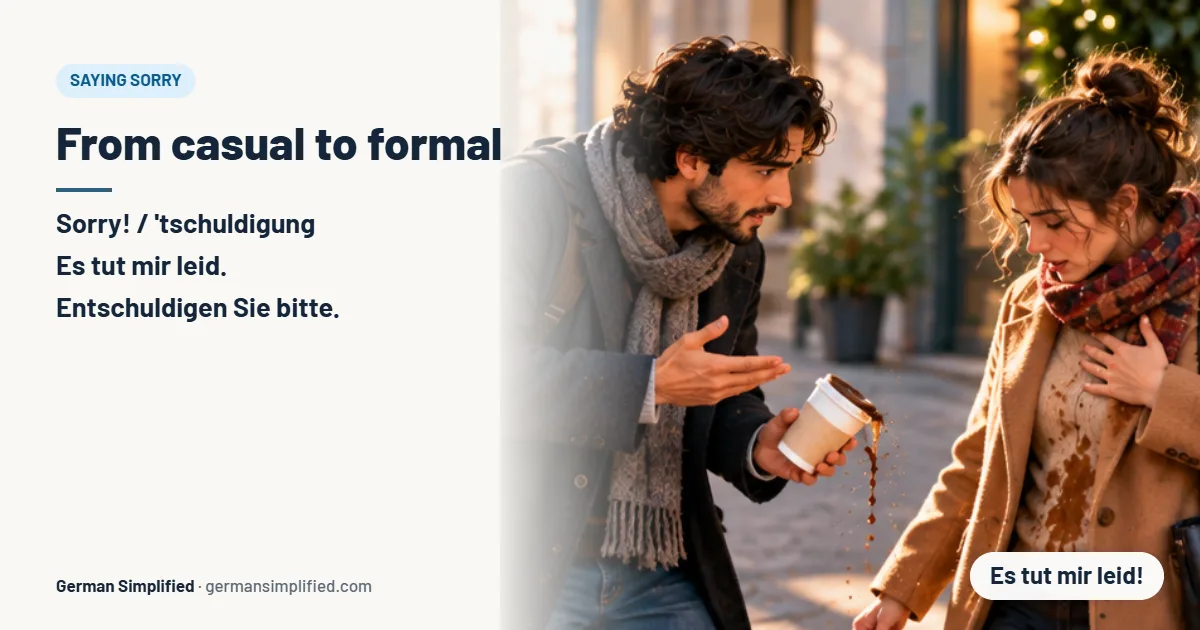
What you say back depends on why someone said it:
- They want your attention: Ja, bitte? (Yes?) or Ja?
- They bumped into you or apologised: Kein Problem. (No problem.) / Macht nichts. (Never mind.) / Schon gut. (It’s fine.)
- They want to get past: just step aside, or say Klar! (Sure!)
- To accept a real apology: Entschuldigung angenommen. (Apology accepted.)
Example Dialogues
At the train station
Sie: Entschuldigung, wo fährt der Zug nach München ab?You: Excuse me, where does the train to Munich leave from?
Mitarbeiter: Von Gleis sieben.Staff: From platform seven.
Sie: Vielen Dank!You: Thank you very much!
On a crowded tram
Sie: Entschuldigung, darf ich mal vorbei? Ich muss hier aussteigen.You: Excuse me, may I get past? I need to get off here.
Frau: Klar, kein Problem.Woman: Sure, no problem.
A small accident
Max: Oh, Entschuldigung! Habe ich Ihnen wehgetan?Max: Oh, sorry! Did I hurt you?
Mann: Nein, nein, schon gut. Nichts passiert.Man: No, no, it’s fine. Nothing happened.
FAQs
What does Entschuldigung mean?
Excuse me or sorry. It’s used to get attention, to get past someone and to apologise for small things.
Is it Entschuldigung or Entschuldigen?
Both exist. Entschuldigung is the noun you say on its own. Entschuldigen is the verb: Entschuldigen Sie (formal) or Entschuldige (informal).
How do you say sorry in German?
For small things, Entschuldigung or Sorry. For a real apology, Es tut mir leid.
Is Entschuldigung formal?
It’s neutral, so you can use it with anyone. Entschuldigen Sie and Verzeihung are more formal.
How do you respond to Entschuldigung?
Kein Problem, Macht nichts or Schon gut if it was an apology; Ja, bitte? if someone wants your attention.
Conclusion
Entschuldigung is your all-purpose “excuse me” and “small sorry”. Use Entschuldigen Sie for extra politeness, Entschuldige or Sorry with friends, and Es tut mir leid when an apology really matters. Pair it with a Danke schön and a friendly Guten Tag, and you’ll sound polite in any situation. For more, see the German phrases guide.
Sources and further reading: DWDS: Entschuldigung and Duden: Entschuldigung.
Keep learning → German vocabulary by topic