

A1–A2 Vocabulary
You need numbers in German from day one: for prices, phone numbers, times, dates and your age. The first twelve take a little memorising, but after that German numbers follow a small set of logical rules, including one famous twist: Germans say 21 as “one-and-twenty”. This lesson takes you from zero to a thousand, then shows you ordinal numbers, prices, dates, years, times and phone numbers, with audio for every key number.
Quick answer
German numbers 1–10: eins, zwei, drei, vier, fünf, sechs, sieben, acht, neun, zehn. From 21 to 99 the ones come first: 21 = einundzwanzig (“one-and-twenty”), 47 = siebenundvierzig. Hundreds and thousands are added in front and the whole number is written as one word: 365 = dreihundertfünfundsechzig, 1000 = tausend.
Tip: Tap the speaker buttons and say each number aloud before you listen. Saying numbers aloud makes them automatic much faster than reading them.
Numbers 0–20
These are the building blocks. Everything else is made from them.
| # | German | # | German |
|---|---|---|---|
| 0 | null | 11 | elf |
| 1 | eins | 12 | zwölf |
| 2 | zwei | 13 | dreizehn |
| 3 | drei | 14 | vierzehn |
| 4 | vier | 15 | fünfzehn |
| 5 | fünf | 16 | sechzehn |
| 6 | sechs | 17 | siebzehn |
| 7 | sieben | 18 | achtzehn |
| 8 | acht | 19 | neunzehn |
| 9 | neun | 20 | zwanzig |
| 10 | zehn |
Three things to notice:
- 11 and 12 are irregular (elf, zwölf), just like English “eleven” and “twelve”.
- 13–19 are “three-ten”, “four-ten” and so on: drei + zehn. Two shortcuts: sechzehn (16) drops the s of sechs, and siebzehn (17) drops the -en of sieben.
- eins or ein? When you count, it’s eins. In front of a noun it becomes ein or eine: ein Kaffee, eine Stunde. In 21, 31, 41 and so on it’s ein- (einundzwanzig), but at the end of a number it stays eins: hunderteins (101).
The tens
| # | German | Watch out |
|---|---|---|
| 10 | zehn | |
| 20 | zwanzig | not “zweizig” |
| 30 | dreißig | the only ten with ß, not -zig |
| 40 | vierzig | |
| 50 | fünfzig | |
| 60 | sechzig | drops the s, like 16 |
| 70 | siebzig | drops -en, like 17 |
| 80 | achtzig | |
| 90 | neunzig |
21–99: The Reverse Rule
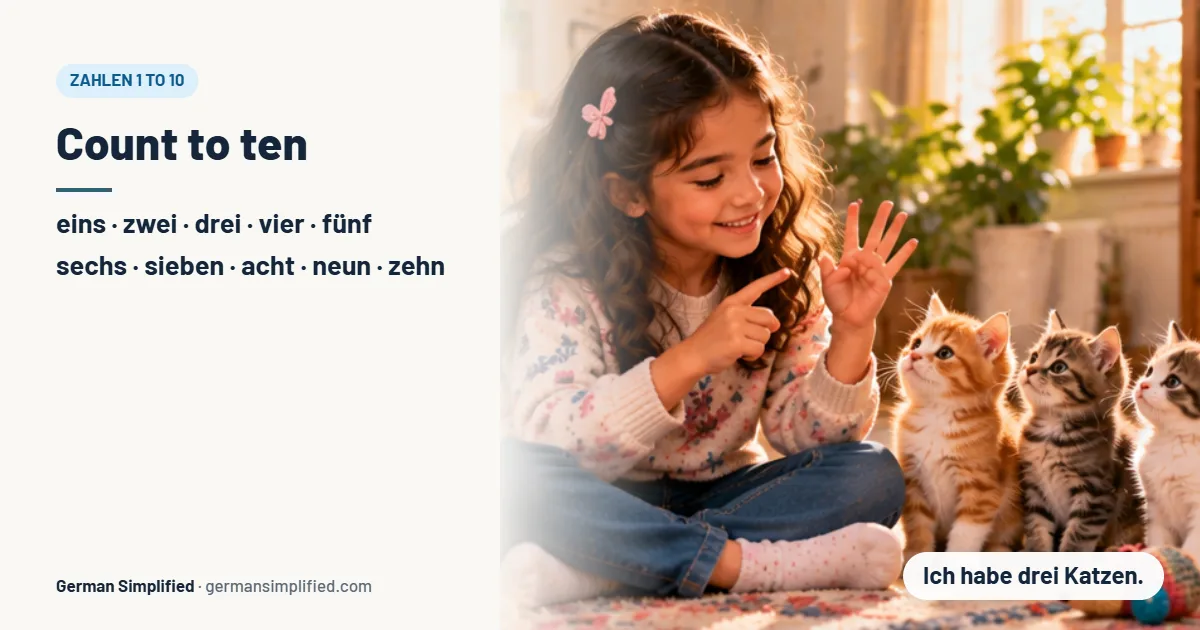
This is the one rule that surprises every English speaker. For numbers from 21 to 99, German says the ones first, then und (and), then the tens. It’s like the old English nursery rhyme “four-and-twenty blackbirds”.
| # | Built as | German |
|---|---|---|
| 21 | one + and + twenty | einundzwanzig |
| 22 | two + and + twenty | zweiundzwanzig |
| 35 | five + and + thirty | fünfunddreißig |
| 47 | seven + and + forty | siebenundvierzig |
| 58 | eight + and + fifty | achtundfünfzig |
| 66 | six + and + sixty | sechsundsechzig |
| 73 | three + and + seventy | dreiundsiebzig |
| 99 | nine + and + ninety | neunundneunzig |
Note that sechs and sieben keep their full form here: sechsundsechzig, siebenundsiebzig. Only the tens are shortened.
Why 21–99 feels hard, and how to fix it
Knowing the rule is easy. Reversing the digits in real time is harder, especially when someone tells you a phone number or a price. Psychologists call this a working-memory load. The fix is practice that makes it automatic: read every number you see today (house numbers, prices, bus numbers) in German, out loud or in your head. Two minutes a day for a week makes a big difference. When listening, write the second digit first: hear sieben, write _7, hear vierzig, fill in 4.
Hundreds and Thousands
Above 99, German simply stacks the parts from biggest to smallest, and writes the whole number as one word. Only the last two digits use the reverse rule.
| # | German |
|---|---|
| 100 | hundert / einhundert |
| 101 | hunderteins |
| 110 | hundertzehn |
| 121 | hunderteinundzwanzig |
| 200 | zweihundert |
| 365 | dreihundertfünfundsechzig |
| 999 | neunhundertneunundneunzig |
| 1000 | tausend / eintausend |
| 1001 | tausendeins |
| 2500 | zweitausendfünfhundert |
| 10 000 | zehntausend |
| 1 000 000 | eine Million |
Writing tip: German uses a full stop or a space to separate thousands and a comma for decimals, the opposite of English. 1.000 or 1 000 = one thousand; 1,5 = one and a half (eins Komma fünf).
Ordinal Numbers
Ordinal numbers (first, second, third) are used for dates, floors and rankings. In writing, Germans put a full stop after the digit: der 3. Mai = the 3rd of May.
The rule: for 1–19 add -te, for 20 and above add -ste. Four forms are irregular.
| # | German | # | German |
|---|---|---|---|
| 1. | der erste (irregular) | 11. | der elfte |
| 2. | der zweite | 12. | der zwölfte |
| 3. | der dritte (irregular) | 19. | der neunzehnte |
| 4. | der vierte | 20. | der zwanzigste |
| 5. | der fünfte | 21. | der einundzwanzigste |
| 6. | der sechste | 30. | der dreißigste |
| 7. | der siebte (irregular) | 31. | der einunddreißigste |
| 8. | der achte (irregular: only one t) | 100. | der hundertste |
Ordinals take adjective endings, so they change with the article and case: der erste Tag, am ersten Tag (on the first day), zum dritten Mal (for the third time).
Prices, Dates and Times
Prices
Say the euros, then the cents, and usually drop the word “Cent”:
- 3,50 € = drei Euro fünfzig
- 12,99 € = zwölf Euro neunundneunzig
- 0,80 € = achtzig Cent
- 1,00 € = ein Euro (not eins Euro)
Useful questions: Wie viel kostet das? (How much is it?) and Das macht zusammen … (That comes to …), which you’ll hear at the till.
Dates
Use the ordinal with an ending:
- Today is the 3rd of October: Heute ist der dritte Oktober. (written der 3. Oktober)
- On the 24th of December: am vierundzwanzigsten Dezember (written am 24. Dezember)
- Numeric dates are written day.month.year: 24.12.2026.
Years
Up to 1999, years are said in hundreds: 1989 = neunzehnhundertneunundachtzig. From 2000, in thousands: 2026 = zweitausendsechsundzwanzig. To say “in 2026”, use either the year alone (2026 war ich in Berlin) or im Jahr 2026. Never “in 2026”.
Times
Official times use the 24-hour clock: 14:30 = vierzehn Uhr dreißig. In conversation, Germans often say halb drei for 2:30, literally “half three”, meaning half an hour before three. That one trips up English and Irish speakers, for whom “half three” means 3:30!
Phone numbers and age
- Phone numbers are read digit by digit or in pairs: 0176 / 23 45 67 = null eins sieben sechs, dreiundzwanzig, fünfundvierzig, siebenundsechzig.
- On the phone, many Germans say zwo instead of zwei so it isn’t confused with drei.
- Age: Ich bin dreißig Jahre alt. (I’m thirty years old.) / Wie alt bist du? (How old are you?)
Big Numbers, Decimals and Percentages
You won’t need these on day one, but they come up in the news, at work and whenever you talk about money.
| Number | German | Watch out |
|---|---|---|
| 1 000 000 | eine Million | Written as a separate word: zwei Millionen |
| 1 000 000 000 | eine Milliarde | This is an English billion |
| 1 000 000 000 000 | eine Billion | This is an English trillion! |
| 1,5 | eins Komma fünf | Comma, not point |
| 0,25 | null Komma zwei fünf | Digits after the comma are read one by one |
| 20 % | zwanzig Prozent | Prozent never takes an -s |
| ½ / ¼ | ein halb / ein Viertel | As in ein halbes Kilo, ein Viertel |
The billion trap: If a German article says eine Billion Euro, that’s a trillion in English. Mixing up Milliarde and Billion is one of the most common translation mistakes, even among advanced learners.
Numbers in Everyday Life
Here’s where you’ll actually use German numbers in the first weeks of living in or visiting a German-speaking country:
- Addresses: the house number comes after the street: Bahnhofstraße 12. Say it as Bahnhofstraße zwölf.
- Trains: Der Zug fährt von Gleis drei ab. (The train leaves from platform three.)
- Buses and trams: Ich nehme die Linie vierzehn. (I’m taking line 14.)
- Hotel rooms and floors: Zimmer 204 = Zimmer zweihundertvier. Floors count from the ground floor (Erdgeschoss), so der erste Stock is the first floor above it.
- At the bakery: Vier Brötchen, bitte. (Four bread rolls, please.)
- Sizes: shoe and clothing sizes are said normally: Ich habe Größe achtunddreißig.
A quick note on fingers
Germans count on their fingers starting with the thumb. A raised thumb means “one”, thumb and index finger mean “two”. If you hold up your index finger in a bar to order one beer, you might be understood perfectly well, but a thumb is the local way. (Fans of a certain war film will remember this scene.)
Common Mistakes
- Writing the digits in English order. When you hear dreiundvierzig, it’s easy to write 34. Train yourself to write the last digit first.
- “einsundzwanzig”. In compound numbers, eins loses its s: einundzwanzig, einunddreißig.
- “dreizig”. It’s dreißig, with ß. The other tens all end in -zig.
- “sechszehn” and “siebenzehn”. The short forms are sechzehn and siebzehn (and sechzig, siebzig).
- “in 2026”. Say 2026 or im Jahr 2026, never in 2026.
- Reading 1.000 as “one point zero”. In German, the full stop separates thousands. 1.000 is a thousand.
How to make numbers automatic
Numbers are one of the few areas where pure repetition really works, because there’s a limited set and you use them constantly. Give yourself one tiny daily habit: read every price you see in German, in your head. Supermarket, menu, petrol station. After two or three weeks, you’ll notice you no longer translate.
Practice
Say each number out loud, then open the answer.
1. 16
sechzehn
2. 34
vierunddreißig
3. 77
siebenundsiebzig
4. 250
zweihundertfünfzig
5. 4,20 €
vier Euro zwanzig
6. The 7th of March (am 7. März)
am siebten März
7. 1996 (as a year)
neunzehnhundertsechsundneunzig
FAQs
How do you count to 10 in German?
Eins, zwei, drei, vier, fünf, sechs, sieben, acht, neun, zehn.
Why do Germans say numbers backwards?
Only from 21 to 99, and it’s a historical pattern found in several Germanic languages (English once said “four-and-twenty” too). The ones come first, joined to the tens with und: einundzwanzig.
Are German numbers written as one word?
Yes, numbers below a million are written as a single word, for example dreihundertfünfundsechzig (365). In everyday writing, people simply use digits.
Why is 30 spelled with ß?
Dreißig keeps the old “ß” ending (-ßig) while the other tens use -zig. Just learn it as the exception.
How do you say dates in German?
Use der + ordinal number + month: der dritte Oktober. For “on” a date, use am: am dritten Oktober.
What is “zwo”?
An alternative form of zwei (two), used mainly on the phone and in announcements so it isn’t confused with drei.
Conclusion
Learn 0–20 and the tens by heart, apply the reverse rule from 21 to 99 (einundzwanzig), and stack hundreds and thousands in front as one word. Add -te or -ste for ordinal numbers, and you can handle prices, dates, years, times and phone numbers. Then put numbers to work with the 100 most common German words, browse the German vocabulary hub, or move on to the next lesson below.
Sources and further reading: German numerals on Wikipedia.
Next lesson → Der, die, das: how to know the gender of German nouns