
Phones are great at maps until the battery dies or the signal drops in an underground station. Then you need to ask a real person. Asking for directions in German is one of the most useful skills for a trip, and the good news is that you only need a handful of phrases to get started.
The harder part is understanding the answer. This guide covers both sides: how to ask politely, and the words people will use when they reply.
Starting the conversation politely
Always open with an apology for interrupting. In German that’s Entschuldigung (excuse me), and it works almost everywhere. If you’d like to know more about this word, we have a full post on what Entschuldigung means.
- Entschuldigung, können Sie mir helfen? (Excuse me, can you help me?)
- Entschuldigen Sie, sprechen Sie Englisch? (Excuse me, do you speak English?)
- Ich suche den Bahnhof. (I’m looking for the train station.)
Use Sie with strangers. Du is fine with people your own age in a relaxed setting, such as students on a campus, but Sie is never wrong.
Core phrases for asking the way
| German | English |
|---|---|
| Wo ist der Bahnhof? | Where is the train station? |
| Wie komme ich zum Museum? | How do I get to the museum? |
| Wie komme ich zur Post? | How do I get to the post office? |
| Gibt es hier in der Nähe eine Apotheke? | Is there a pharmacy near here? |
| Ist das weit von hier? | Is it far from here? |
| Kann ich zu Fuß gehen? | Can I walk there? |
| Wie lange dauert das zu Fuß? | How long does it take on foot? |
| Welcher Bus fährt zum Zentrum? | Which bus goes to the city center? |
| Können Sie mir das auf der Karte zeigen? | Can you show me on the map? |
zum or zur?
After zu, German uses the dative case, and zu merges with the article. Masculine and neuter nouns take zum (zu dem). Feminine nouns take zur (zu der).
- der Bahnhof → zum Bahnhof
- das Hotel → zum Hotel
- die Bank → zur Bank
- die U-Bahn-Station → zur U-Bahn-Station
If you’re not sure of the gender, say zum or zur anyway. People will understand you. Our guide to the dative case in German explains why these endings change.
Understanding the answer
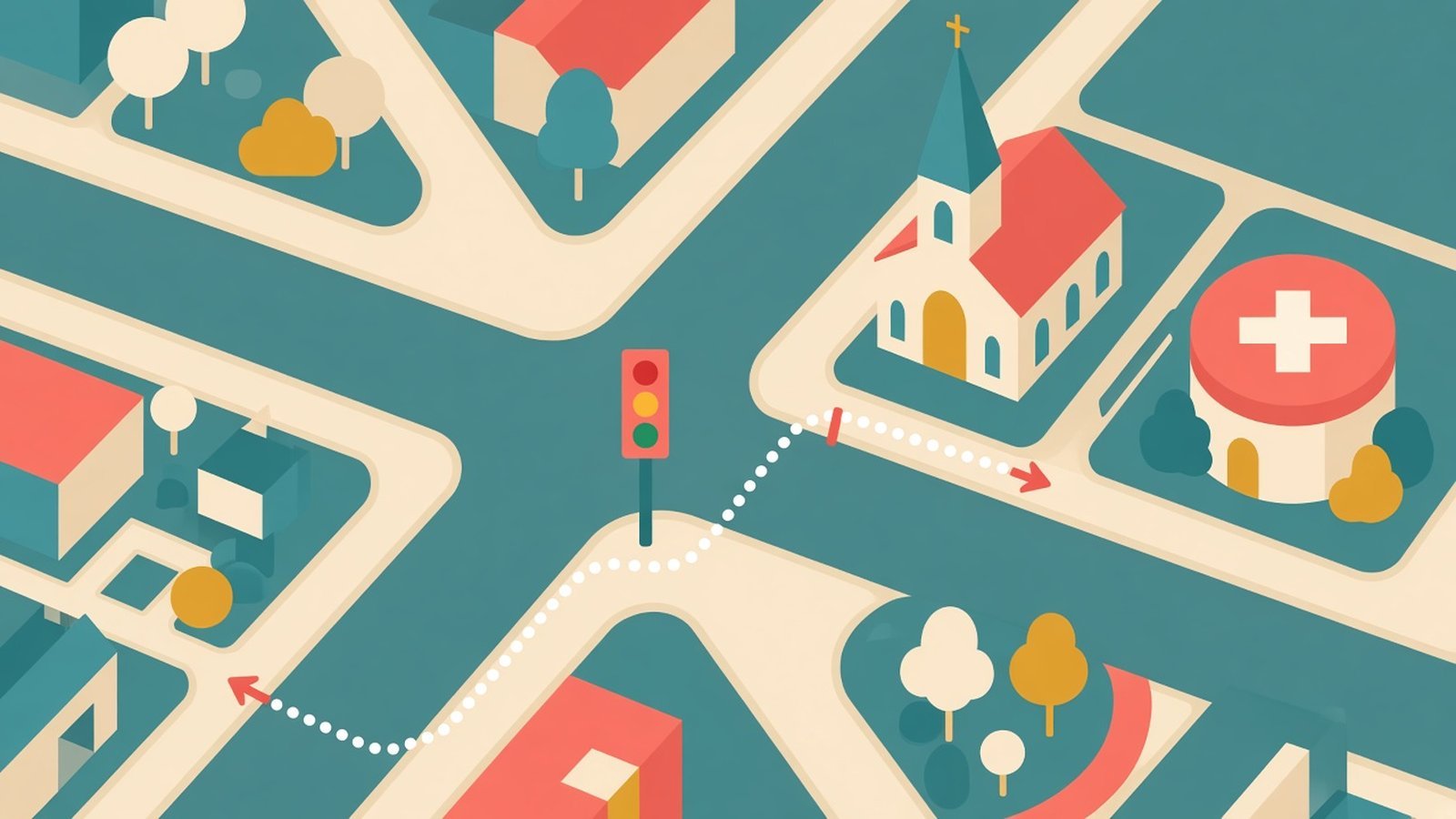
Most directions are built from the same small set of words. Learn these and you’ll catch the important parts even when the person speaks quickly.
Direction words
| German | English |
|---|---|
| geradeaus | straight ahead |
| links / nach links | left / to the left |
| rechts / nach rechts | right / to the right |
| abbiegen | to turn |
| zurück | back |
| die erste / zweite Straße | the first / second street |
| an der Ampel | at the traffic light |
| an der Kreuzung | at the intersection |
| an der Ecke / um die Ecke | at the corner / around the corner |
| über die Straße | across the street |
| über die Brücke | over the bridge |
| durch den Park | through the park |
| bis zur Kirche | as far as the church |
Location words
- gegenüber vom Rathaus (across from the town hall)
- neben der Bäckerei (next to the bakery)
- hinter dem Supermarkt (behind the supermarket)
- vor dem Kino (in front of the movie theater)
- auf der linken Seite (on the left side)
- in der Nähe (nearby)
Notice that most of these use the dative too: neben der, hinter dem, vor dem. Movement words like durch and über (when you cross something) take the accusative, which is why it’s durch den Park. For the full picture, see our post on German prepositions.
The command form you’ll hear
Germans usually give directions with the formal imperative, where the verb comes first and Sie follows it:
- Gehen Sie geradeaus. (Go straight ahead.)
- Biegen Sie an der Ampel links ab. (Turn left at the traffic light.)
- Nehmen Sie die zweite Straße rechts. (Take the second street on the right.)
- Fahren Sie mit der U2 bis zum Hauptbahnhof. (Take the U2 to the main station.)
You’ll also hear the friendlier Sie müssen… (You have to…) and plain statements like Da gehen Sie rechts.
A sample conversation
Tourist: Entschuldigung, wie komme ich zum Stadtpark?
Passant: Zum Stadtpark? Gehen Sie hier geradeaus bis zur Ampel. Dann biegen Sie links ab. Nach etwa 200 Metern sehen Sie den Park auf der rechten Seite.
Tourist: Ist das weit?
Passant: Nein, das sind ungefähr zehn Minuten zu Fuß.
Tourist: Vielen Dank!
Passant: Gern geschehen.
(Tourist: Excuse me, how do I get to the city park? Passerby: The city park? Go straight ahead to the traffic light. Then turn left. After about 200 meters you’ll see the park on the right. Tourist: Is it far? Passerby: No, it’s about ten minutes on foot. Tourist: Thanks a lot! Passerby: You’re welcome.)
Numbers come up constantly in directions, for distances, bus lines and platforms. If they still slow you down, review German numbers before your trip.

When you don’t understand
This happens to everyone, so have these ready:
- Können Sie das bitte wiederholen? (Could you repeat that, please?)
- Langsamer, bitte. (Slower, please.)
- Also, geradeaus und dann links? (So, straight ahead and then left?)
- Tut mir leid, ich verstehe das nicht. (Sorry, I don’t understand.)
Repeating the directions back is the most useful trick here. People are happy to confirm “yes, exactly” or correct one step.
Useful places to know
der Bahnhof (train station), der Hauptbahnhof (main station), die Haltestelle (bus or tram stop), der Flughafen (airport), die Apotheke (pharmacy), das Krankenhaus (hospital), die Toilette (restroom), der Geldautomat (ATM), das Rathaus (town hall), die Innenstadt (downtown).
Key takeaways
- Open with Entschuldigung and use Sie with strangers.
- Wie komme ich zum/zur…? is the most useful question for asking for directions in German.
- Learn geradeaus, links, rechts, an der Ampel and abbiegen first.
- Directions usually come as Gehen Sie… or Biegen Sie… ab.
- Repeat the directions back to check you understood.
FAQ
How do you say “Where is the bathroom?” in German?
Wo ist die Toilette? In a restaurant or café, you can also say Wo sind die Toiletten, bitte? Both are polite and common.
Is it rude to ask strangers for directions in Germany?
No. Start with Entschuldigung, keep it short and say Danke at the end. Most people will help, and many will switch to English if they see you struggling.
What’s the difference between links and nach links?
Links describes where something is (Die Bank ist links, the bank is on the left). Nach links describes movement toward the left (Gehen Sie nach links). In fast speech, people often use them interchangeably.