A2–B2 Words Explained
If you’ve watched German films or chatted with Germans, especially in the south, you’ve heard halt everywhere: Das ist halt so, Dann machen wir das halt morgen, and of course the shouted Halt! The halt meaning changes completely depending on how it’s used. It can be a command (“Stop!”), a tiny particle that adds a shrug (“just”, “simply”), or a form of the verb halten (to hold, to stop). Below you’ll find each use with examples, a comparison of halt with eben, the usual learner mistakes and a short quiz.
Quick answer
Halt has two main meanings. As a command, Halt! means “Stop!” As a particle in the middle of a sentence, halt means “just” or “simply” and signals that something can’t be changed: Das ist halt so (That’s just the way it is). Halt is also part of the verb halten (to hold, to stop): Der Bus hält hier (The bus stops here).
This lesson belongs to our series German words explained. If you like particles, also read what genau means, another word Germans can’t stop saying.
What Does “halt” Mean? (Quick Answer)
Think of halt as two separate words that happen to look the same:
- Halt! at the start of a sentence or on its own = “Stop!”
- halt inside a sentence = “just”, “simply”, “well…”, with a shrug.
Both are pronounced the same: HALT, with a short a as in hut.
The Main Uses of halt
Halt! (stop)
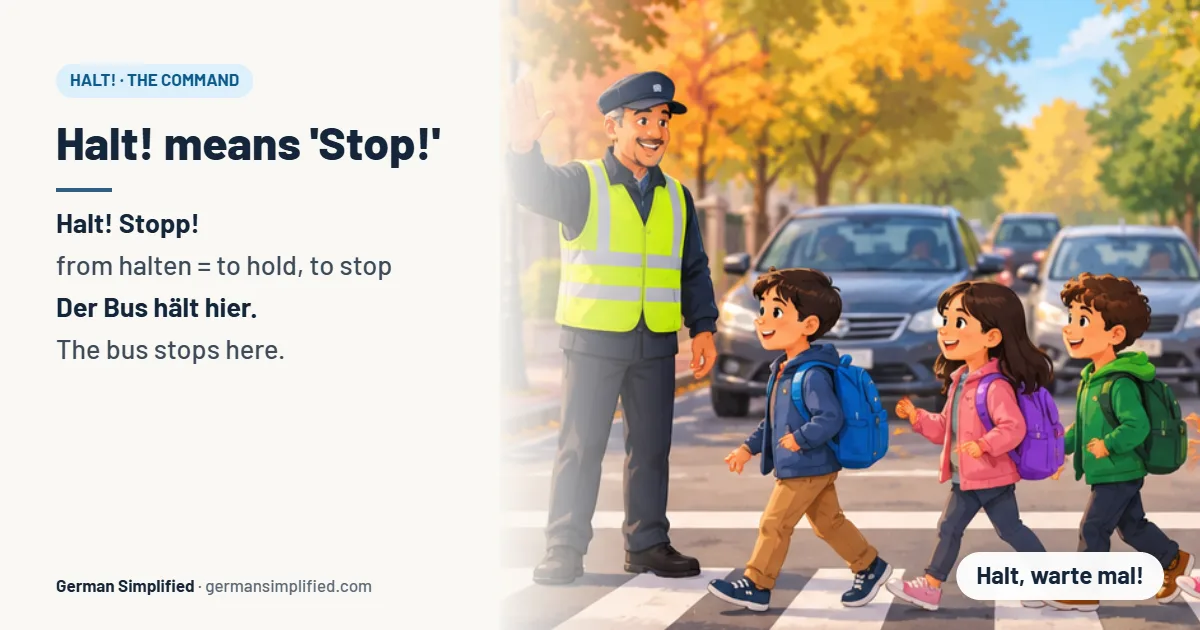
As an interjection, Halt! tells someone to stop immediately. You’ll hear it from police, security staff, parents and in films:
Halt! Polizei!Stop! Police!
Halt, warte mal! Du hast dein Handy vergessen.Wait, hold on! You forgot your phone.
Halt, stopp! Das ist zu viel Salz!Stop, stop! That’s too much salt!
Halt! sounds stronger and more official than Stopp!. In everyday life, Moment! (One moment!) or Warte! (Wait!) are softer alternatives.
The particle halt (just / simply)
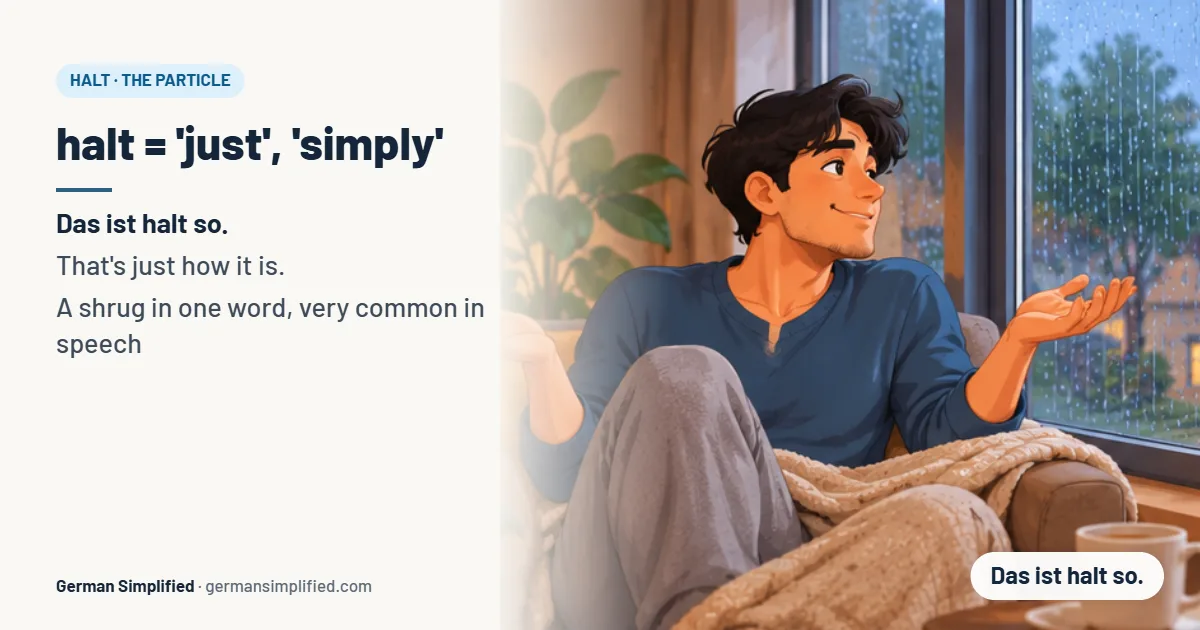
This is the use that makes learners curious. As a modal particle, halt shows the speaker’s attitude: “that’s how it is, nothing to be done”, often with a shrug or a sigh.
Das ist halt so.That’s just the way it is.
Dann nehmen wir halt den nächsten Zug.Well, then we’ll just take the next train.
Ich habe halt keine Zeit.I just don’t have time, that’s all.
Er ist halt ein bisschen schüchtern.He’s just a bit shy, you know.
The particle halt expresses:
- Resignation or acceptance: Es regnet halt. Was soll man machen? (It’s raining. What can you do?)
- An obvious reason: Ich bin müde. Ich habe halt wenig geschlafen. (I’m tired. I simply didn’t sleep much.)
- A simple solution: Wenn du Hunger hast, iss halt was! (If you’re hungry, just eat something!)
Where it goes: The particle halt sits in the middle of the sentence, after the verb and usually after pronouns, but before the new or important information: Das ist halt so, Ich muss halt arbeiten. It never starts a sentence; at the start, Halt! means “Stop!”
Halt vs eben
Eben is the closest equivalent to the particle halt. Both express that something is simply the way it is. The difference is mainly regional and stylistic:
| Feature | halt | eben |
|---|---|---|
| Meaning as particle | just, simply (resigned) | just, simply (resigned, matter-of-fact) |
| Region | more common in southern Germany, Austria, Switzerland | more common in northern Germany |
| Style | very colloquial | colloquial, a bit more neutral |
| Other meanings | Halt! (stop), part of halten | just now (Er war eben hier), flat/even, Eben! (Exactly!) |
| Example | Das ist halt so. | Das ist eben so. |
Many Germans combine them for extra emphasis: Das ist halt eben so. Both are informal; in formal writing, rephrase the sentence instead (Das lässt sich nicht ändern, That can’t be changed).
halten (the verb)
Halt and hält are also forms of the verb halten, which has several common meanings:
| Meaning | Example | English |
|---|---|---|
| to hold | Kannst du mal meine Tasche halten? | Can you hold my bag for a moment? |
| to stop (vehicles) | Der Zug hält in Köln. | The train stops in Cologne. |
| to keep | Ich halte mein Versprechen. | I keep my promise. |
| to give (a speech) | Sie hält eine Rede. | She’s giving a speech. |
| halten von (to think of) | Was hältst du von der Idee? | What do you think of the idea? |
| halten für (to consider) | Ich halte ihn für ehrlich. | I consider him honest. |
| sich halten an (to stick to) | Bitte halte dich an die Regeln. | Please stick to the rules. |
Conjugation: ich halte, du hältst, er/sie/es hält, wir halten, ihr haltet, sie halten. Past: hielt, hat gehalten. Related nouns: der Halt (stop, support: nächster Halt: Hauptbahnhof) and die Haltestelle (bus or tram stop).
Why particles make you sound fluent
Modal particles like halt, ja, doch and eben carry emotion and attitude rather than facts. Learners often skip them because they don’t seem to “mean” anything, but listeners notice their absence: speech without particles can sound blunt or robotic. Start by noticing them in podcasts and series, then copy one fixed phrase like Das ist halt so. Repeated real examples teach attitude words faster than any definition can.
halt in Example Sentences
„Warum kommst du nicht mit?“ – „Ich muss halt arbeiten.““Why aren’t you coming?” – “I just have to work.”
Wir haben den Bus verpasst. Dann laufen wir halt.We’ve missed the bus. Then we’ll just walk.
Halt! Nicht über die Straße, die Ampel ist rot!Stop! Don’t cross, the light is red!
Was hältst du von meinem Plan?What do you think of my plan?
So ist das Leben halt.That’s life, I guess.
Common Mistakes
- Starting a sentence with the particle. Halt ich habe keine Zeit means “Stop, I don’t have time.” The particle must go in the middle: Ich habe halt keine Zeit.
- Using it in formal writing. The particle halt is spoken and informal. Leave it out of emails to your boss, essays and exams.
- Mixing up halt and hält. Hält (with an umlaut) is the verb form for er/sie/es: Der Bus hält. The particle never has an umlaut.
- Overusing it. One halt adds a natural shrug; three in a row make you sound fed up.
- Translating it as “hold”. Outside the verb halten, halt almost never means “hold”.
Quiz
1. What does “Das ist halt so” mean?
That’s just the way it is.
2. A guard shouts “Halt!”. What should you do?
Stop.
3. Put halt in the right place: “Ich habe kein Geld.”
Ich habe halt kein Geld.
4. Which particle is the northern equivalent of halt?
eben
5. Translate: “What do you think of the film?”
Was hältst du von dem Film?
FAQs
What does halt mean in German?
As a command, Halt! means “Stop!” As a particle inside a sentence, halt means “just” or “simply” and shows resignation: Das ist halt so.
Is halt rude in German?
No. The particle is informal but not rude. Halt! as a command can sound sharp, like “Stop!” in English.
What’s the difference between halt and eben?
As particles they mean the same. Halt is more common in the south, Austria and Switzerland; eben is more common in the north.
What does “Was hältst du davon?” mean?
What do you think of it? It comes from the verb halten von (to think of).
Where does halt go in a sentence?
The particle goes in the middle of the sentence, after the conjugated verb: Ich muss halt arbeiten.
Conclusion
The halt meaning depends on its position: Halt! on its own means “Stop!”, the particle halt in mid-sentence adds a resigned “just” or “simply” (Das ist halt so), and halt/hält are forms of the verb halten (to hold, to stop, to think of). Use the particle in casual conversation, keep it out of formal writing. Next, explore more everyday expressions in our phrases hub.
Sources and further reading: DWDS: halt, Duden and DWDS: halten.
Keep learning → German phrases and greetings: what to say in every situation
