

A1 Phrases
Knowing how to say bye in German is just as important as saying hello, and Germans have plenty of ways to do it. You’ll hear a cheerful Tschüss! at the bakery, a polite Auf Wiedersehen at the doctor’s office, Ciao! among friends and Servus! in Bavaria. In this guide you’ll learn what Tschüss means and how to pronounce it, when to choose a formal or casual goodbye, 14 alternatives in one table, how to respond, and short dialogues you can use straight away.
Quick answer
The most common way to say bye in German is Tschüss! (pronounced “chooss”, with a rounded ü). It works in almost every everyday situation. In formal settings, say Auf Wiedersehen! (ow-f VEE-der-zayn), and on the phone, Auf Wiederhören! Among friends, Ciao!, Bis bald! (See you soon) and Mach’s gut! (Take care) are very common.
This lesson is part of our guide to German phrases and greetings. It pairs well with how are you in German, the question you’ll usually ask before saying goodbye.
What Does “Tschüss” Mean?
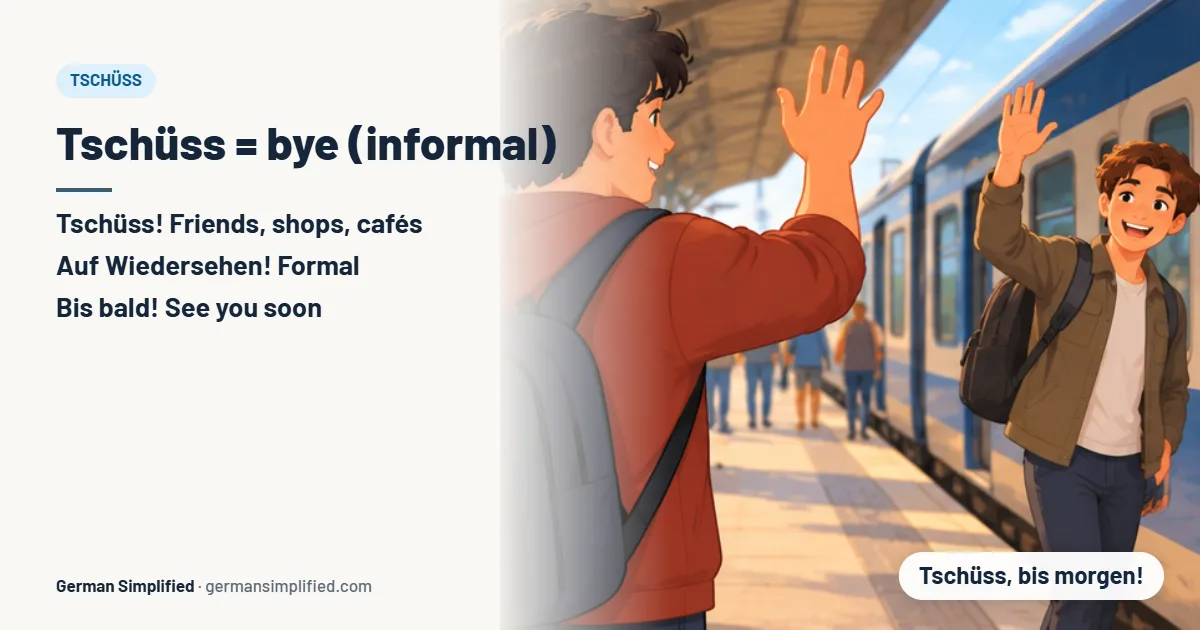
Tschüss simply means “bye”. It’s friendly, short and used by almost everyone, from children to shop assistants. The word comes from the old farewell adjüs, borrowed from Spanish adiós or French adieu (“to God”), and has been the standard casual goodbye across most of Germany for decades. You’ll also see it spelled tschüs (with one s, also correct) and hear the playful tschüssi or tschüssikowski.
Tschüss is not too casual: Learners often think Tschüss is slang. It isn’t. It’s perfectly polite in shops, cafés, with neighbors and colleagues. Save Auf Wiedersehen for more formal moments.
How to Pronounce It
- Tsch = “ch” as in church
- ü = say “ee” and round your lips (see the German ü)
- ss = a sharp s
So: chüss, rhyming roughly with “juice” said with rounded lips. For Auf Wiedersehen, say owf VEE-duh-zay-en: auf sounds like “owf”, wieder is “VEE-duh” and sehen is “ZAY-en”.
When to Use It
Formal
With officials, doctors, at job interviews, in formal shops and with older people you call Sie:
- Auf Wiedersehen! Goodbye! (literally “until we see again”)
- Auf Wiederhören! Goodbye! (on the phone; literally “until we hear again”)
- Einen schönen Tag noch! Have a nice day!
Vielen Dank für Ihre Hilfe. Auf Wiedersehen!Thank you for your help. Goodbye!
Informal
With friends, family, classmates and colleagues you know well:
- Tschüss! Bye!
- Ciao! Bye! (borrowed from Italian, often spelled tschau)
- Mach’s gut! Take care!
- Bis bald! See you soon!
- Bis später! See you later!
Regional
| Region | Goodbye | Note |
|---|---|---|
| Bavaria and Austria | Servus! | also means hello |
| Vienna | Baba! | very casual |
| Bavaria, western Austria | Pfiat di! | “God protect you”; Pfiat eich to a group |
| Austria | Auf Wiederschauen! | the polite form, instead of Wiedersehen |
| Rhineland, Cologne | Tschö! | short for tschüss |
| Swabia, Switzerland | Ade! / Adieu! | traditional and friendly |
| Northern Germany | Tschüss! or Moin! | Moin is mainly hello, sometimes bye |
For more on Austrian expressions, see what language is spoken in Austria.
Alternatives
Here are 14 ways to say goodbye in German, from most formal to most casual:
| Goodbye | Meaning | Register |
|---|---|---|
| Auf Wiedersehen | Goodbye | formal |
| Auf Wiederhören | Goodbye (phone) | formal |
| Einen schönen Tag noch | Have a nice day | polite, neutral |
| Schönes Wochenende | Have a nice weekend | neutral, Friday favorite |
| Tschüss | Bye | neutral, everyday |
| Bis bald | See you soon | neutral |
| Bis später | See you later (today) | neutral |
| Bis dann | See you then | casual |
| Bis morgen | See you tomorrow | neutral |
| Mach’s gut | Take care | casual, warm |
| Ciao / Tschau | Bye | casual |
| Man sieht sich | See you around | casual |
| Servus / Baba | Bye | regional, casual |
| Leb wohl | Farewell | dramatic, final, rare |
The bis phrases are so useful they have their own lesson: Bis morgen, bis später, bis bald. And if you’re leaving in the evening, see good night in German.
“Leb wohl” means forever
Leb wohl (farewell) suggests you may never see the person again. It belongs in films and emotional goodbyes, not at the end of a work day. For a warm everyday goodbye, Mach’s gut! is the right choice.
How to Respond

The simplest response is to repeat the same goodbye: „Tschüss!“ – „Tschüss!“ Germans often double it up and add a wish:
| They say | You can answer |
|---|---|
| Tschüss! | Tschüss! / Ciao! |
| Auf Wiedersehen! | Auf Wiedersehen! |
| Schönen Tag noch! | Danke, gleichfalls! (Thanks, you too!) |
| Mach’s gut! | Du auch! (You too!) |
| Schönes Wochenende! | Danke, dir/Ihnen auch! |
| Bis bald! | Ja, bis bald! |
The “goodbye chunk” trick
Goodbyes happen fast, often while someone is already turning away, so there’s no time to build a sentence. That’s why it helps to store two or three complete “goodbye chunks”, such as Danke, tschüss! and Schönen Tag noch!, and say them aloud until they’re automatic. Ready-made chunks are retrieved from memory as one unit, so you don’t have to build them on the spot.
Example Dialogues
At the bakery
Verkäuferin: Das macht 3,20 Euro.Shop assistant: That’s 3.20 euros.
Kunde: Bitte schön. Danke, tschüss!Customer: Here you go. Thanks, bye!
Verkäuferin: Tschüss, schönen Tag noch!Shop assistant: Bye, have a nice day!
Leaving the office
Maria: So, ich gehe jetzt. Schönes Wochenende!Maria: Right, I’m off now. Have a nice weekend!
Jan: Danke, dir auch! Bis Montag!Jan: Thanks, you too! See you Monday!
On the phone (formal)
Frau Braun: Vielen Dank für Ihren Anruf. Auf Wiederhören!Ms Braun: Thank you for your call. Goodbye!
Herr Ito: Auf Wiederhören!Mr. Ito: Goodbye!
FAQs
How do you say bye in German?
Tschüss! is the everyday way. Auf Wiedersehen is formal, and Ciao or Mach’s gut are casual.
Is Tschüss formal or informal?
It’s neutral. It’s fine with friends, in shops and with most colleagues. In very formal situations, use Auf Wiedersehen.
How do you spell tschüss?
Both tschüss (with ss) and tschüs (with one s) are correct.
What’s the difference between Auf Wiedersehen and Auf Wiederhören?
Auf Wiedersehen means “until we see again”; Auf Wiederhören means “until we hear again” and is used on the phone.
What does Mach’s gut mean?
Take care, literally “make it good”. It’s a warm, casual goodbye.
Conclusion
To say bye in German, Tschüss! covers almost every everyday situation, Auf Wiedersehen (or Auf Wiederhören on the phone) handles formal ones, and Ciao, Bis bald and Mach’s gut keep it friendly. Add a regional touch like Servus or Tschö when you travel, and answer with the same word or Danke, gleichfalls! Next, master the most useful bis goodbyes in bis morgen, bis später, bis bald.
Sources and further reading: DWDS: tschüs, Duden: tschüss.
Keep learning → Bis morgen, bis später, bis bald: “see you” in German