All levels Resource
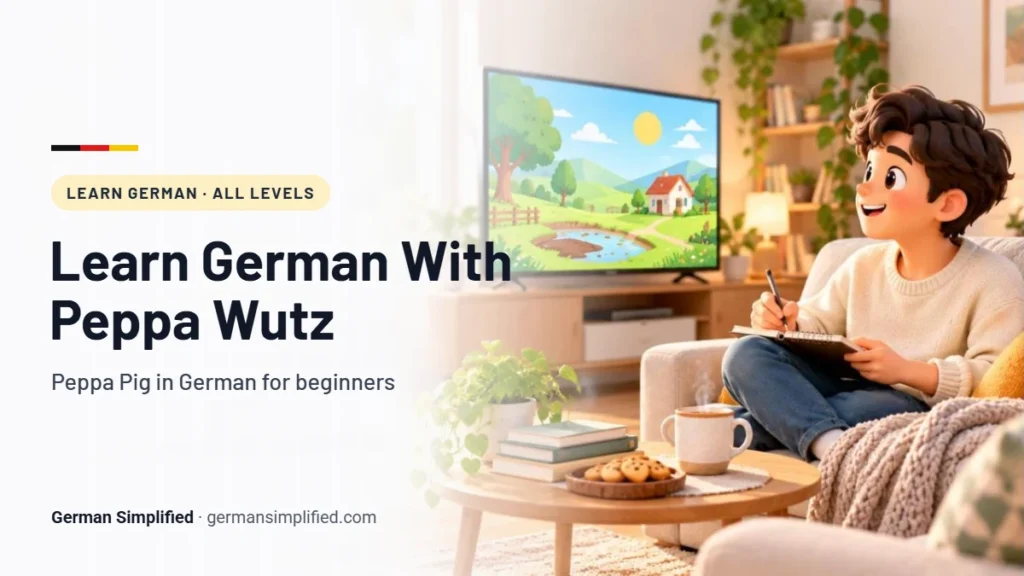
In Germany, Peppa Pig is called Peppa Wutz, and she might be the best German teacher you’ll find for free. The episodes are five minutes long, the characters speak slowly and clearly, and every sentence is backed up by a picture. Adults learning German use her just as much as children do. This guide shows you why it works, where to watch Peppa Wutz legally, the words you’ll hear in almost every episode, and a step-by-step method to learn from a single episode.
Quick answer
Peppa Wutz is the German name of Peppa Pig. It’s ideal for A1–A2 learners because episodes are about 5 minutes long, use simple everyday German and repeat the same phrases. Watch it on the official German Peppa Pig YouTube channel or on a streaming service that offers German audio in your country, and study one episode at a time: watch, note 5–10 words, rewatch with subtitles, then shadow the lines.
Why Kids’ Shows Work for Beginners
Language researchers talk about comprehensible input: you learn fastest from language you can almost fully understand. Adult TV in German is far beyond that point for a beginner. Peppa Wutz sits right in the sweet spot:
- Short episodes. Five minutes is short enough to watch three times in one sitting without getting bored.
- Clear speech. The narrator and characters speak slowly, in standard German, with no slang.
- Pictures explain the words. When Papa Wutz says Es regnet, you see the rain. You understand without translating.
- Repetition. The same phrases come back in nearly every episode, so they stick without any drilling.
- Everyday topics. Family, weather, food, school, the playground: exactly the A1 topics in any course.
Why it doesn’t feel like studying
When something is mildly fun and easy to follow, the brain stays relaxed and attentive at the same time. That’s the best state for picking up new words. Stress and confusion do the opposite: they narrow your attention. A five-minute cartoon you can mostly follow keeps you in the good zone, which is why many learners can watch Peppa long after they’d have given up on a textbook dialogue.
Where to Watch Peppa Wutz Legally
Availability changes by country, so here are the reliable options. All of them are legal; avoid random re-uploads, which often have poor audio and vanish quickly.
| Option | Cost | Best for |
|---|---|---|
| Official German Peppa Pig channel on YouTube (search “Peppa Wutz Deutsch”) | Free | Starting today, full episodes and compilations |
| Streaming services with German audio (check JustWatch for your country) | Subscription | Switching audio and subtitles to German |
| Language platforms such as Yabla | Subscription | Interactive German subtitles and word lookup |
| Peppa Wutz audiobooks (Hörspiele) on Audible or music apps | Varies | Listening practice on the go |
| German DVDs and picture books | One-off | Learners who want offline material |
Tip: On streaming services, set both the audio and the subtitles to German. German subtitles help you see how words are spelled; English subtitles make your brain stop listening.
Meet the Characters
Most names are translated, so it helps to know them before you start:
| English | German |
|---|---|
| Peppa Pig | Peppa Wutz |
| George | Schorsch |
| Mummy Pig | Mama Wutz |
| Daddy Pig | Papa Wutz |
| Grandpa and Granny Pig | Opa Wutz and Oma Wutz |
Episode Vocabulary Lists
These words come up again and again across the series. Learn them first and you’ll understand far more from your very first episode.
Family words
| German | English |
|---|---|
| die Familie | family |
| die Mama / der Papa | mum / dad |
| der Bruder / die Schwester | brother / sister |
| die Oma / der Opa | grandma / grandpa |
| der Freund / die Freundin | friend (male / female) |
| das Baby | baby |
Weather words
| German | English |
|---|---|
| Es regnet. | It’s raining. |
| Die Sonne scheint. | The sun is shining. |
| Es schneit. | It’s snowing. |
| Es ist windig. | It’s windy. |
| die Pfütze | puddle |
| matschig | muddy |
| die Gummistiefel | wellies, rubber boots |
Everyday phrases
| German | English |
|---|---|
| Hurra! | Hooray! |
| Das macht Spaß! | This is fun! |
| Wir gehen nach draußen. | We’re going outside. |
| Was ist los? | What’s the matter? |
| Zeit fürs Bett! | Time for bed! |
| Ich habe Hunger. | I’m hungry. |
| Das ist nicht fair! | That’s not fair! |
| Gute Idee! | Good idea! |
| Alle lachen. | Everyone laughs. (the narrator’s favourite ending) |
How to Study One Episode
Watching passively helps a little. Watching actively, with this five-step routine, helps a lot. It takes about 25 minutes per episode.
- Watch once without subtitles (5 min). Don’t pause. Just follow the story from the pictures and catch what you can.
- Watch again with German subtitles (5–8 min). Pause when you hear a word or phrase you want. Write down 5–10 of them, nouns with their article (die Pfütze, not just Pfütze).
- Look up only what you wrote down. Resist translating everything.
- Shadow 3–5 lines (5 min). Play a line, pause, and repeat it out loud with the same rhythm and tone. This trains your pronunciation and your listening at once.
- Rewatch the next day without subtitles. You’ll be surprised how much more you understand. That moment of “I get it now” is what keeps you motivated.
Make flashcards: Put your 5–10 words into a flashcard app with the sentence from the episode on the back. Words learned in context are remembered far longer than words from a list. Our free German PDFs and worksheets are a good companion.
A Sample Study Session
Here’s what the five-step routine looks like in practice. Say you’re watching an episode about a rainy day. On your second viewing, with German subtitles on, you might pause and write down lines like these:
| What you hear | What it means | What to notice |
|---|---|---|
| Heute regnet es. | It’s raining today. | The verb comes second, so es moves after it. |
| Zieh deine Gummistiefel an! | Put your wellies on! | anziehen splits: zieh … an. |
| Darf ich nach draußen gehen? | Can I go outside? | dürfen = to be allowed to. |
| Wir sind in die Pfütze gesprungen! | We jumped into the puddle! | Past tense with sein, because it’s movement. |
That’s it: four lines, four little grammar lessons, and you didn’t open a textbook. Next day, when you rewatch, you’ll hear those sentences pop out of the audio. That small “I know that!” moment is what keeps you coming back.
Grammar You’ll Pick Up Without Trying
Peppa Wutz isn’t a grammar course, but it repeats a few patterns so often that they quietly sink in:
- Commands (imperative): Komm her! (Come here!), Schau mal! (Look!), Hör auf! (Stop it!). Parents and children use them constantly.
- The past tense in conversation (Perfekt): Wir haben gespielt, Ich bin gefallen. This is how Germans actually talk about the past.
- Modal verbs: Ich will … (I want to), Darf ich …? (May I?), Wir müssen … (We have to). Children’s shows are full of them.
- The little -chen ending: it makes things small and cute, and every -chen word is neuter: das Häschen (the little bunny).
Mistakes to Avoid
- Watching with English subtitles. Your eyes will read the English and your ears will switch off. Use German subtitles or none.
- Bingeing ten episodes in the background. It feels productive, but very little sticks. One episode, studied properly, wins every time.
- Looking up every word. You’ll exhaust yourself in three minutes. Limit yourself to 5–10 words per episode.
- Never speaking. Shadowing a few lines out loud is the step most people skip, and it’s the one that improves your accent.
- Staying with Peppa too long. Once you understand almost everything, the show has done its job. Move up a level.
A Simple 4-Week Plan
| Week | What to do | Time per day |
|---|---|---|
| Week 1 | One new episode a day with the full five-step routine. Collect your words in a notebook or app. | 25 minutes |
| Week 2 | Keep going, and add shadowing of five lines per episode. | 25–30 minutes |
| Week 3 | Rewatch your favourite three episodes without subtitles. Try retelling one in simple German: Peppa und Schorsch spielen im Garten … | 20 minutes |
| Week 4 | Mix in one episode of a slightly harder show (see below) and notice how much more you understand than a month ago. | 30 minutes |
Why the retelling step works
Retelling forces you to pull words out of memory instead of just recognising them. Psychologists call this retrieval practice, and it’s one of the most reliable ways to make learning last. Even three clumsy sentences about an episode do more for your memory than another hour of watching.
Which Level Is Peppa Wutz?
As a rough guide:
- Total beginner: you’ll follow the story from the pictures and pick up single words. Still worth it.
- A1: the sweet spot. You’ll understand a good part of each episode with the routine above.
- A2: you’ll understand most of it. Move on to slightly harder shows (below) once Peppa feels easy.
- B1 and above: use it for shadowing and pronunciation, but you’ll get more from shows made for older children or adults.
More German Kids’ Shows
When you’re ready for more, these are popular German-language options, roughly from easiest to hardest:
| Show | Why it’s good | Level |
|---|---|---|
| Bobo Siebenschläfer | Very slow narration, simple daily situations | A1 |
| Bluey (German dub) | Natural family German, a bit faster than Peppa | A1–A2 |
| Feuerwehrmann Sam | Clear speech, useful everyday vocabulary | A2 |
| Die Sendung mit der Maus | A German classic: short, clearly explained documentary clips | A2–B1 |
| Löwenzahn | Science and nature explained for children | B1 |
FAQs
What is Peppa Pig called in German?
Peppa Wutz. Her little brother George is called Schorsch, and her parents are Mama Wutz and Papa Wutz.
Can adults really learn German with Peppa Wutz?
Yes. The simple, slow and repetitive German is exactly what A1–A2 learners need. Use the active study routine rather than just watching in the background.
Where can I watch Peppa Wutz for free?
The official German Peppa Pig YouTube channel has full episodes and long compilations. Search for “Peppa Wutz Deutsch” and choose the official channel.
Should I use English or German subtitles?
German subtitles. They show you how the words are written while you still listen to the German. English subtitles pull your attention away from the audio.
How many episodes should I watch per day?
One episode studied properly (about 25 minutes) beats five episodes watched passively. Add extra episodes just for fun if you have time.
Conclusion
Peppa Wutz turns five minutes of cartoon into a real German lesson: short, clear, visual and full of everyday phrases. Learn the core words above, study one episode at a time with the five-step routine, and move on to the next show once it feels easy. To see where this fits in your overall plan, read our step-by-step guide to learning German, and keep the German grammar guide nearby for when you want to know why Peppa says things the way she does.
Sources and further reading: JustWatch (check where Peppa Wutz streams in your country) and Krashen’s input hypothesis on Wikipedia.
Keep learning → Free German PDFs, worksheets and word lists