

Eating out is one of the best ways to practice German, because the conversation follows the same script almost every time. You walk in, find a table, order drinks, order food, and ask for the check. If you know the dozen or so phrases that come up at each step, you can get through a whole meal in German, even at A1 level.
This guide walks through a restaurant visit from the door to the tip, with the phrases you’ll say, the ones you’ll hear, and a few customs that surprise visitors.
Getting a table
In many casual German restaurants, cafés and beer gardens you simply pick a free table yourself. In more formal places, wait near the entrance and someone will come over. If you booked ahead, mention your name.
- Einen Tisch für zwei Personen, bitte. (A table for two, please.)
- Haben Sie noch einen Tisch für vier frei? (Do you have a table for four available?)
- Ich habe einen Tisch auf den Namen Becker reserviert. (I reserved a table under the name Becker.)
- Können wir draußen sitzen? (Can we sit outside?)
In a busy beer garden or café you might share a long table with strangers. Before you sit down, ask:
- Ist hier noch frei? (Is this seat free?)
- Darf ich mich dazusetzen? (May I join you?)
Use the formal Sie with restaurant staff. Waiters may switch to du in a trendy café, and then you can follow their lead.
What the waiter will say
Half the battle is understanding the questions. These are the ones you’ll hear most often.
| German | English |
|---|---|
| Haben Sie reserviert? | Do you have a reservation? |
| Was darf ich Ihnen zu trinken bringen? | What can I bring you to drink? |
| Haben Sie schon gewählt? | Have you decided? |
| Was darf es sein? | What would you like? |
| Sonst noch etwas? | Anything else? |
| Hat es Ihnen geschmeckt? | Did you enjoy your meal? |
| Zusammen oder getrennt? | Together or separate checks? |
Reading the menu
The menu is die Speisekarte, or simply die Karte. To ask for it, say Die Speisekarte, bitte or, more politely, Könnten wir bitte die Karte haben? Here are the section headings you’ll see:
- die Vorspeisen: appetizers
- die Suppen: soups
- die Hauptgerichte or Hauptspeisen: main courses
- die Beilagen: side dishes
- die Nachspeisen or Desserts: desserts
- die Getränke: drinks
Look out for das Tagesgericht (the dish of the day) and, at lunchtime, der Mittagstisch, a cheaper weekday lunch menu many restaurants offer.
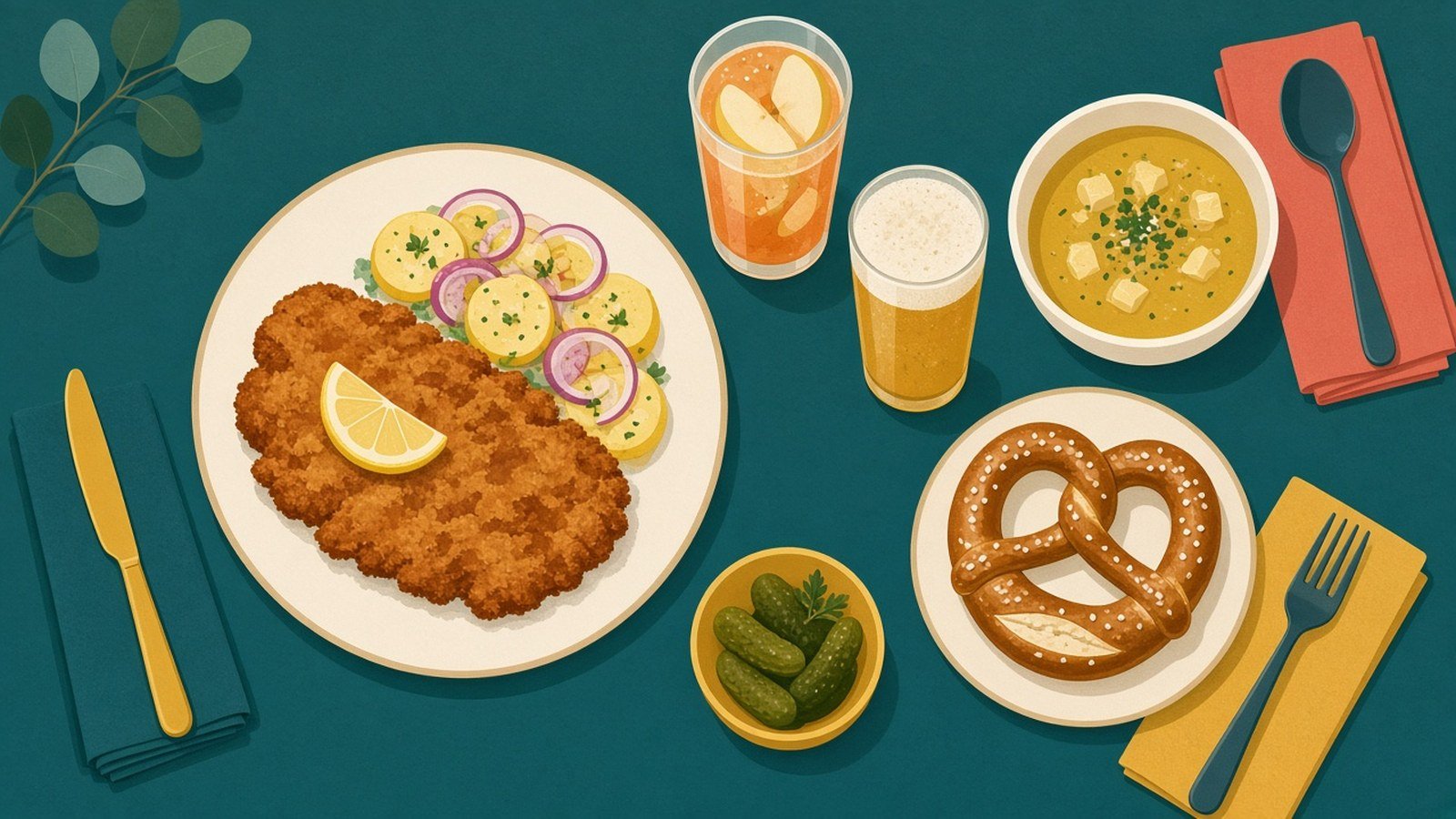
A few words that come up again and again on German menus: das Schnitzel (breaded cutlet), die Bratkartoffeln (fried potatoes), der Kartoffelsalat (potato salad), das Gemüse (vegetables), das Hähnchen (chicken), das Rindfleisch (beef) and das Schweinefleisch (pork).
Ordering drinks
Drinks usually come first. The magic phrase for ordering anything is Ich hätte gern… (I would like…). It’s polite and works for food too.
- Ich hätte gern eine Apfelschorle. (I’d like an apple juice spritzer.)
- Ein Mineralwasser, bitte. (A mineral water, please.)
- Ein stilles Wasser, bitte. (A still water, please.)
- Für mich ein Bier vom Fass. (A draft beer for me.)
- Ein Glas Rotwein, bitte. (A glass of red wine, please.)
Mineral water in Germany is usually sparkling unless you ask for still. Free tap water isn’t a given either. You can ask for ein Glas Leitungswasser, and some places will bring it gladly, but many restaurants expect you to order a bottled drink.
Ordering food
When you’re ready, these patterns cover almost everything:
- Ich nehme den Schweinebraten. (I’ll have the roast pork.)
- Ich hätte gern das Tagesgericht. (I’d like the dish of the day.)
- Für mich bitte die Tomatensuppe. (The tomato soup for me, please.)
- Was können Sie empfehlen? (What do you recommend?)
- Kann ich statt Pommes einen Salat haben? (Can I have a salad instead of fries?)
Notice the article after Ich nehme. The dish is the direct object, so masculine words take den: den Salat, den Fisch, den Braten. Feminine and neuter words don’t change: die Suppe, das Schnitzel.
Dietary needs and allergies
- Ich bin Vegetarier. / Ich bin Vegetarierin. (I’m vegetarian, said by a man / by a woman.)
- Ich esse vegan. (I eat vegan.)
- Ist da Fleisch drin? (Is there meat in it?)
- Ich bin allergisch gegen Nüsse. (I’m allergic to nuts.)
- Ohne Zwiebeln, bitte. (Without onions, please.)
- Haben Sie etwas Glutenfreies? (Do you have anything gluten-free?)
During the meal
When the food arrives, people at the table wish each other Guten Appetit! Before the first sip, you raise your glass and say Prost! With wine, Zum Wohl! is common. Make eye contact when you clink glasses. Many Germans take that part seriously.
If you need the waiter, catch their eye or say Entschuldigung! (Excuse me!). Snapping your fingers or waving wildly is rude. Avoid the old-fashioned Fräulein! for a waitress, which sounds dated and condescending today.
- Könnten wir noch zwei Gläser Wasser haben? (Could we have two more glasses of water?)
- Entschuldigung, das habe ich nicht bestellt. (Excuse me, I didn’t order this.)
- Es schmeckt sehr gut! (It tastes very good!)
Paying and tipping
German waiters rarely bring the check before you ask, since rushing guests is considered impolite. When you’re ready, say:
- Die Rechnung, bitte. (The check, please.)
- Wir möchten bitte zahlen. (We’d like to pay, please.)
- Zahlen, bitte! (Check, please! A bit more casual.)
- Kann ich mit Karte zahlen? (Can I pay by card?)
Card payment is now common, but some smaller places still take cash only, so it’s worth carrying some euros.
The waiter will often ask Zusammen oder getrennt? Splitting the bill item by item is completely normal in Germany, so don’t feel awkward answering getrennt.
Tipping works differently from the US. People usually round up or add around five to ten percent, and you don’t leave the money on the table. Instead, you tell the waiter the total you want to pay when they tell you the amount. If the bill is 27.40 euros and you hand over 30, say Dreißig, bitte or Stimmt so (Keep the change).
A sample dialogue
Kellner: Guten Abend! Haben Sie reserviert?
(Good evening! Do you have a reservation?)
Gast: Nein. Haben Sie noch einen Tisch für zwei frei?
(No. Do you still have a table for two?)
Kellner: Ja, gern. Kommen Sie bitte mit. Was darf ich Ihnen zu trinken bringen?
(Yes, of course. Please follow me. What can I bring you to drink?)
Gast: Eine große Apfelschorle und ein Glas Weißwein, bitte.
(A large apple spritzer and a glass of white wine, please.)
Kellner: Haben Sie schon gewählt?
(Have you decided?)
Gast: Ja. Ich hätte gern das Schnitzel mit Kartoffelsalat, und meine Frau nimmt die Gemüsesuppe.
(Yes. I’d like the schnitzel with potato salad, and my wife will have the vegetable soup.)
Kellner: Sehr gern.
(Certainly.)
Later…
Gast: Wir möchten bitte zahlen.
(We’d like to pay, please.)
Kellner: Zusammen oder getrennt?
(Together or separately?)
Gast: Zusammen, bitte.
(Together, please.)
Kellner: Das macht 46,50 Euro.
(That comes to 46.50 euros.)
Gast: Machen Sie fünfzig.
(Make it fifty.)
Kellner: Vielen Dank! Einen schönen Abend noch!
(Thank you very much! Have a nice evening!)
Prices in German use a comma where English uses a decimal point, so 46,50 Euro is read as sechsundvierzig Euro fünfzig.
Key takeaways
- Ich hätte gern… is the most useful ordering phrase. Use it for food and drinks.
- Use Sie with staff and Entschuldigung to get their attention.
- Ask for the check yourself: Die Rechnung, bitte.
- Say the tip out loud when you pay instead of leaving it on the table.
FAQ
Is it rude to ask for separate checks in Germany?
Not at all. Getrennt, bitte is a normal answer, even for couples, and waiters are used to splitting a bill by item.
What’s the difference between “Ich möchte” and “Ich hätte gern”?
Both are polite and both are fine in a restaurant. Ich hätte gern sounds slightly softer, and Ich möchte is just as common. Avoid Ich will (I want), which sounds demanding.
Do I have to tip in a German restaurant?
It isn’t required, because service is included in the price, but rounding up or adding five to ten percent for good service is the custom.